Same label, very different plastics
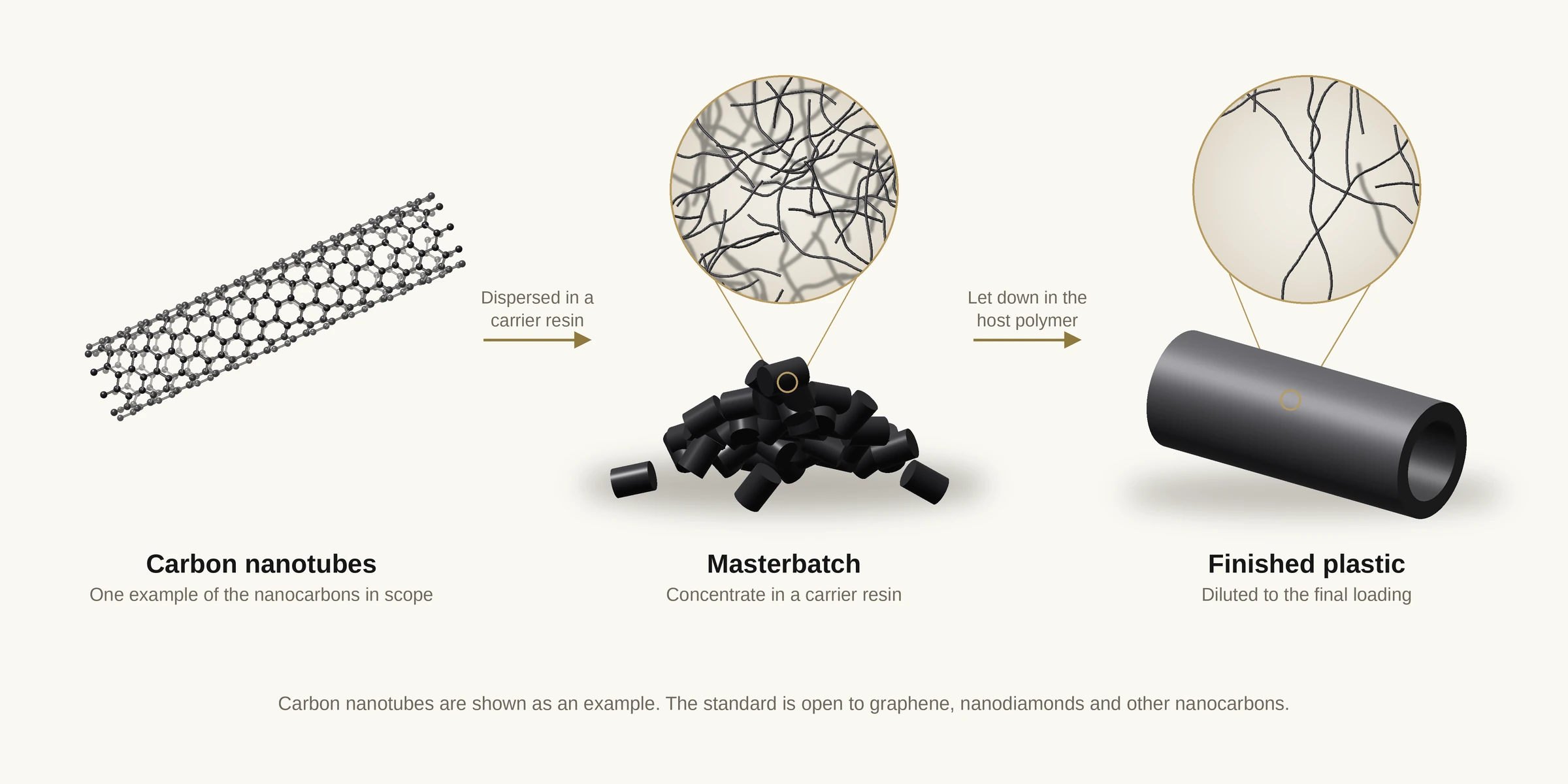
Masterbatches are how nanocarbons reach mainstream plastics. The additive is pre-dispersed at high loading in a carrier resin, and compounders and converters let it down into the final polymer. That avoids handling loose nanopowders and makes dosing practical.
Graphene, carbon nanotubes and nanodiamonds are now sold this way into polyolefins, PET and engineering polymers from PA to PEEK, to add strength, conductivity, thermal performance or barrier properties.
The benefit depends on more than the additive. How much nanocarbon is really there, how well it is dispersed and how it interacts with the host polymer all decide whether the finished part performs. Today two products with the same description can behave very differently, and buyers have no internationally agreed way to check what they are buying or to compare suppliers like for like.
A Chinese group standard on characterising and testing carbon nanomaterial masterbatches was published in 2025, but there is no international equivalent. A standard agreed now can shape data sheets and purchasing specifications while the market is still forming.
Two masterbatches sold as “graphene, 10%” can differ where it matters
- Identity
- Whether the additive is really graphene, nanotubes or nanodiamond, or graphite or carbon black
- Loading
- How much nanocarbon is actually present, against the label
- Dispersion
- Agglomerate size in the pellet and after let-down
- Carrier resin
- Which polymer carries the nanocarbon, and how well it suits the host
- Moisture and volatiles
- Water and low-molecular residues that cause processing defects
- Performance after let-down
- The mechanical, electrical or thermal gain at the recommended dilution
Five elements, from identification to the test report
The draft will set out how to characterise a nanocarbon masterbatch and the plastics made from it. It builds on existing work, including the CGIA group standard T/CGIA 038-2025 and international standards for characterising graphene and carbon nanotubes, and asks participants what an international standard needs on top.
The ISO route is under consideration: ISO/TC 256 (Pigments, dyestuffs and extenders), whose ISO 23900 series covers the dispersion of pigments and extenders in plastics, or ISO/TC 229 (Nanotechnologies).
a) Identification
Confirming which nanocarbon the masterbatch contains, and that it is not graphite or carbon black, using methods such as Raman spectroscopy, electron microscopy and XRD on material extracted from the pellet.b) Masterbatch properties
Basic properties measured on the pellets, such as nanocarbon content, ash, moisture and volatile content, density and pellet weight uniformity, each reported with a unit.c) Performance after let-down
How the masterbatch behaves once diluted into the host polymer: dispersion and compatibility, mechanical properties, and functions such as electrical and thermal conductivity, flame retardancy and barrier performance.d) Designation
One consistent product code built from the carrier resin, the nanocarbon type, the main function and the loading.e) Test report
A minimum data set and reporting format, so purchasers can compare products like for like.
Consensus through a modified Delphi process
Participants answer short online questionnaires in rounds. After each round, ACC and the Steering group analyse the anonymised answers. When the next round opens, everyone sees the group result and can revise their view.
The method reaches experts across time zones without meetings, stops any one producer or senior voice from dominating, and leaves an auditable record of how consensus formed. That record becomes evidence for the ISO proposal.
Round 0: Prepare
ACC and CGIA project team
- We ask
- Build seed lists of characteristics and test methods from existing standards, including T/CGIA 038-2025, and published practice
- Format
- Desk research
- Output
- Round 1 questionnaire
Round 1: Explore
- We ask
- What should the standard cover: which nanocarbons, carrier resins and product forms? Which properties of the masterbatch, and of the diluted plastic, matter most?
- Format
- Open questions, plus seed lists to add to or strike out
- Output
- Agreed scope and a long list of characteristics
Round 2: Rate
- We ask
- How important is each characteristic? Which test methods are suitable and practical for quality control?
- Format
- 1 to 9 scale with comments
- Output
- Agreed items, with contested items flagged
Round 3: Converge
- We ask
- Re-rate contested items against the group result, and agree the product designation and the test report
- Format
- Ratings plus a draft designation
- Output
- Draft standard
Round 4: Confirm, if needed
- We ask
- Settle what remains and review the test report template
- Format
- Accept or amend
- Output
- Final draft for ISO
An item is in when at least 70% of participants rate it 7 to 9, out when at least 70% rate it 1 to 3, and re-rated otherwise.
Each round is open for two weeks, followed by two weeks of analysis and feedback. The process stops after four rounds, or sooner if ratings stop moving.
Who should take part
- Nanocarbon producers
- Companies making graphene, carbon nanotubes, nanodiamonds and other nanocarbons for plastics.
- Masterbatch and compound manufacturers
- Companies dispersing nanocarbons into PE, PP, PET, PA, PEEK and other carrier resins.
- Converters, OEMs and brand owners
- Teams moulding, extruding or specifying nanocarbon-enhanced plastics in products.
- Researchers
- University and institute groups working on dispersion, processing or polymer nanocomposites.
- Testing laboratories
- Labs that characterise nanocarbons or test plastics, and can judge which methods suit quality control.
- Standards, regulatory and government bodies
- Including national mirror committees of ISO/TC 256 and ISO/TC 229.
What it involves
- Your time
- Three to four online rounds, each open for two weeks. Answer on your own schedule, in more than one sitting if you need to.
- Anonymity
- Other participants will not know who you are. ACC, as facilitator, does, and results are reported by stakeholder group.
- No sensitive data
- We never ask for prices, capacities, customers, formulations or other commercially sensitive information, in line with competition law.
- Your contribution
- By joining, you agree that your input may be used, anonymised, in the draft standard ACC and CGIA put forward to ISO.
Questions
How much time will it take?
Three to four rounds over about five months. Each round stays open for two weeks and can be completed in more than one sitting.
Will other participants know who I am?
No. Participants are anonymous to each other. ACC, as facilitator, knows who took part, and results are reported by stakeholder group rather than by person or company.
What happens to my answers?
After each round they are combined into the anonymised group result. At the end they feed the draft standard that ACC and CGIA put forward to ISO, and the round-by-round record shows how consensus formed.
Will you ask for commercially sensitive information?
No. We do not collect prices, capacities, customers, formulations or other commercially sensitive data.
Which ISO committee will receive the draft?
That is under consideration: ISO/TC 256 (Pigments, dyestuffs and extenders) or ISO/TC 229 (Nanotechnologies). We will confirm the route with the committees as the work progresses.
How is CGIA involved?
This is a joint project of ACC and the Zhongguancun Huaqing Graphene Industry Alliance (CGIA), announced in May 2026. CGIA brings its members and its experience of developing T/CGIA 038-2025, the Chinese group standard for carbon nanomaterial masterbatches.
What will the standard cover?
That is a first-round question for participants: which nanocarbons, which carrier resins and which product forms.
Can colleagues take part?
Yes. Each person joins individually, so share this page with anyone who should be involved.
Join the task force
Enter your work email and we will send you a secure link. If we already hold your details they will be filled in for you, so confirming them and joining takes about two minutes.
Questions about the task force? Email [email protected].