Carbon fibre spine joints tested for 3D-printed architectural composites
Researchers at RMIT Architecture | Tectonic Formation Lab developed and tested carbon fibre spine joints for 3D-printed architectural composites, achieving a flexural strength of 38.17 MPa in the strongest configuration.
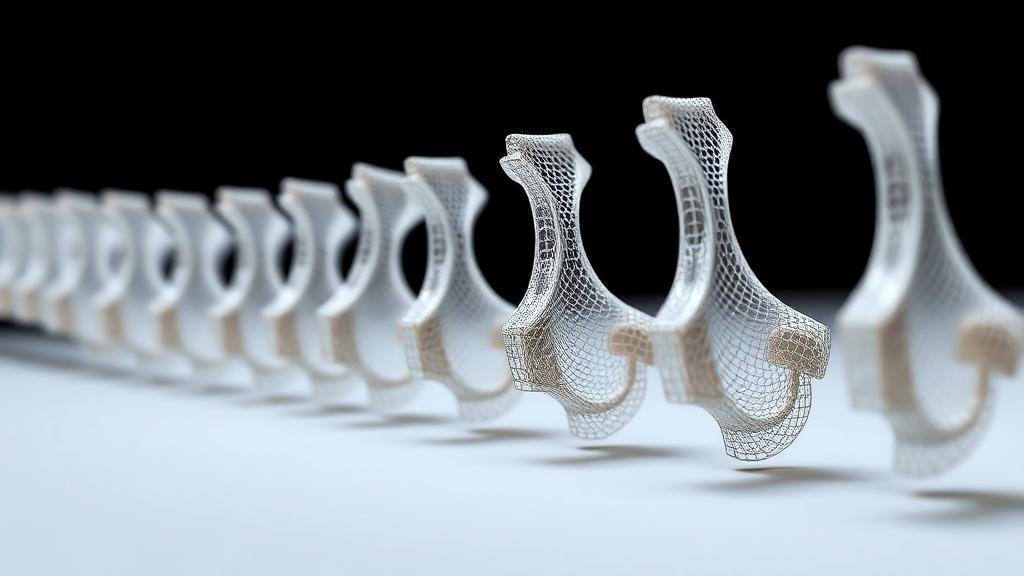
Large-scale 3D printing in architecture offers the potential for seamless, continuous curves, translating digital models into physical forms. However, the physical constraints of six-axis robotic arms, print bed dimensions, and the sequential deposition and curing of composite materials necessitate segmenting these structures, resulting in seams. A new study, published in Architectural Intelligence on June 1, 2026, addresses these seams by treating them as engineered architectural details rather than flaws.
Led by Alan ‘Ho Kyeong’ Kim, with Stuart Bateman, Phillip Crothers, and Roland Snooks from the RMIT Architecture | Tectonic Formation Lab, the research employs an iterative, research-through-design approach to enhance joint design in multi-material additively manufactured fiber composite systems. The team developed seven joint iterations over two experimental stages, combining robotic additive manufacturing of polymer shells with carbon fiber reinforcement through cycles of prototyping, mechanical testing, and full-scale application. The study's key finding is that joint performance is primarily influenced by the continuity of reinforcement, fastener integration, and interface control, with the unbroken internal reinforcement path being crucial.
In the first experimental stage, three prototypes were created using PETG polymer substrates. Large-scale surfaces were fabricated with robotic Fused Granulate Fabrication using a KUKA KR-150 robot and a custom extruder, printing SK Chemicals Skygreen S2008 PETG pellets through a 3.00 mm nozzle at 2.20 mm layer height and 220 °C. Internal reinforcement cores were printed on a desktop Fused Filament Fabrication printer with finer tolerances, integrating E-glass and carbon fiber (both 200 g/m² plain woven fabric) through manual wet lay-up and vacuum bagging with West System epoxy, cured at 20 °C under −100 kPa gauge vacuum for 24 hours. M4 steel clinch floating nuts were embedded in the spine component and bonded with Araldite 420 A/B aerospace-grade epoxy, post-cured at 50 °C for five hours where mechanical fastening was required.
Iteration 01 featured a PETG spine with carbon fiber reinforcement integrated within the joint interface, assembled with M4 bolts and nuts without an external plate, leaving the seam continuous and translucent. Iteration 02 used three continuous E-glass fiber sheets within the spine, masking the seam behind an external plate. Iteration 03 replaced the fiberglass with carbon fiber to enhance strength and stiffness, concealing the seam beneath a carbon fiber plate. Iteration 03 was selected for full-scale implementation in the architectural demonstrator project, Ghost Tectonics.
Ghost Tectonics, developed at RMIT Architecture | Tectonic Formation Lab in collaboration with Boeing Aerostructures Australia, Hightex, and the Leibniz-Institut für Polymerforschung Dresden, combines robotic large-format 3D printing with carbon fiber Tailored Fibre Placement (TFP). It deploys 150 k tow carbon fiber strands directly onto the substrate surface along main structural stress paths, integrating discrete joint sites into a continuous reinforcement field. Spine geometry was varied parametrically across the assembly, thickened at critical intersections to optimize load transfer and reduced at tapering regions to facilitate assembly. Custom plate-based detailing covered seam regions, adjusted according to local stress analysis, producing a diamond-like articulation that reinforced the joint and made the connection logic visible on the building's envelope.
During fabrication and assembly, three issues emerged. First, placing carbon fiber spines within curved and irregular geometries required more precision than specimen tests indicated, as small misalignments degraded bonding quality and slowed assembly. Second, vacuum curing and post-processing introduced small deformations affecting the fit between printed components. Third, aligning internal spine, printed substrate, and external plate simultaneously proved challenging due to separate tolerance demands. These observations shifted the research focus from material strength to managing tolerance, sequence, and assembly for architectural scale buildability.
The second experimental stage produced Iterations 04 through 07, each varying a single parameter. Iteration 04 tested a plate-only configuration with self-tapping screws, which pulled out under load, damaging the substrate and preventing reassembly. Iteration 05 split the spine into two segments with a 10 mm gap, bridged by a carbon fiber plate, resulting in the lowest flexural strength at 1.90 MPa, confirming the necessity of an uninterrupted internal reinforcement path. Iteration 06 returned to the plate-only strategy with bonded M4 clinch floating nuts, achieving 28.93 MPa, similar to Iteration 04's 29.21 MPa, indicating that better fasteners cannot compensate for a missing spine. Iteration 07 removed the external plate and overlapped the printed substrate, retaining the internal carbon fiber spine.
Mechanical evaluation used the ASTM D790 standard three-point bending method on specimens 48 mm wide and 500 mm long, with a 400 mm support span and three to four replicates per iteration. Specimens were oriented to load the interlayer interfaces, probing the weakest axis of the printed material. Iteration 03 achieved the highest average flexural strength at 38.17 MPa, with Iteration 01 close behind at 36.67 MPa, both sustaining mean peak forces above 2,000 N, with Iteration 03 reaching 2,686 N. Configurations without the spine or with interrupted continuity recorded mean peak forces below 166 N, regardless of external plate presence.
The difference between spine-only and spine-plus-plate configurations was approximately 4 percent, but with standard deviations of ±6.38 and ±3.46 MPa, the ranges overlap, indicating the small increase cannot be confidently attributed to the plate alone. The internal spine accounts for most of the flexural capacity. The plate-only configuration, at 28.93 MPa, was about 21 percent below the spine-only joint, suggesting the external plate serves as secondary reinforcement. Iteration 07, though not the strongest, accumulated load progressively across an extended displacement range with small stepped force reductions followed by recovery, indicating sequential damage at individual reinforcement interfaces and relatively high energy absorption. The authors note that the span-to-thickness ratio of roughly 14.5:1 was slightly below the ASTM-recommended 16:1, a compromise that may have increased shear effects but does not affect comparative validity among specimens.
The authors acknowledge limitations. The iterations formed a directed design progression rather than a fully controlled experiment, so the contribution of any single variable cannot be attributed with full statistical rigor. The coupon-scale specimens, tested in three-point bending with three to four replicates per iteration, do not replicate the multi-axial stress states, curvature, or distributed loads of real architectural application, a gap confirmed by the Ghost Tectonics evaluation. Future work will develop intermediate-scale specimens approximating demonstrator curvature and loading and will systematically compare external plate systems in place of internal spines. The study establishes a quantified hierarchy: continuity of internal reinforcement dominates joint performance, fastening and interface geometry matter, and the joint itself can be designed as a site where structural behavior and tectonic expression are developed through the same assembly logic, neither purely revealed nor concealed, but distributed across the material divisions that fabrication inevitably imposes.
Source: Carbon Fiber Feed