NSF funds 3D printed CFRP composite finishing project at Miami University
Miami University of Ohio received a $200,000 NSF grant to develop sustainable finishing methods for 3D printed carbon fiber-reinforced polymer composites.
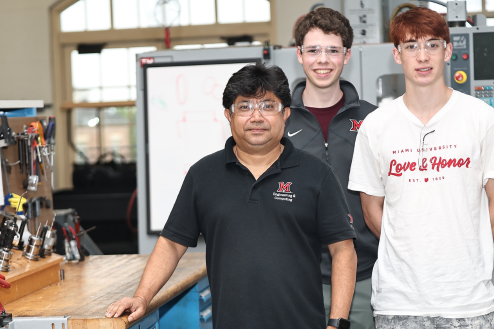
Miami University of Ohio is at the forefront of advancing sustainable finishing methods for 3D printed carbon fiber-reinforced polymer (CFRP) composites, thanks to a project led by Muhammad Jahan, Ph.D., an associate professor of mechanical and manufacturing engineering. Supported by a $200,000 grant from the National Science Foundation (NSF) awarded in June 2026, Jahan's research focuses on enhancing the finishing processes of CFRP parts used in aerospace, automotive, and other high-performance sectors.
Additive manufacturing allows for the creation of CFRP components that are nearly complete in shape, yet these parts often require additional finishing to meet precise specifications. Jahan's project aims to develop sustainable machining techniques that improve surface finish and dimensional accuracy while preserving the material's strength and performance. This is crucial as these components are expected to withstand stress and operate in challenging environments.
The project explores sustainable machining by investigating methods that consume less energy, resources, and cutting fluid compared to traditional techniques. Jahan will examine the effects of dry machining, minimum quantity lubrication, and cryogenic coolant machining on the quality and performance of 3D printed CFRP parts.
The NSF grant also facilitates research opportunities for both graduate and undergraduate engineering students at Miami University. These students will gain valuable experience in advanced manufacturing, materials characterization, experimental procedures, and computer simulations. Jahan emphasizes the importance of undergraduate students' recent practical experience with design, CAD, CNC machines, and project-based learning, while graduate students will provide mentorship. "Undergraduate students can work very closely with graduate students to form teams and share some of the responsibilities," Jahan notes.
If successful, Jahan's project could significantly contribute to the development of more sustainable manufacturing methods for producing strong, lightweight components in high-performance industries.
In related industry news, Mejzlik Propellers is expanding its custom CFRP propeller capabilities by adding a higher-rate compression molding line to meet the growing demands of the UAV market. Additionally, Exel is advancing its sustainability efforts by purchasing Polynt bio-based resin, which reduces the CO2 footprint of composites manufacturing by 20%. Meanwhile, Swift Engineering has utilized HyperX software to reduce the weight of a 38-foot graphite/epoxy cored nose cone for the X-59 supersonic aircraft by 100 pounds.
Source: Carbon Fiber Feed