From perfume waste to water filter: vetiver root biochar strips lead
Scientists converted used vetiver roots from the perfume industry into biochar capable of removing up to 100% of lead from water.
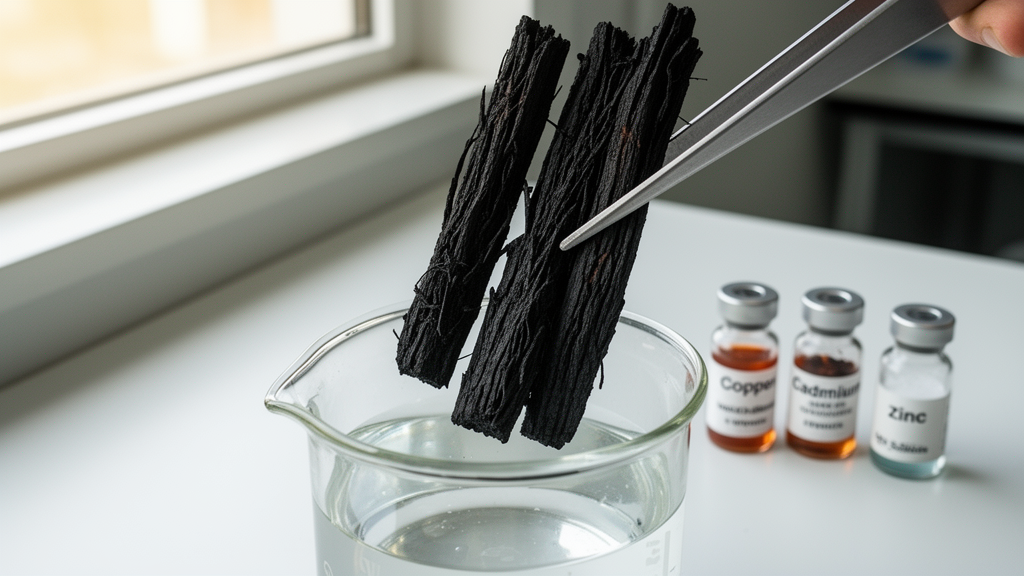
Researchers have demonstrated that biochar derived from spent vetiver roots, a byproduct of the perfume industry, can effectively remove heavy metals from contaminated water. The study, published in Frontiers in Environmental Chemistry, highlights the potential of this biochar to adsorb toxic metals such as lead, copper, cadmium, and zinc, achieving removal efficiencies comparable to or exceeding conventional adsorbents.
The team, led by Sameer Neve at Stevens Institute of Technology, in collaboration with Rowan University and Michigan Technological University, converted vetiver roots (Chrysopogon zizanioides) into biochar through pyrolysis at 500 degrees Celsius. The resulting material had a high surface area of 308.2 square meters per gram and a solid yield of 53.8 percent, identified as optimal for this feedstock in prior studies.
Heavy metals enter water systems from various sources, including industrial effluents and stormwater runoff. Lead and cadmium are among the top ten most toxic substances under U.S. environmental regulations, while zinc and copper, though essential micronutrients, become harmful at high concentrations. The study's batch adsorption experiments showed that the biochar could remove 100 percent of lead, 99.9 percent of copper, 92.6 percent of zinc, and 77.0 percent of cadmium from water.
The researchers also conducted competitive multi-metal experiments, finding that the presence of multiple metals did not significantly affect the removal of lead, copper, and zinc. Surprisingly, cadmium removal improved in the mixed system, attributed to synergistic co-precipitation effects.
Kinetic modeling indicated that chemical interactions were the rate-limiting step in metal adsorption, with a pseudo-second-order model best fitting the data. The biochar's adsorption capacity for lead was notably high at 189.58 milligrams per gram, surpassing most unmodified biochars.
The study also explored the stability of the captured metals, finding minimal leaching in extraction tests. Regulatory leaching tests confirmed that the spent biochar could be disposed of safely as nonhazardous waste. The circular-economy potential of this approach is significant, as it repurposes waste from the perfume industry into a valuable adsorbent without chemical activation.
Future research will need to address the challenges of using this biochar in natural waters, which contain competing organic matter and hardness cations. The study's findings are based on synthetic solutions and high metal concentrations typical of industrial effluents. Validation in continuous-flow systems is necessary for practical applications, but the research demonstrates a promising use of industrial byproducts in environmental remediation.
Source: Biochar Feed