New learning tool accelerates search for 2D quantum materials
Dr Qian Yang at the National Graphene Institute, University of Manchester, has developed a new learning tool to expedite the search for two-dimensional quantum materials. This advancement could accelerate the discovery and application of graphene and other 2D materials in various technologies.
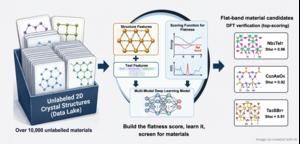
Researchers at The University of Manchester have developed a new machine-learning method to accelerate the identification of two-dimensional materials with unique electronic properties. This approach, published in Science Advances, focuses on materials with 'flat bands,' where electrons exhibit minimal kinetic energy. Such conditions can lead to phenomena like magnetism and unconventional superconductivity.
Traditional methods for finding materials with flat bands often rely on density functional theory calculations, which are computationally intensive. The Manchester team introduced a physics-informed scoring system that identifies flat-band behavior by analyzing atomic structures. This method allows for a more efficient search across large datasets.
Dr. Xiangwen Wang, the study's lead author, explained that flat bands are linked to atomic geometry, allowing the model to learn from structure and search larger material spaces effectively. The framework was trained on known two-dimensional materials and applied to over 10,000 unlabelled candidates. High-scoring materials with kagome-like structures were further validated with quantum calculations, confirming flat-band behavior with 98.2% accuracy.
The study also identified materials likely to exhibit fragile topological flat bands, associated with strongly correlated quantum phases. Dr. Qian Yang from the National Graphene Institute highlighted that this method changes the search process by integrating physical intuition and structural learning, making it more scalable and interpretable.
While the approach remains computational, experimental validation is necessary for the most promising candidates. The researchers suggest the strategy could be adapted for other quantum materials, provided the target properties can be expressed as a physics-based score. This study offers a more efficient path from large material databases to potential candidates for further quantum calculations and experimental testing.
Source: Graphene Feed