Novel graphene material enables soft lenses to change focus without moving parts
Researchers have integrated ultra-thin transparent electrodes made from reduced graphene oxide into a soft, electrically driven lens to enable focus adjustment without moving parts.
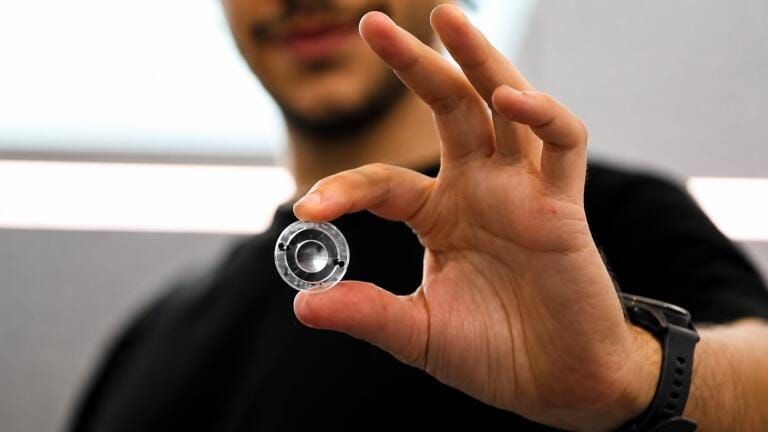
Researchers at Queen Mary University of London, led by Professor James Busfield, have developed a transparent graphene-based material that enables soft lenses to change focus electronically. This innovation eliminates the need for bulky moving parts, paving the way for more compact medical imaging devices and wearable displays.
The study highlights the integration of ultra-thin transparent electrodes made from reduced graphene oxide into a soft, electrically driven lens. This results in a compact device that adjusts its focal distance with a small electrical field. Unlike conventional rigid lenses, the prototype behaves similarly to a human eye, with a soft membrane that stretches the lens when electricity is applied, altering its shape to focus on objects at varying distances.
Traditional electrostatically actuated adaptive lenses position electrodes around the lens edge due to light-blocking materials, while conventional soft lenses require opaque flexible electrodes. By engineering transparent electrodes from reduced graphene oxide, the research team integrated them directly onto the expanding actuator beneath the lens, reducing size and complexity.
The researchers achieved a balance between electrical performance and optical clarity by controlling the graphene deposition on the soft membrane, resulting in a functioning adaptive lens prototype. This technology could lead to a new generation of thinner, quieter, and more energy-efficient adaptive optical devices.
Dr. Giacomo Sasso, the study's first author, noted potential applications in autofocus cameras, wearable displays, virtual and augmented reality headsets, and miniature medical imaging devices. Graduate student Alec Lamoreux, the second author, emphasized the potential of electrically active polymers and graphene in transforming optical systems design.
Further work is needed to enhance the transparency and performance of graphene electrodes, but the findings demonstrate the feasibility of building soft, electrically tunable lenses using simple manufacturing techniques and affordable materials.
Source: Graphene Feed