Graphene's ultrafast Landau-Zener-Majorana dynamics unveiled
Researchers in Regensburg, Marburg, and Jülich observed ultrafast electron transitions in graphene using a new approach that combines laser technology and electron microscopy.
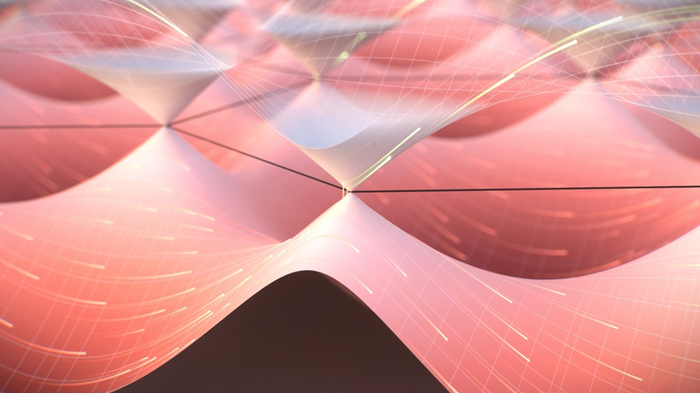
A collaborative research team from the University of Regensburg, Philipps-Universität Marburg, and Forschungszentrum Jülich has made a significant advancement in understanding the ultrafast dynamics of graphene. Their findings, published in Nature, reveal the intricate processes of Landau-Zener-Majorana transitions in this carbon-based material.
Using a combination of ultrafast laser techniques and electron microscopy, the researchers have directly observed how strong electric fields can propel electrons through graphene, allowing them to cross energy gaps in a seemingly paradoxical manner. This phenomenon is likened to an elevator skipping multiple floors to reach a higher level, illustrating how electrons can transition between energy states without occupying intermediate states. Such Landau-Zener-Majorana transitions are expected to gain importance as semiconductor technology continues to evolve.
The team utilized a slow-motion electron camera to capture the dynamics of electrons accelerated by the electric field of a light pulse. In typical semiconductors, electrons are confined to specific energy bands, separated by a band gap. However, during these transitions, electrons appear to traverse this forbidden region with ease. This breakthrough was achieved by merging electron spectroscopy with rapidly oscillating intense laser fields, enabling controlled electron movement.
Vincent Eggers, the study's first author from the University of Regensburg, emphasized the importance of observing numerous electrons simultaneously to capture those undergoing quantum mechanical transitions. The research employed a photoemission momentum microscope, which, unlike traditional microscopes, measures electron energies and motion to map their distribution.
Rupert Huber, a key researcher, highlighted the years of effort that went into developing this experiment, allowing them to track electron movements across a solid's energy landscape in real time. Ulrich Höfer, a pioneer in ultrafast electron spectroscopy, noted the significance of observing such fundamental quantum processes during their initial measurement campaign. The experiments relied on custom-made, atomically thin carbon layers of exceptional purity from Forschungszentrum Jülich, ensuring that impurities did not obscure the delicate quantum dynamics.
The study revealed that under intense light fields, electrons could cross the band gap with a tunneling probability of up to 100%. This high probability of Landau-Zener-Majorana transitions occurs even when energy states are distinctly separated, driven by the velocity of electrons near the band gap. These transitions differ fundamentally from traditional quantum tunneling across spatial energy barriers.
This innovative approach provides a panoramic view of the quantum world, enabling exploration of basic quantum transitions and the factors affecting precise electron manipulation. Observations on graphene have shown how interactions with the crystal lattice can disrupt the organized movement of electrons. These findings are crucial for future technologies where electrons are controlled by light oscillations rather than electrical voltages.
Giacomo Inzani from the University of Regensburg remarked on the potential of this method to be applied to other quantum materials, opening new possibilities for selectively controlling electronic properties with light. This research marks the beginning of a new era in understanding and manipulating quantum dynamics in advanced materials.
Source: Graphene Feed