Jeonbuk National University increases photocatalytic hydrogen output fivefold using electron beam
Researchers enhanced the visible-light use and stability of a TiO₂–MXene photocatalyst, increasing hydrogen production fivefold by creating oxygen vacancies with an electron beam.
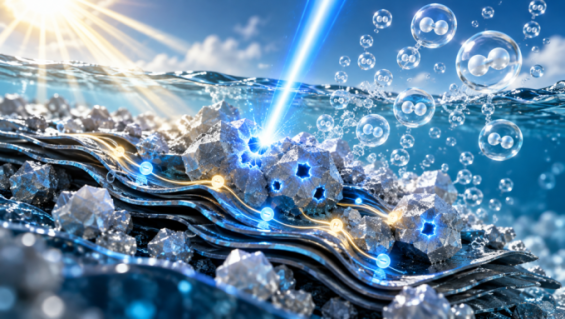
Electron-beam engineered oxygen vacancies in TiO₂–MXene photocatalysts enhance visible-light use and stability
Researchers at Jeonbuk National University have developed a method to significantly enhance the performance of photocatalysts used for hydrogen production from water. By applying an electron beam, they created oxygen vacancies within a titanium dioxide (TiO₂) and MXene composite catalyst, which improved light energy utilization and electron transfer, resulting in a more than fivefold increase in hydrogen generation. This advancement could lead to the development of high-efficiency photocatalysts with less reliance on precious metals and enhance existing catalyst performance.
The National Research Foundation of Korea (NRF) reported that the research team, led by Professors Yoo Seung-hwa and Jin Kyung-hwan, achieved this breakthrough by irradiating an electron beam onto a TiO₂-MXene photocatalyst. The findings were published in the journal Applied Catalysis B: Environmental and Energy on September 29.
Titanium dioxide is a common photocatalyst due to its affordability and stability, but it has limited hydrogen production efficiency as it mainly absorbs ultraviolet light, making visible light utilization challenging. Additionally, the recombination of electrons and holes generated upon light absorption reduces its effectiveness in hydrogen production.
The team enhanced the photocatalyst by integrating titanium dioxide with MXene, a two-dimensional material known for its high electrical conductivity. They exposed the catalyst to an electron beam at room temperature and atmospheric pressure, creating oxygen vacancies—missing oxygen atoms in the crystal lattice.
Experiments showed that the optimal hydrogen generation performance occurred when MXene constituted 3% by weight of the catalyst and the electron beam dose was 500 kilogray (kGy). Under these conditions, the hydrogen generation rate increased by 5.25 times compared to pre-irradiation levels.
The analysis indicated that the oxygen vacancies facilitated light absorption and reduced electron-hole recombination. At the interface between titanium dioxide and MXene, changes in electron distribution mitigated the excessive binding of hydrogen to the catalyst surface, establishing favorable conditions for hydrogen evolution reactions.
Professor Yoo Seung-hwa highlighted the significance of this achievement in addressing the low hydrogen evolution rate and stability issues of existing TiO₂-MXene photocatalysts through electron beam-induced defect control and interfacial design.
Yoo also noted the need for further research, including complete water-splitting experiments using pure water and outdoor demonstrations. The team plans to verify performance under real sunlight without sacrificial agents and assess the long-term stability, uniformity, and economic feasibility of the electron-beam irradiation process.
Source: MXenes