Magnetic field affects electronic patterns in graphene
Researchers found that magnetic fields can influence electronic pattern formations in graphene, potentially affecting its electronic properties and applications.
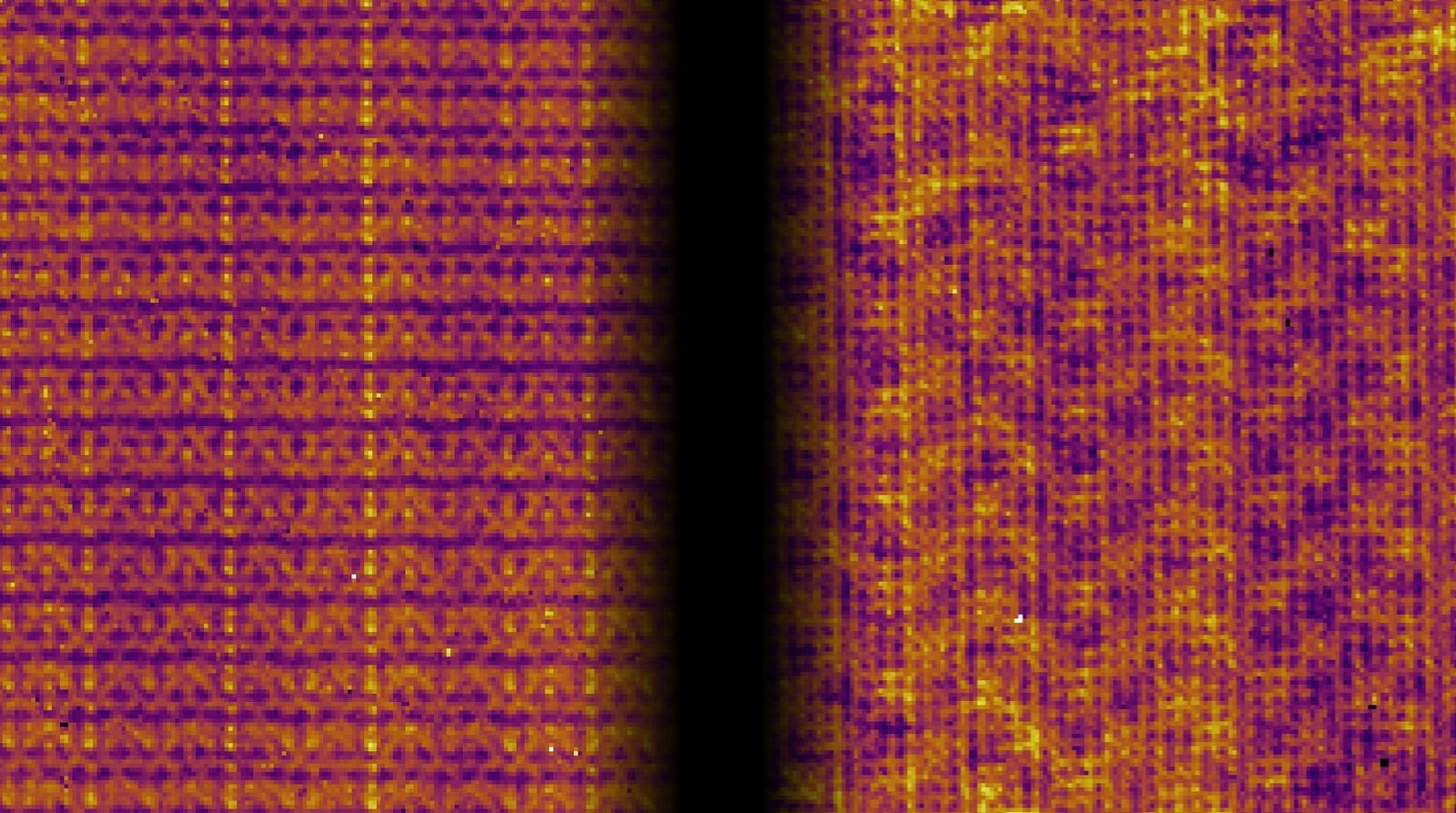
Researchers from the Okinawa Institute of Science and Technology and Hiroshima University have demonstrated that a small magnetic field can switch the electronic states of the quantum material CeTe₃ between striped and checkerboard patterns. This discovery, published in Nature Communications, highlights the role of magnetism in reorganizing electronic states in quantum materials.
CeTe₃, composed of cerium and tellurium atoms, shares some characteristics with graphene as a two-dimensional layered material with highly mobile electrons. However, unlike graphene, CeTe₃ features localized electrons on cerium sites that behave like tiny magnets due to their spin, allowing manipulation of electronic states via a magnetic field.
Using scanning tunneling microscopy, researchers mapped the electron arrangement within CeTe₃ at the atomic level. At near absolute zero, they observed a striped electronic pattern, which transformed into a checkerboard pattern upon applying a magnetic field. This transformation is attributed to electronic frustration, where electrons can organize into multiple low-energy patterns with no single preferred arrangement.
A second study, published in Physical Review B, explored the magnetic structure of CeTe₃ using neutron scattering. This research revealed a complex magnetic order at temperatures near absolute zero, with magnetic moments forming intricate repeating patterns. The periodicity of this magnetic structure aligns with the striped electronic state, indicating a close link between the magnetic and electronic structures.
The findings suggest that electronic frustration can be harnessed by coupling it with magnetism, providing a method to manipulate collective electronic states with a small magnetic field. This interplay could lead to new strategies for controlling electronic states in quantum materials, potentially impacting future quantum and spintronic technologies.
Source: Graphene Feed