Mesophase pitch offers a route to $5/lb carbon fiber
An Advanced Carbons Council webinar compared mesophase-pitch carbon-fiber routes with PAN, citing estimated costs as low as $3/lb for asphaltene-derived fiber. The discussion also examined feedstock consistency, performance requirements and emissions.
During an Advanced Carbons Council webinar on June 9, Jeramie Adams of Western Research Institute (WRI) compared pitch, asphaltene, coal and lignin precursor routes against PAN, reporting carbon fiber cost estimates as low as $3/lb ($6.60/kg) and a path to the automotive industry's $5/lb target.
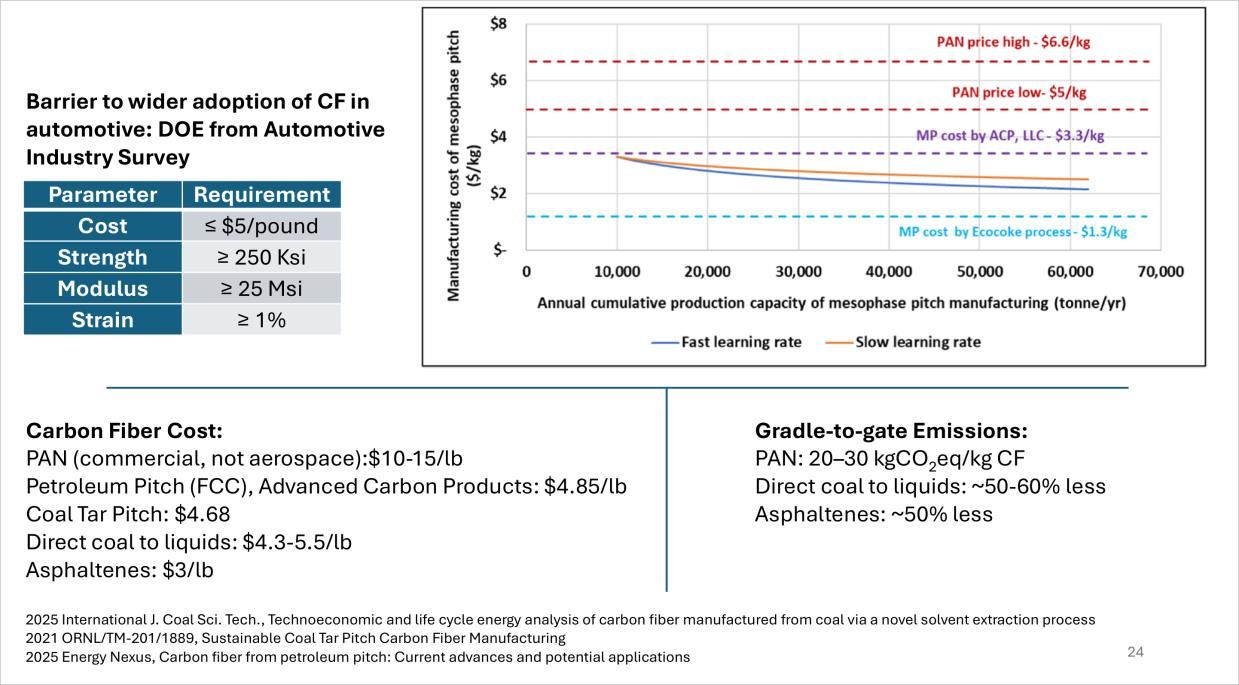
Precursors account for 53% of the cost of producing polyacrylonitrile (PAN)-based carbon fiber, where commercial-grade PAN fiber costs $10-15/lb ($22-33/kg) to produce. Carbon fiber spun from mesophase pitch can be produced for $4.85/lb ($10.70/kg) using petroleum pitch from fluid catalytic cracking (FCC), $4.68/lb ($10.30/kg) using coal tar pitch and an estimated $3/lb ($6.60/kg) using heavy oil asphaltenes. Those figures anchored a recent webinar hosted by the Advanced Carbons Council (ACC), titled "Mesophase Pitch as a Feedstock for More Economical Carbon Fiber Production" which was presented by Jeramie Adams, Ph.D., vice president of the Renewable Upcycling, carbon Materials and Asphalt Technology research group at Western Research Institute (WRI, Laramie, WY, U.S.), an ACC member organization.
Terrance Barkan, executive director of the ACC, a global trade association for producers and users of engineered carbon materials, opened the session by noting that new carbon fiber capacity is being planned in several geographies and that "there's a need to have both an economical and a lower carbon footprint type material for carbon fiber production."
A market projected to multiply
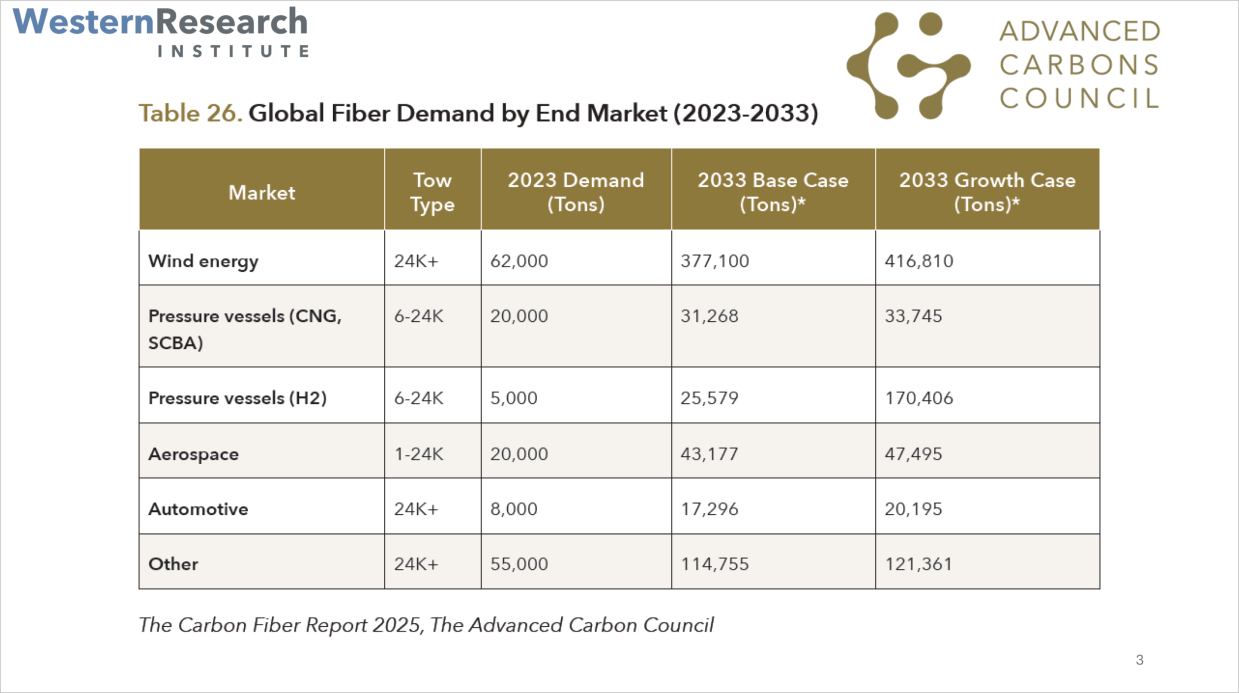
Adams began with the market context. Carbon fiber's strength-to-weight ratio is, in some cases, can be more than 100 times greater than steel or more, he said, which first drove adoption in aerospace followed by wind turbine blades, pressure vessels and, to a lesser extent, automotive structures as major CF outlets. Citing demand figures from the ACC's The Carbon Fiber Report 2025, Adams showed global demand for wind energy alone is projected to grow from 62,000 tons in 2023 to a base case of 377,100 tons by 2033, with hydrogen pressure vessels, aerospace and automotive all doubling or more (Figure 1). "It doesn't really matter whose data you look at," Adams said. "It is projected to increase significantly into the future."
Adams also pointed to unmanned vehicles and drones (notably driven by warfare in Ukraine and the Middle East) as a potential fast-growing future market, since lightweight composites extend how deep a drone can strike.
Hydrocarbon producers hunt for new outlets
Adams then turned to why hydrocarbon producers are examining carbon fiber as a potential non-fuel-based outlet for coal by-products and petroleum fractions. Renewable energy has grown as a component of U.S. primary energy consumption to 8.8% in 2023, overtaking coal at 8.7%, while petroleum has stayed essentially flat, he said, describing an approximately one-for-one swap of coal for natural gas over 11 years. U.S. coal production has fallen by roughly half since peaking around 2008. A 2019 National Coal Council study, Coal in a New Carbon Age, identified carbon fiber as one of the most attractive diversification markets for the coal industry. In Canada, Alberta Innovates ran a similar exercise for heavy oil under its Bitumen Beyond Combustion initiative and launched the Carbon Fiber Grand Challenge, now in phase three with about five companies working toward commercialization. Patent filings on mesophase pitch synthesis have climbed steadily since the mid-2000s, and WRI has worked with companies globally on what to do with hydrocarbon feedstocks as fuel demand plateaus.
What mesophase pitch is and why alignment matters
Mesophase pitch forms when a highly aromatic feedstock is thermally treated so that large polyaromatic molecules stack and organize into liquid crystalline domains. Anisotropic spheres initially appear in the isotropic pitch. They grow with continued treatment and eventually coalesce until a phase inversion occurs so that the mesophase (anisotropic phase) becomes the continuous phase. The softening point rises as mesophase content increases, creating a processing sweet spot: the pitch must melt spin cleanly without further chemical change during the melt-spinning process.
The alignment, that gives mesophase pitch-based fiber its properties, comes from the melt spinning step itself, Adams explained. Shear in the spinneret orients the liquid crystalline domains along the fiber axis. Oxidative stabilization then cross-links the molecules and fiber structure in place, and carbonization grows and orders graphitic crystallites inside the fiber, producing interlocking layers that Adams compared to plywood. Graphitization can push modulus higher still, at a cost penalty for the additional heat. Pitch-based fibers are known for high modulus while PAN-based fibers dominate high-strength grades, though Adams noted that pitch-based fibers falling within the higher end of the PAN strength range have been demonstrated.
Feedstocks and precursor costs
Adams compared the major candidate feedstocks by volume, chemistry and cost. Canadian heavy oil sands bitumen is the largest at 200-210 million metric tons per year, but research is early stage; the material carries roughly 7% sulfur plus nickel, vanadium and iron impurities. Lignin, at 50-80 million metric tons, is mostly burned as fuel within pulp mills, and its oxygen-rich chemistry differs sharply from the aromatics that build mesophase. FCC slurry oil (35-45 million metric tons) is a known feedstock but contains catalyst fines, while ethylene cracker bottoms, or pyrolysis fuel oil (8-12 million metric tons), are chemically similar with potentially less fines. Coal tar pitch requires energy-intensive removal of quinoline insolubles. Newer liquefaction processes in Utah and Kentucky, which Adams said grew out of federal investment for new uses of coal during the first Trump administration, convert coal into pitch-type materials, while synthetic pitches made from refined aromatics, such as naphthalene, with Lewis acid catalysts offer high purity at very high cost.
On a precursor basis, Adams' figures put PAN at roughly $5,000-6,600 per metric ton and synthetic pitch above $10,000, against about $3,500 for coal tar pitch, $3,300 for FCC bottoms and pyrolysis fuel oil, $800-1,500 for coal liquefaction routes and $900 for asphaltenes, though asphaltene-derived fiber has not yet been proven at high-performance grades. Asphaltenes precipitate as a melt-spinnable solid when an aliphatic solvent such as heptane is added to heavy oil, and they hold little value for refiners today, typically being coked into fuels. Acrylonitrile persists as the standard, Adams said, because high-purity monomer gives producers precise control and predictability: hydrocarbon streams vary with the crude slate, and mesophase conversion and melt spinning demand a consistent feed.
Melt spinning, the $5/lb target and emissions
Process economics compound the feedstock advantage. Melt spinning pitch costs about $0.04/lb ($0.09/kg), Adams reported, versus about $0.77/lb ($1.70/kg) for the solution spinning used with PAN, which requires dope preparation, stretching and solvent handling. An Oak Ridge National Laboratory comparison of wet-spun versus melt-spun PAN likewise showed lower capital and operating cost for melt spinning.
A U.S. Department of Energy (DOE) survey of the automotive industry set the bar for wider adoption at a cost of $5/lb ($11/kg) or less with tensile strength of at least 250 ksi (1.72 GPa), modulus of at least 25 Msi (172 GPa) and strain to failure of at least 1%. A fiber produced at Oak Ridge National Laboratory, produced from mesophase coal tar pitch made at WRI, has measured 361 ksi (2.49 GPa) tensile strength, 26 Msi (179 GPa) modulus and 1.17% strain, clearing all three property floors. Against that target, direct coal-to-liquids routes run $4.3-5.5/lb, with FCC petroleum pitch (as produced by Advanced Carbon Products LLC), coal tar pitch and asphaltenes at the figures cited above, versus $10-15/lb for commercial PAN (Figure 2). Cradle-to-gate emissions for PAN-based fiber run 20-30 kilograms of CO2 equivalent per kilogram of fiber, he said, with direct coal-to-liquids routes roughly 50-60% lower and asphaltenes about 50% lower.
Beyond fiber, Adams showed mesophase pitch converted into carbon foams, made by pressurizing and heating pitch in a reactor before carbonizing and optionally graphitizing the product. Pore size, density, strength and conductivity can be tuned, and a commercial product from CFOAM, part of Consol Energy alongside composites producer Touchstone Advanced Composites, serves diverse applications from heat sinks and insulation panels to spacecraft nose cones. Mesophase-derived carbons are also used for battery anodes, including graphitized mesocarbon microbeads, pitch coatings on natural graphite and pitch-based fibers.
Q&A: the feedstock stability barrier
In the question-and-answer session, moderated by Barkan, an attendee asked whether biochar from wood pyrolysis could serve as a feedstock. Particulate additives can be co-spun if small enough relative to fiber diameters of roughly 10-20 microns, Adams answered. "You'll get an increase in your modulus of your fibers, but you'll decrease your strength significantly, because strength is a defect density issue," he said.
Barkan then pressed on the central puzzle: a cheaper precursor, lower capital cost, lower energy cost and a simpler process flow, yet limited adoption. Adams gave two reasons. Historically, pitch-based fibers could not deliver the flexibility and strength some applications demand, though polymer co-feeds have been closing that gap. The larger barrier has been feedstock stability. Refiners produce pitch precursors as byproducts, he explained: "They're not caring about the consistency of what they're producing on the back end. They're trying to make fuels. That's where their economics comes from." Adams recalled a WRI project with a pitch-based fiber producer evaluating a new supply: "They came back and said, well, for us to qualify a new pitch for our process, it's $2 million just to qualify the pitch."
Barkan added a market observation from the association's own work. "We, as the Advanced Carbons Council, do engage with quite a number of oil and gas companies. They are actively searching for other higher value-add carbons to come out of their oil products, especially as part of decarbonization efforts," he said.
Incumbents, new entrants and vertical integration
Barkan asked whether incumbent PAN-based producers would adopt mesophase pitch or whether disruption would come from new entrants, likening the situation to "Kodak inventing digital photography and not being willing to kill their legacy business and migrate to the new one. So they left it to somebody else to kill that business for them." Adams answered that it can be both. Large PAN producers are unlikely to move while demand stays high and their market share holds, he said, while companies such as Solvay that already run both PAN-based and pitch-based operations may shift further into pitch. The bigger structural change he sees is vertical integration by the largest hydrocarbon producers, which already control and understand their own feedstock; he cited Saudi Aramco's $200 million investment in a carbon center investigating carbon fiber, anode-grade materials and other carbon products.
Barkan agreed, noting publicly announced plans for carbon fiber production in Saudi Arabia as well as activity in Turkey, India and Great Britain. He pointed to aerospace qualification lock-in around Airbus and Boeing, boom-bust supply cycles in which producers want offtake committed before investing $125-150 million in a new plant, cost-limited opportunities in sporting goods and automotive, the weight of battery electric vehicles and defense demand. "Carbon fiber becomes a strategic material, and then you get countries that want to have a domestic source of supply for defense purposes, and not being cut out of the supply chain," Barkan said.
A final audience question asked what makes a good mesophase pitch precursor. The literature often calls for 90% or even 100% mesophase content, Adams said, but a coalesced mesophase of about 65% or more anisotropic content works because the remaining molecules are close behind. The softening point should fall between about 280°C and 330°C (536-626°F): high enough that oxidative stabilization, a diffusion-limited step and one of the biggest energy consumers in the process, finishes in reasonable time, but not so high that the pitch reacts during melt spinning. Oxygen, nitrogen, sulfur and metal contamination should be minimized because they become defects during carbonization and graphitization. Adams added a caveat from WRI's asphaltene work: a feedstock can pass every compositional screen and still misbehave, because small aromatic units joined by single carbon-carbon bonds react and crosslink in three dimensions rather than preferentially growing the planar aromatics of well-ordered mesophase, and correcting that chemistry adds cost.
Asked for any last words, Adams closed simply: "Let's keep moving the future forward with pitch-based fibers."