Monolithic microLEDs eye AI
Researchers at CEA-Leti and CRHEA/CNRS grew InGaN nanopyramids through a patterned graphene monolayer on SiC, achieving red, green, and blue emission from a single epitaxial growth with an indium content up to 45 percent in the quantum wells. The approach uses graphene as a selective-area growth mask to produce relaxed InGaN pseudo-substrates, addressing the long-standing efficiency drop in InGaN-based red emitters that has blocked monolithic full-colour microLED integration for AR displays.
III-nitride materials are gaining attention for their potential in augmented reality (AR) applications, particularly through their use in microLEDs. These LEDs, with pixel pitches as small as 10 µm, offer high brightness and are promising for high-resolution micro-displays central to AR technology.
Efforts to manufacture these displays have identified three main approaches: a pick and place process using III-nitrides and phosphide materials, color conversion with phosphors or quantum dots, and monolithic integration using a single material family for all primary colors. Monolithic integration, leveraging InGaN's ability to cover the visible spectrum by adjusting indium content, is favored for its cost, efficiency, and resolution benefits.
However, challenges remain, particularly with the external quantum efficiency of InGaN, which decreases from blue to red wavelengths. This efficiency drop is linked to crystal quality degradation at higher indium contents. To address these issues, CEA-Leti and CRHEA/CNRS are developing InGaN nanopyramids grown through a graphene mask, enabling the emission of red, green, and blue from one epitaxial growth.
The use of a graphene mask, due to its lack of dangling bonds, facilitates selective-area growth of InGaN nanopyramids. This method allows for the creation of nanopyramids with a well-oriented crystalline structure, crucial for LED manufacturing. The approach has demonstrated the potential for regular red, green, and blue quantum wells with indium content up to 45 percent.
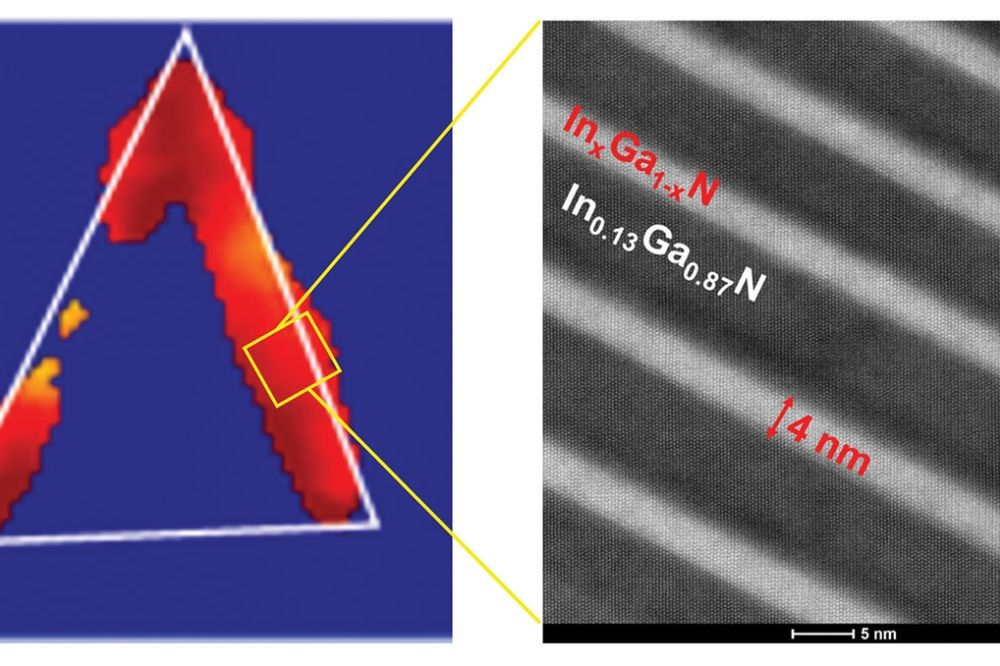
Cathodoluminescence mapping of single nanopyramids shows that emission wavelengths correlate with nanopyramid sizes. Cyan emission is observed in smaller nanopyramids, while larger ones emit amber-red light. The graphene mask's self-organized hole pattern plays a role in this size-dependent emission.
Transmission electron microscopy and cathodoluminescence characterizations confirm the regularity and chemical homogeneity of the quantum wells, indicating a consistent indium distribution. This research suggests that a relaxed InGaN pseudo-substrate enhances indium incorporation without compromising crystal quality.
Future goals include refining the graphene mask's hole pattern to create organized red, green, and blue sub-pixels and advancing the integration of nanoLEDs onto conductive substrates. This combination of graphene masks and InGaN structures offers a promising path for achieving efficient, high-quality red, green, and blue emissions from a single growth process.
This research was supported by the French National Research Agency's "Recherche Technologique de Base" and "France 2030 - ANR-22-PEEL-0014" programs. The authors acknowledge contributions from CEA-Leti and CRHEA/CNRS team members.
Source: Graphene Feed