MXene and sulfur-doped graphene coating controls zinc dendrites in water-based systems
Researchers have developed a coating using MXene and sulfur-doped graphene to control zinc dendrite formation in water-based systems.
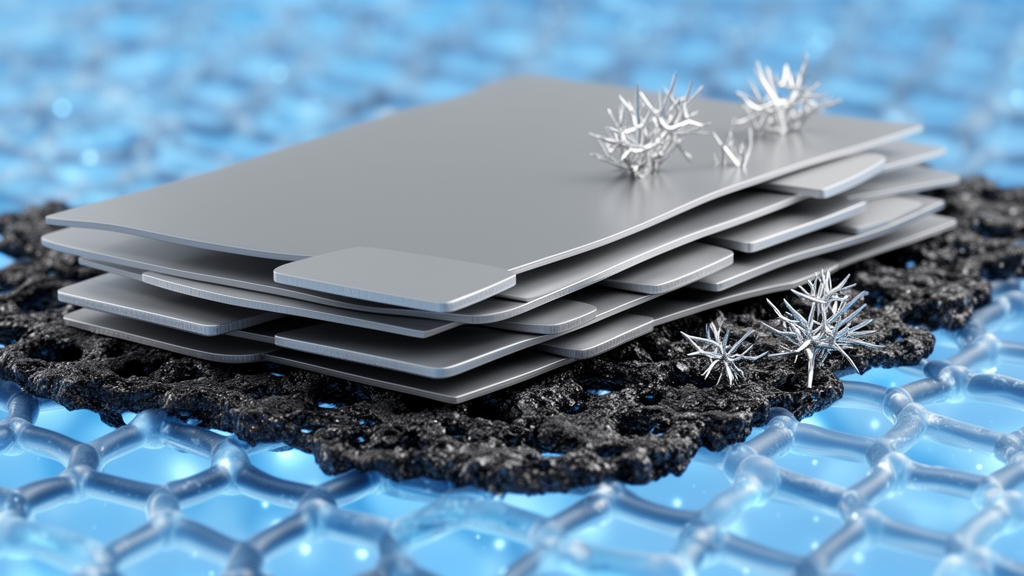
A recent study from Northeast Petroleum University in Daqing, China, highlights the development of a multifunctional artificial protective layer composed of MXene and sulfur-doped graphene, aimed at enhancing the performance of aqueous zinc-ion batteries. These batteries, known for their safety and cost-effectiveness, often suffer from zinc dendrite growth, hydrogen evolution, and corrosion, which degrade their efficiency and lifespan. The research, published in the journal Ionics, demonstrates that this new coating effectively addresses these issues.
Zinc anodes are valued for their high theoretical specific capacity of 820 milliampere-hours per gram and moderate redox potential, making them suitable for grid-scale energy storage. However, challenges arise from uneven ion flux and reactions with the aqueous electrolyte, leading to dendrite formation and other side reactions. The MX/S-GR coating, combining MXene and sulfur-doped graphene, creates a protective layer that modifies the electrochemical environment at the anode-electrolyte interface.
The MXene component, represented by Ti3C2Tx, features negatively charged surface groups that repel sulfate anions and promote zinc ion desolvation, reducing corrosive attacks and enhancing ion transfer. Meanwhile, sulfur-doped graphene evens out the electric field and provides zincophilic sites, guiding zinc deposition into a uniform, dendrite-free morphology. This dual approach significantly improves the transport kinetics of Zn2+ ions.
Electrochemical tests reveal that the MX/S-GR-coated zinc anodes maintain stability for over 1000 hours at various current densities, demonstrating both longevity and robustness. Full cell tests with a manganese dioxide cathode further confirm the coating's effectiveness, achieving stable cycling for more than 2400 cycles while retaining substantial discharge capacity.
The integration of MXene and sulfur-doped graphene into a single coating addresses multiple failure modes simultaneously, setting it apart from other anode protection strategies that typically focus on a single issue. This multifunctional approach could be pivotal for the commercialization of zinc-ion batteries, particularly for applications in grid storage and renewable energy buffering.
The study underscores the potential of interfacial engineering to transform zinc anodes into actively designable reaction environments. By combining two-dimensional materials with complementary surface chemistries, the research provides a promising pathway for enhancing the durability and performance of aqueous zinc-ion batteries, potentially facilitating their broader adoption in energy storage solutions.
Source: MXenes