New graphene soft lens reimagines camera focus
Researchers have developed ultra-thin transparent electrodes using reduced graphene oxide for soft lenses, potentially transforming camera focus technology.
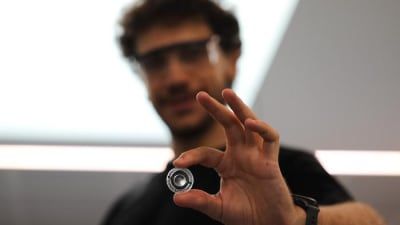
Researchers at Queen Mary University of London have developed transparent graphene-based electrodes that allow soft lenses to change focus electronically, advancing the development of compact adaptive optics for cameras, medical imaging and wearable devices.
The human eye changes focus almost effortlessly, shifting between nearby objects and distant scenes. Reproducing that capability in artificial optical systems has traditionally required mechanical components that add size, weight and complexity.
Researchers at Queen Mary University of London have developed a soft, electrically tunable lens incorporating transparent electrodes made from reduced graphene oxide (rGO). The technology offers a route toward optical systems that can adjust their focal length without the bulky moving components used in conventional autofocus mechanisms.
Led by Professor James Busfield, the research, published in Advanced Functional Materials, combines advances in graphene processing, soft materials and dielectric elastomer actuators (DEAs).
One of the principal challenges was developing an electrode that could conduct enough electricity to actuate the lens without substantially reducing the amount of light passing through it.
"Increasing the amount of graphene improves the electrode’s ability to conduct electricity, but at the same time reduces the amount of light that can pass through it," first author Giacomo Sasso explained in an interview with Tech Briefs.
The team developed a stable rGO ink, carefully controlling graphene concentration and solvent selection. The solvent needed to disperse graphene flakes effectively while remaining compatible with the soft 3M VHB elastomer membrane used in the actuator.
The researchers developed a spray-deposition process using a heated plate positioned behind the membrane, allowing the solvent to evaporate rapidly without compromising the underlying material.
Second author Alec Lamoreux, who joined the team as an MSc student, conducted the ink tests, optimized the graphene concentration and manufactured the actuators.
Developing a suitable electrode was only part of the challenge. The researchers also needed to integrate the conductive material into a lens that could deform predictably and reversibly under an applied voltage.
"Making a lens is not easy; making it soft, transparent and electrically tunable makes it considerably more challenging," Sasso said.
The team drew on the expertise of Professor Federico Carpi and his SMART Lab group at the University of Florence, which has pioneered tunable lenses based on dielectric elastomer actuators. Professor Nicola Pugno contributed expertise in graphene and modeling.
In the resulting device, the soft lens sits on a transparent actuator incorporating the rGO electrodes. Applying a voltage produces electrostatic forces that deform the actuator, changing the lens's optical characteristics.
Although the technology remains at an early stage, the researchers identified opportunities to improve its performance through better graphene dispersion and smoother electrode surfaces.
Scanning electron microscopy revealed flake agglomerations and non-planar orientations that could be reduced through improved solvent selection. Better dispersions could also enable electrode surface densities below the 0.10 µg/mm² threshold examined in the study, potentially improving transparency and actuation strain.
Sasso sees the technology as part of a broader effort to develop optical components capable of electronically controlling not only focal length but also more complex optical properties.
"Soft materials offer the possibility of creating optical components that can actively change their shape and optical behaviour," he said.
The longer-term goal is to develop thinner, lighter and more adaptable optical systems for applications ranging from autofocus cameras to medical imaging and wearable displays.
Source: Graphene Feed