Scientists create carbon-nanotube foam that remembers impact force
Researchers developed a carbon nanotube foam with mechanical memory, retaining its shape after compression. This property could lead to advanced impact-resistant materials and mechanical computing applications.
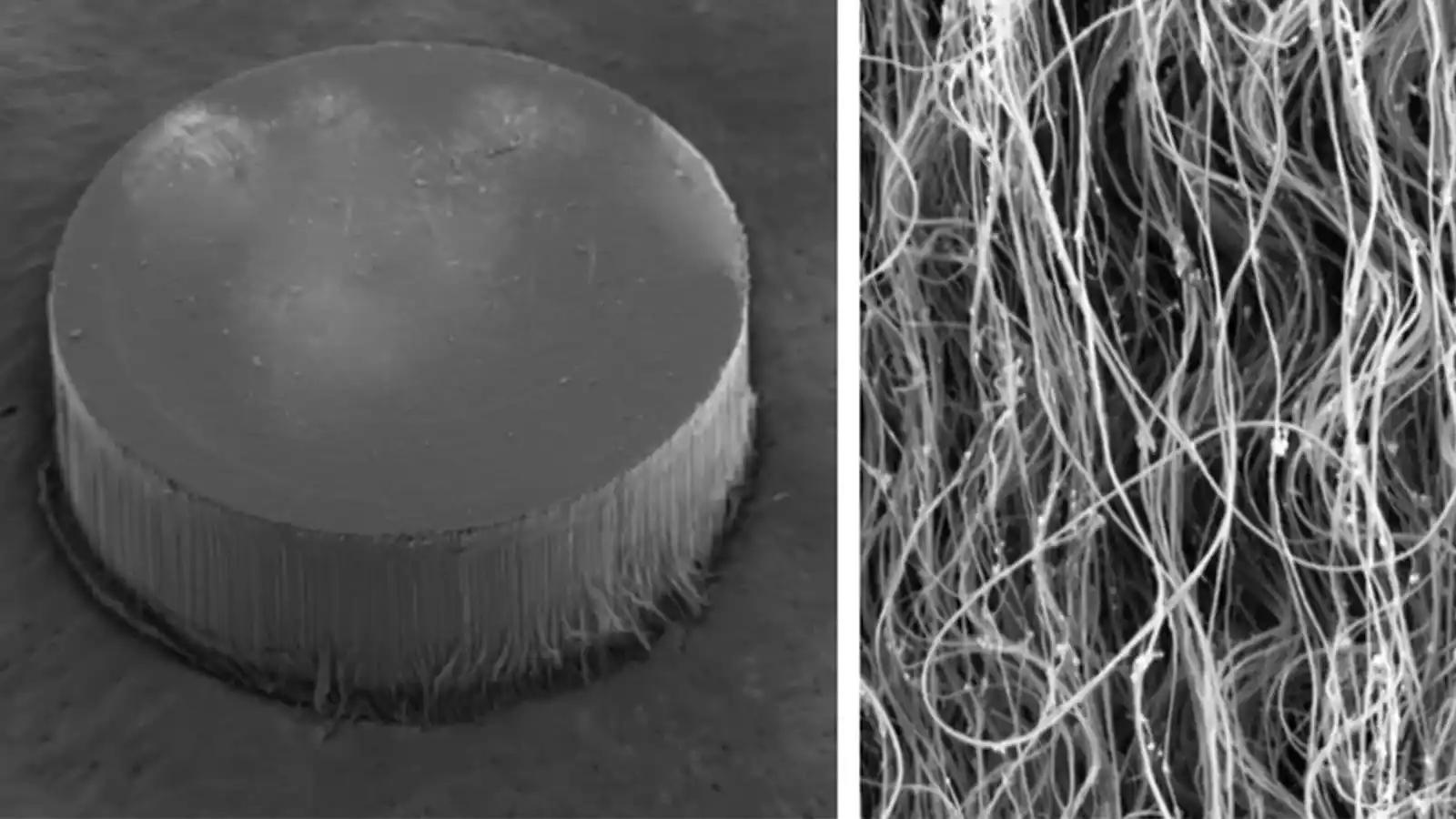
Researchers have developed a foam made from vertically aligned carbon nanotubes (VACNTs) that exhibits a unique mechanical memory. This foam can remember the force applied to it, even after returning to its original shape. This characteristic, detailed in the journal Physical Review X, distinguishes it from traditional cushioning materials that typically lose their previous state over time.
The VACNT foam's ability to retain mechanical memory allows it to control the speed of impact waves traveling through it. This feature could lead to advancements in protective gear, such as helmets and shock-absorbing liners, and even in mechanical computing systems that operate without electronics.
The foam comprises multiwalled carbon nanotubes arranged in dense, vertically aligned structures. Despite their small size, these structures can dissipate energy while maintaining a consistent mechanical state. Unlike ordinary polymer foams, which have a viscoelastic nature and exhibit fading memory, the VACNT foam maintains a stable stress level even under repeated compressions.
This behavior, known as return point memory, is akin to the magnetic memory seen in hard drives. It occurs due to friction between neighboring nanotubes, which bend and slide against each other during compression. This interaction leads to energy dissipation without the time-dependent viscosity seen in polymer foams.
The researchers demonstrated the foam's potential by stacking it between aluminum layers to create a waveguide. They found that precompressing the foam increased wave speed, while stronger impacts slowed it down. This suggests that the material could be programmed to handle impacts differently based on their intensity.
The study highlights the potential of VACNT foams in applications where electronic components are impractical. The foam's inherent memory and tunable wave speed could be leveraged in protective equipment, vehicle components, and ultrasound systems, offering new ways to manage mechanical signals without electronics.
The research, titled "Enduring Mechanical Memory from the Constitutive Response of Elastically Recoverable Nanostructured Materials," was conducted by Gupta, A., Maheswaran, B., Jaegersberg, N., et al, and published in Physical Review X.
Source: Carbon Nanotubes Feed