Strain-dependent wetting of graphene
Researchers used machine learning to predict a 72.1° contact angle for water on free-standing graphene, revealing that mechanical strain significantly alters its wetting properties.
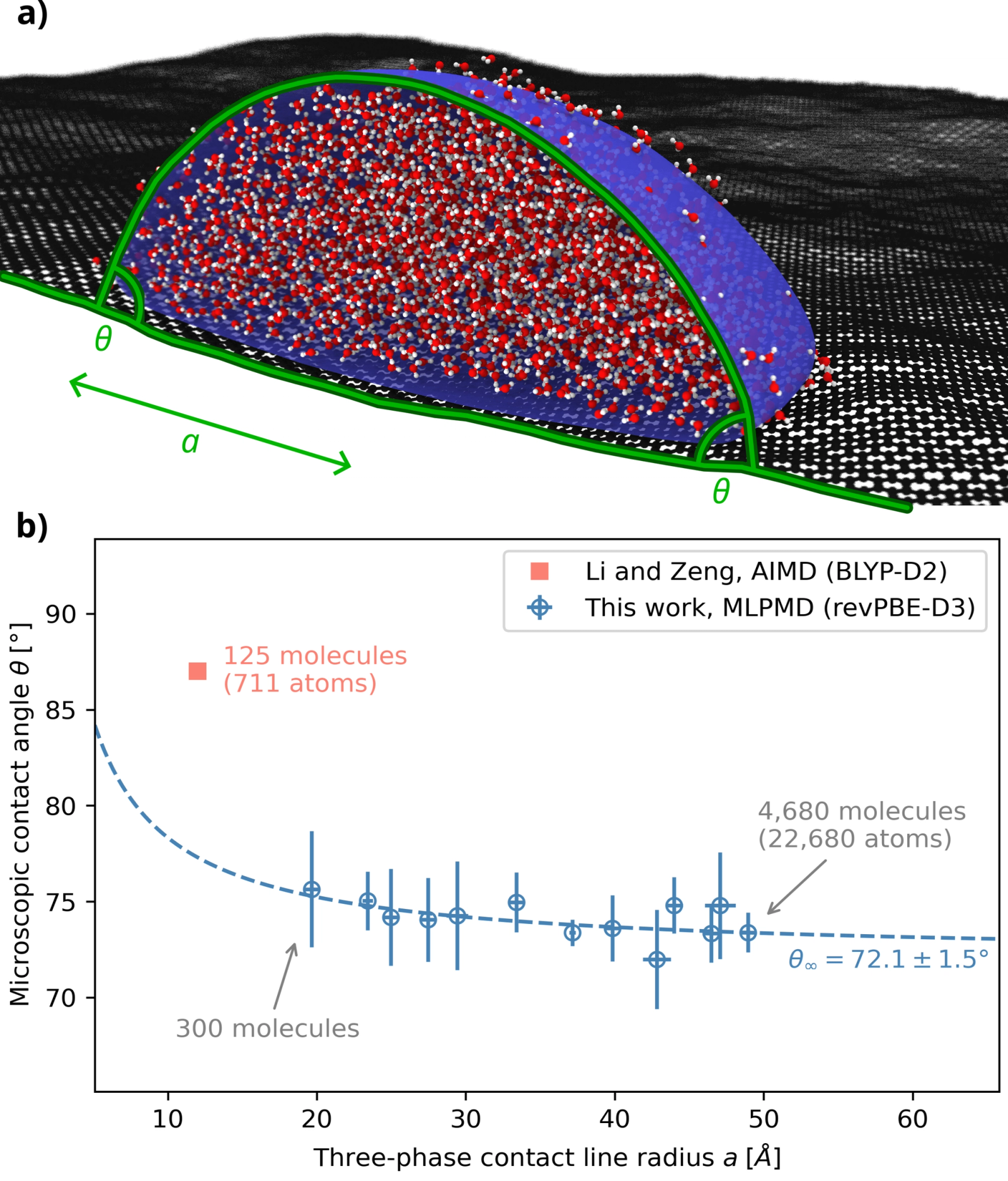
Graphene's interaction with water is pivotal for its application in nanofluidic, sensing, and energy technologies. The contact angle of a liquid droplet on graphene is a key measure of its wetting properties, yet experimental results for free-standing graphene vary widely. Utilizing a machine learning potential with ab initio accuracy, this study provides an atomistic first-principles prediction, identifying a weakly hydrophilic contact angle of 72.1 ± 1.5 degrees. Notably, graphene's wetting properties are highly sensitive to mechanical strain: tensile strain reduces hydrophilicity, while compressive strain creates ripples around the droplet, leading to anisotropic wetting and contact angle hysteresis. The study reveals a strong coupling between the three-phase contact line and graphene's intrinsic thermal ripples, contributing to this strain sensitivity. These findings highlight that the wettability of 2D membranes is influenced by both chemistry and dynamic morphology, offering a new perspective on experimental variability and suggesting mechanical strain as a control mechanism in 2D nanomaterials-based technologies.
The water-graphene interface is a scientifically intriguing and technologically significant water-solid interface, exhibiting altered dielectric properties, anomalous friction, and potential superionic states. Its applications span water filtration, desalination, blue energy, and biomolecular translocation. Despite extensive research, it remains unclear whether graphene is inherently hydrophobic or hydrophilic, and how its rippled nature affects wettability.
Wettability is quantified by the water droplet contact angle, but experimental measurements vary significantly, from 10 to 143 degrees. This variation is partly due to the substrate used to support the graphene sheet, with some studies attempting to isolate effects by measuring contact angles on free-standing graphene. However, results are inconsistent, possibly due to contaminants and imperfections during sample preparation.
Computational estimates also face challenges, limited by system size or accuracy. Simulations based on empirical force fields yield inconsistent contact angles, influenced by parametrization and water model choice. A pioneering ab initio molecular dynamics study provided early insights but was limited by computational costs. Capturing graphene's flexibility and thermal rippling is essential for a realistic description of its wettability.
This study offers an atomistic first-principles prediction for the contact angle of water on free-standing graphene using molecular dynamics simulations. By focusing on free-standing graphene, the study isolates its intrinsic wetting behavior, free from substrate or contamination influences. A novel methodology defines the contact angle for a spherical nanodroplet on a non-flat surface, accounting for surface rippling. Using a machine learning potential trained to replicate density functional theory calculations, the study simulates larger droplets than previous ab initio studies, addressing finite-size effects.
The interplay between surface ripples in free-standing graphene and the wetting of nanoscale water droplets is examined by applying mechanical strain to the graphene sheet. The study finds that strain significantly affects the graphene-water contact angle, with surface rippling playing a major role in wetting. This suggests strain as a control lever for wettability, contributing to experimental variability.
To determine the intrinsic wetting behavior, water droplets of varying sizes were simulated, and their contact angles extracted. A machine learning potential with first-principles accuracy enabled simulations for systems containing up to 23,000 atoms and nanosecond timescales, allowing for a systematic assessment of finite-size effects. The contact angles were determined using a novel methodology based on the geometrical intersection of the droplet’s time-averaged interface with the time-averaged graphene heightmap.
The finite-size corrected contact angle was obtained by plotting microscopic contact angles against droplet radii and extrapolating to infinity. The apparent line tension required for this best-fit was within the range of previously reported values. This procedure yields a macroscopic contact angle of 72.1 ± 1.5 degrees, considered a good estimate for water on pristine, free-standing graphene, accounting for thermal and dynamical effects.
The contact angle directly yields the surface energy difference via the Young equation. Based on the liquid-vapour surface tension, the contact angle translates to a surface energy difference of 22.9 ± 1.9 mN/m, indicating weak hydrophilicity. This estimate aligns with experimental measurements using a pull-off force method on glass-supported graphene samples, with discrepancies potentially explained by substrate effects.
The study compares this result with simulations using empirical force fields, which report varying contact angles based on different models and parameters. These findings underscore the need for simulations treating interatomic interactions from first principles to resolve the intrinsic graphene-water contact angle.
Source: Graphene Feed