Two-dimensional flash memory redefines speed, power, and reliability
Researchers developed a flash memory device using few-layer graphene, molybdenum disulfide, and boron nitride, enhancing speed, power efficiency, and reliability.
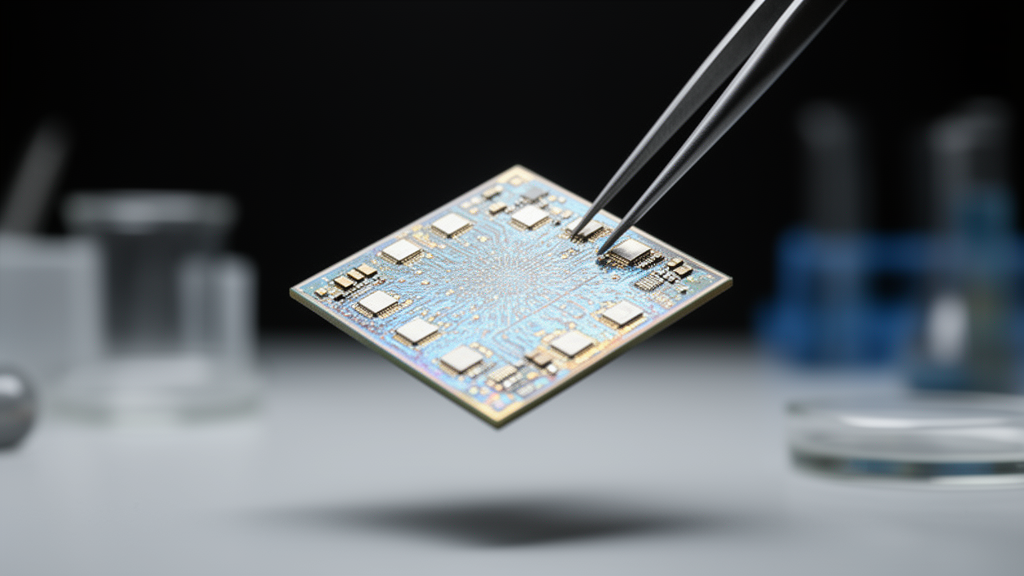
Two-dimensional (2D) materials are poised to transform flash memory technology by enhancing speed, power efficiency, and reliability. A recent review highlights how 2D materials like graphene, molybdenum disulfide, and hexagonal boron nitride can redefine the process of writing data in memory cells. These materials enable programming speeds in the subnanosecond range, operate at low voltages, and consume minimal energy, offering a new approach to memory design that could integrate computing capabilities.
Traditional silicon-based flash memory relies on pushing charge through insulating barriers using strong electric fields, a method that increases energy dissipation and accelerates degradation. In contrast, 2D materials create atomically sharp interfaces with fewer defects, allowing for precise control over charge injection, transport, and release. This interface-controlled charge programming reduces the need for high electric fields, enhancing device endurance and efficiency.
The performance of 2D flash memory is notable. While conventional silicon flash writes in microseconds to milliseconds, 2D devices achieve programming in nanoseconds at lower voltages, with energy consumption dropping significantly. Some 2D systems have demonstrated over a million write-erase cycles, far surpassing the endurance of traditional devices. However, retention remains a challenge, with most 2D devices evaluated over shorter periods than the ten-year standard for commercial flash.
Several devices exemplify the potential of 2D materials. One device using molybdenum disulfide, boron nitride, and graphene achieved programming in about 10 nanoseconds. Another device based on indium selenide and graphene demonstrated programming and erasing in 21 nanoseconds. A graphene-channel device achieved programming in approximately 400 picoseconds, showcasing the advantages of atomically thin channels.
Low-power operation is another benefit of 2D materials. Devices using molybdenum disulfide and graphene have achieved write pulses at extremely low voltages, with energy costs as low as 10 femtojoules per operation. These advancements highlight the potential for 2D flash memory to operate efficiently with minimal power consumption.
Beyond data storage, 2D flash memory is emerging as a platform for in-memory computing. Arrays of flash cells can perform vector-matrix multiplications, crucial for neural-network workloads, directly in memory. This capability reduces the need for data transfer between processor and memory, enhancing computational efficiency.
Integration with existing silicon infrastructure remains a challenge, but initial results are promising. Some teams have successfully integrated 2D flash modules with CMOS circuitry, achieving high chip yields and low energy consumption. However, issues like wafer-scale synthesis and thermal compatibility need to be addressed for 2D flash to become mainstream.
The future of 2D flash memory hinges on the ability to transition from laboratory demonstrations to manufacturable hardware. Whether it becomes a mainstream memory solution or a niche computing accelerator will depend on the successful implementation of interface-controlled design in large-scale production.
Source: Graphene Feed