Twisting graphene to explore correlation and topology
Researchers have discovered new quantum states in twisted graphene, revealing interactions between electronic correlation, superconductivity, and topology.
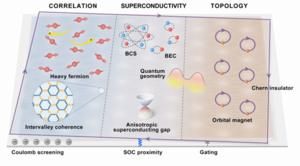
The exploration of twisted bilayer graphene, particularly at the magic angle, has unveiled significant advancements in condensed matter physics. Researchers have discovered that a slight twist of 1.1° between two graphene layers creates a moiré superlattice, which suppresses electron kinetic energy and results in a strongly correlated flatband system. This has led to the identification of various quantum phenomena, including orbital magnetism, the quantum anomalous Hall effect, fractional quantum topological states, and unconventional superconductivity.
Assistant Professor Shuo-Ying Yang from the Southern University of Science and Technology and Professor Cheng Shen from the University of Electronic Science and Technology of China have published a review in the National Science Review titled "Twisting Graphene into Correlation and Topology." This review delves into the mechanisms of flatband formation, correlated electronic states, topological quantum states, and unconventional superconductivity in magic-angle bilayer graphene, extending the discussion to multilayer twisted graphene systems.
The review emphasizes the unique flatband electronic structure of magic-angle bilayer graphene, where reduced kinetic energy allows electronic Coulomb interactions to dominate. This interaction drives complex behaviors such as correlated insulators, valley-coherent orders, and heavy-fermion-like states. Additionally, the non-trivial quantum geometry and Berry curvature of the flatband lead to emergent topological quantum states, including orbital Chern insulators and quantum anomalous Hall phases.
Superconductivity in twisted graphene is noted to deviate from conventional BCS theory, suggesting a strong-coupling, unconventional pairing mechanism. Quantum geometry's role in enhancing superfluid stiffness is highlighted as a factor in maintaining stable superconductivity within these flatband systems.
The review also discusses emerging platforms like M+N layer graphene, alternating-twist multilayer graphene, and supermoiré systems. These configurations offer richer band structures, enhanced tunability, and distinct correlated and topological quantum states compared to magic-angle bilayer graphene.
Twisted graphene has evolved beyond its initial conception as a rotated two-dimensional material, becoming a leading platform for studying strong correlation, topological quantum phases, and unconventional superconductivity. The advancement of moiré engineering and quantum control technologies is anticipated to further propel the discovery of novel quantum states and their application in future device technologies.
Source: Graphene Feed