What really controls water chemistry in nanoscale spaces
Researchers from Cambridge, Harvard, Caltech, and the Max Planck Institute for Polymer Research published findings in Science Advances showing that nanoconfined water's apparent chemical reactivity is driven by pressure and surface chemistry rather than confinement itself, using machine-learning simulations of water trapped between graphene and hexagonal boron nitride sheets. The work establishes that graphene's chemically inert surface leaves water reactivity unchanged, while reactive surfaces like hBN can actively enhance water dissociation—a design principle relevant to graphene and 2D carbon material applications in membranes, fuel cells, and electrochemical systems.
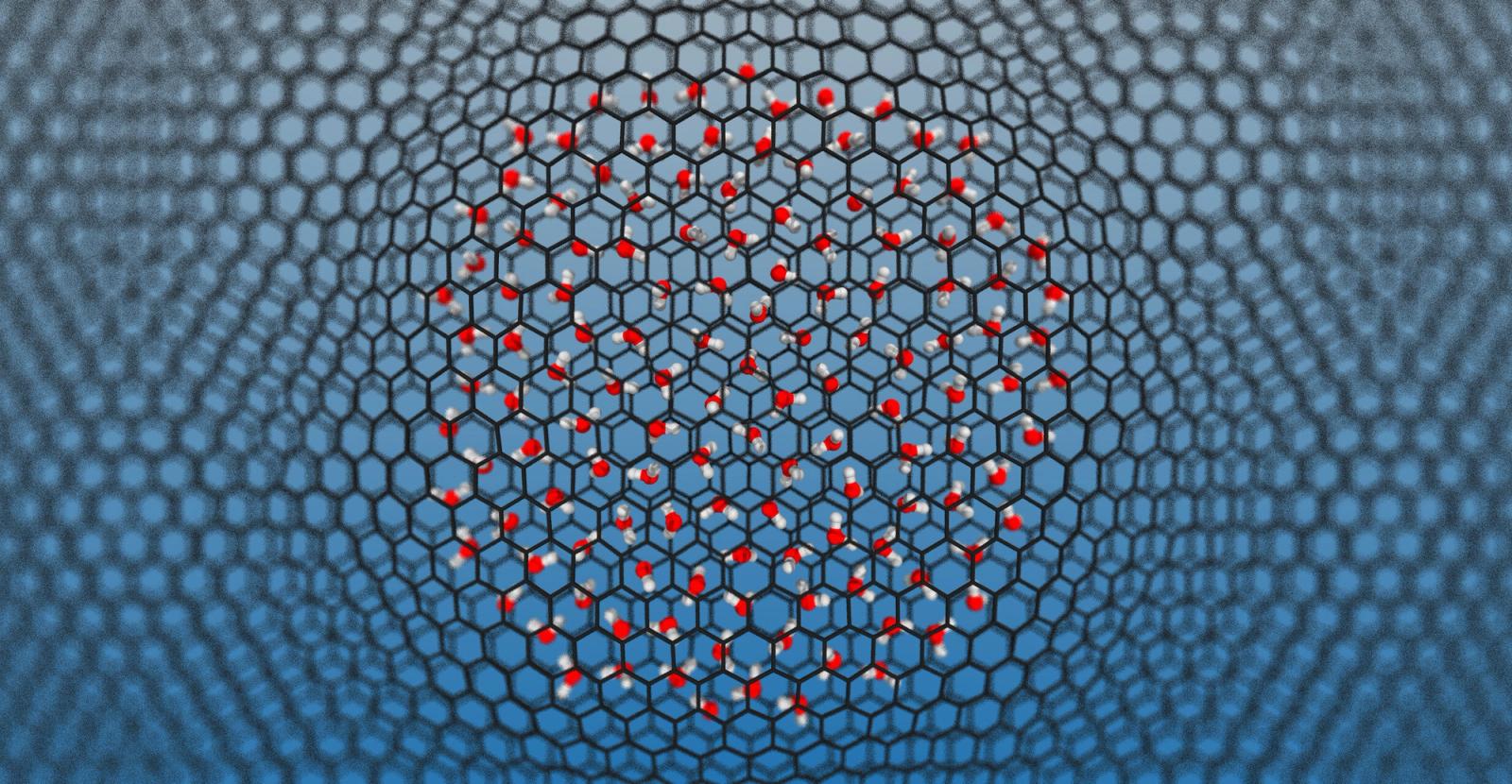
Researchers have long sought to understand the chemical behavior of water when confined to nanoscale spaces, such as those found in pores, membranes, and biological channels. A recent study published in Science Advances sheds light on this topic, revealing that water's reactivity in such confined spaces is highly sensitive to factors like density, pore width, wall flexibility, and surface chemistry.
The study, conducted by researchers from Cambridge, Harvard, Caltech, and the Max Planck Institute for Polymer Research, utilized machine-learning-based simulations to achieve quantum-mechanical accuracy. They explored water confined between sheets of graphene and hexagonal boron nitride (hBN), two atomically thin materials with distinct surface chemistries.
The findings indicate that the apparent reactivity of nanoconfined water is not inherently altered by confinement alone. Instead, the reactivity is primarily influenced by the pressures exerted on the water, which can reach several gigapascals. These pressures arise from van der Waals forces between the confining layers, rather than any external force.
The study also highlights the role of the confining material in influencing water chemistry. In hBN, hydroxide ions formed at the edges of water droplets chemically bond to the material, stabilizing the ions and enhancing water dissociation. This effect is absent in graphene, which does not interact chemically with the ions.
The research provides a framework for understanding water chemistry at the nanoscale and suggests a practical design principle for engineering chemical environments in technologies like hydrogen fuel cells and batteries. Future research will focus on more realistic confinement environments and screening two-dimensional materials to tailor water reactivity for specific applications.
Source: Graphene Feed