Aerospace students build drone that carries twice its weight
A Texas A&M student team built a six-pound carbon fiber drone that successfully lifted 110 pounds during the DARPA Lift Challenge.
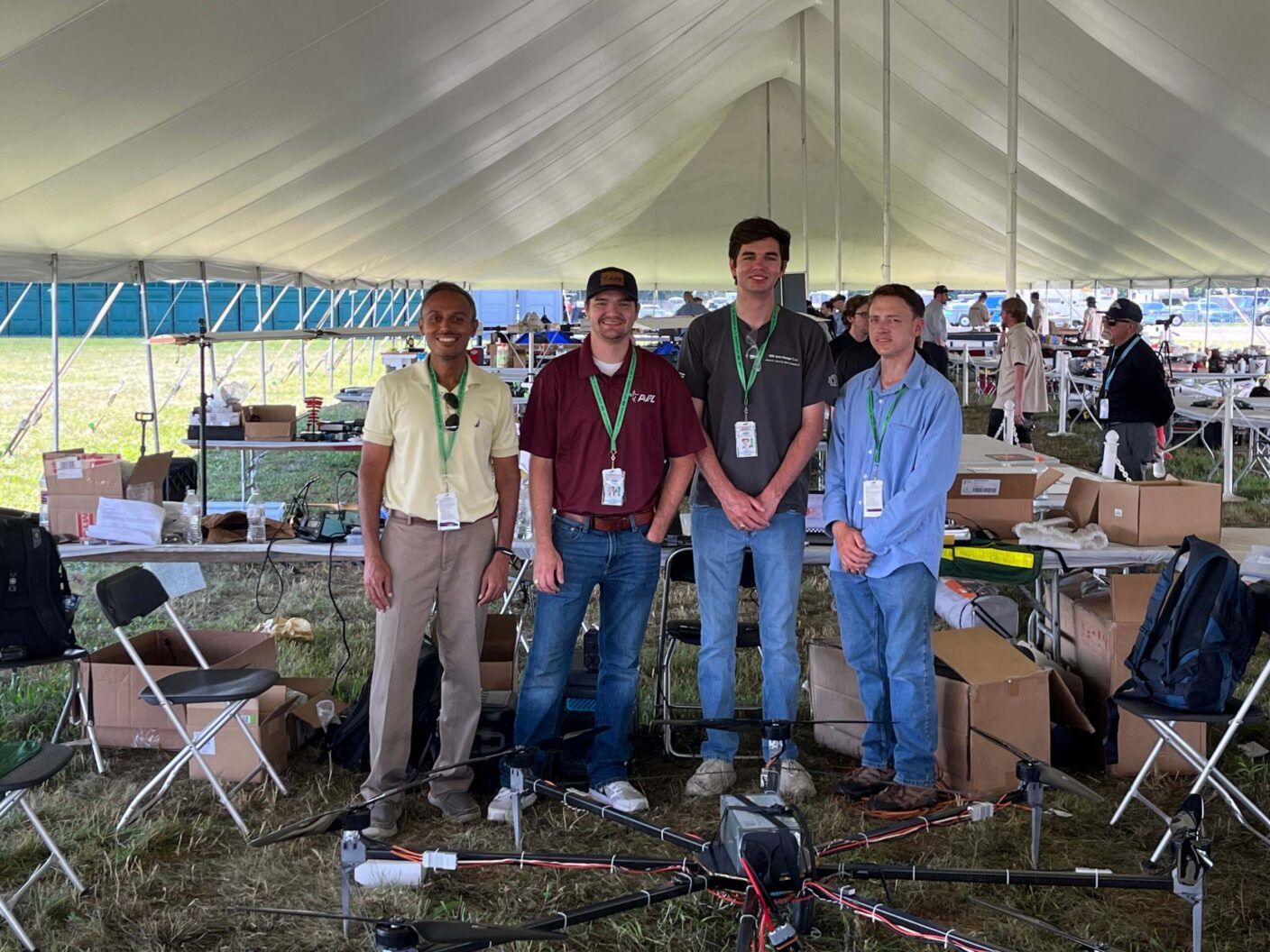
A drone with a six-pound carbon fiber frame, developed by a team of Texas A&M University students, successfully carried 110 pounds at the DARPA Lift Challenge. This achievement placed them among only six teams out of 87 to complete the course.
Led by aerospace engineering professor Dr. Moble Benedict, the Advanced Vertical Flight Laboratory team participated in the Defense Advanced Research Projects Agency (DARPA) Lift Challenge on August 9. The competition, held for the first time this year, saw 480 teams submit concepts, with 110 invited to compete. Ultimately, 87 teams participated in the challenge, which involved carrying as much weight as possible over four nautical miles near the National Museum of the U.S. Air Force in Dayton, Ohio.
The Texas A&M team constructed a 50-pound drone capable of transporting 110 pounds of barbell weights across the designated distance in 12 minutes. The drone's design featured a carbon fiber frame with a central battery, supported by eight arms holding the motors and propellers. Unlike conventional drones assembled with nuts and bolts, this drone was bonded together, resulting in a lightweight frame of just six pounds without the battery.
Dr. Benedict highlighted the significance of creating a drone that could carry more than twice its weight, noting that most current drones achieve only a one-to-one weight ratio. "Allowing a six-pound drone to carry 110 pounds is the main innovation that we are proud of," he stated.
Team member Cayden Brown explained the decision to use a battery as the energy source, despite its heavier weight compared to gas-powered alternatives. "A battery weighs the same at the beginning of the flight as it does at the end," Brown said, emphasizing the need to account for consistent weight throughout the flight.
The team developed five prototypes over eight months, a timeline Dr. Benedict noted is typically much longer. Most of the time was spent on design and virtual simulations, with the actual construction taking only a few weeks.
Looking ahead, the team aims to refine the design further. Dr. Benedict suggested that such drones could enhance disaster relief, package delivery, and surveillance systems. The prototype's material cost is approximately $10,000, potentially making it more accessible than many existing drones.
"We’re very proud of this product," Benedict concluded. "It’s still a prototype, but it has the potential for realistic missions, especially in disaster relief and surveillance."
Source: Carbon Fiber Feed