Biomass carbon from agricultural waste could improve potassium-ion batteries
Researchers at the University of Science and Technology of China have developed carbon nanotubes from distilled grain residues to enhance potassium-ion battery performance.
The increasing demand for electric vehicles, portable electronics, and renewable energy systems is driving the need for more efficient rechargeable batteries. While lithium-ion batteries currently lead the market, their reliance on limited lithium resources has prompted the search for more sustainable alternatives.
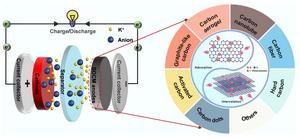
A recent review in Sustainable Carbon Materials explores the potential of potassium-ion batteries, emphasizing the role of carbon materials derived from agricultural residues and biomass in enhancing anode performance. These biomass-derived carbon materials could address the technical challenges of developing stable, high-performance anodes for potassium-ion batteries.
According to Qingang Xiong from the South China University of Technology, "Biomass-derived carbon combines renewable raw materials with structural features that are highly favorable for potassium storage." By analyzing factors such as pore structure and surface chemistry, researchers aim to design improved anodes, moving potassium-ion technology closer to practical application.
Potassium offers advantages over lithium, including greater abundance and the ability to support batteries with competitive voltages and rapid ion transport. These features make potassium-ion batteries appealing for stationary energy storage, where cost-effectiveness and longevity are crucial.
However, the larger size of potassium ions compared to lithium ions can lead to slower reactions and structural damage in conventional anodes, reducing battery capacity and lifespan. Biomass-derived carbon materials, with their large surface areas and porous structures, offer a potential solution by providing additional sites for potassium storage and reducing ion travel distances.
The review examines various biomass-derived carbon anodes, such as activated carbon, graphite-like carbon, carbon aerogels, hard carbon, carbon nanotubes, carbon dots, and carbon fibers. These materials can be sourced from corn husks, rice husks, tea waste, soybeans, cellulose, and more. Some materials have shown strong cycling stability, like graphite-like carbon from tea waste and carbon nanotubes from distilled grain residues, both retaining 94 percent capacity after extensive cycles.
No single material meets all practical requirements. While activated carbon offers extensive potassium-storage surfaces, it may have limited cycling performance. Hard carbon provides structural stability but often has low initial efficiency. Carbon aerogels and nanotubes present attractive properties but face challenges in processing and cost.
The authors discuss production methods such as pyrolysis, hydrothermal treatment, and microwave-assisted carbonization, noting that the chosen method affects pore structure, surface chemistry, and electrochemical performance. Future research priorities include heteroatom doping, balancing potassium adsorption, and improving production processes for carbon aerogels and nanotubes.
The review concludes that scalable, energy-efficient manufacturing is essential for converting low-cost biomass into viable battery materials. By linking renewable feedstocks with advanced energy storage solutions, biomass-derived carbon could reduce reliance on lithium resources while promoting waste utilization.
Source: Carbon Nanotubes Feed