CFRP pipeline repair: a technical guide to structural rehabilitation
A new technical guide details the use of Carbon Fiber Reinforced Polymers (CFRP) for structural rehabilitation in pipeline repair, offering empirical data for design improvements.
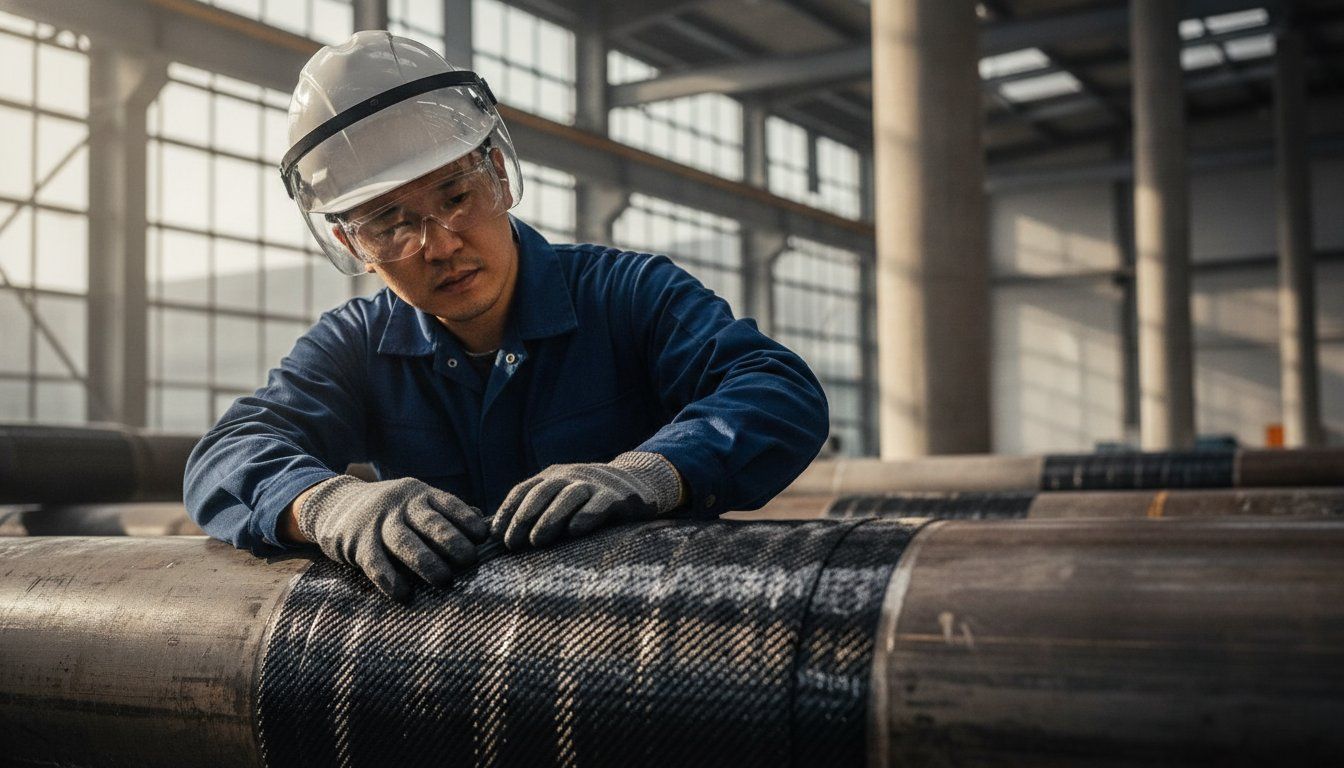
Carbon Fiber Reinforced Polymer (CFRP) pipeline repair systems offer a high-strength, trenchless alternative to traditional excavation methods for restoring structural integrity in aging infrastructure. The Tyfo® Fibrwrap® system exemplifies this approach, providing a solution that adheres to ISO/TS 24817 standards and extends asset life without disrupting service continuity. This guide explores the engineering principles behind CFRP applications, emphasizing their role in maintaining pressure capacity and structural integrity in pipelines.
The United Kingdom's utility and industrial sectors face the challenge of managing a network of legacy pipelines nearing the end of their design life. Corrosion and structural degradation are common in metallic and concrete assets from the mid-20th century. With a projected £718 billion investment in infrastructure by 2026, the focus has shifted to strategic life-extension solutions that minimize community disruption while meeting regulatory standards for asset integrity.
Pipeline degradation often compromises the pressure-bearing capacity of assets, with hoop stress failure being a primary concern. Non-Destructive Testing (NDT) methods like ultrasonic thickness gauging are crucial for assessing these deficiencies. CFRP solutions are designed to restore original design pressures, offering a structural reinforcement that surpasses non-structural liners like CIPP, which lack the tensile modulus required for full capacity restoration.
The financial and social costs of traditional excavation methods are increasingly difficult to justify. CFRP repair techniques reduce project timelines by up to 66% and lower the carbon footprint by avoiding heavy machinery and raw material production. This aligns with the industry's focus on whole-life cost analysis, where repair longevity is weighed against environmental impact and disruption.
CFRP's efficacy lies in the combination of high-modulus carbon fibers and advanced epoxy resins, designed to assume mechanical loads previously carried by the host pipe. The Tyfo® Fibrwrap® system restores hoop and longitudinal strength, with the bond between the composite laminate and substrate being critical for stress transfer. The polymer matrix also provides a barrier against environmental degradation, making CFRP suitable for high-pressure and chemically aggressive environments.
Design methodologies for CFRP systems include stand-alone and composite approaches, both adhering to standards like ISO/TS 24817. These designs account for internal and external loads, ensuring stability under all operational scenarios. The Tyfo® Fibrwrap® system offers a bespoke solution tailored to specific hydraulic and structural requirements, ensuring modern safety factors are met without extensive civil works.
Asset managers must differentiate between non-structural lining and genuine structural reinforcement. CFRP provides a structural solution that maintains the asset's original design pressure capacity, critical for large-diameter pipelines. Unlike slip-lining or CIPP, CFRP systems offer high-strength reinforcement with minimal impact on internal diameter, preserving hydraulic capacity and improving flow characteristics.
CFRP is classified as a fully structural repair under standards like AWWA C305 and ASTM, capable of resisting internal and external loads independently. Its high tensile strength allows for precision in complex geometries, outperforming traditional liners in challenging configurations. The Tyfo® Fibrwrap® system ensures long-term security with a 50-year design life, avoiding the complexities of full replacement.
The installation of CFRP systems requires adherence to technical specifications, beginning with asset isolation and cleaning. Surface preparation is critical for bond integrity, achieved through abrasive blasting or high-pressure water jetting. Moisture and humidity management are essential for epoxy adhesion, with industrial dehumidifiers and heaters often deployed.
Quality control is integral to the installation process, with on-site witness panels and pull-off tests verifying bond strength. This ensures the rehabilitated structure performs as intended for its design life. Composites Construction UK, as the exclusive UK licensee for Tyfo® Fibrwrap® systems, provides end-to-end project management, ensuring design and installation are seamlessly integrated.
A rigorous technical assessment initiates each rehabilitation project, analyzing site-specific data to develop bespoke specifications. Finite Element Analysis (FEA) models the behavior of the composite laminate in complex junctions, ensuring alignment with original design life requirements. Compliance with UK standards is maintained through disciplined quality assurance, ensuring CFRP repairs meet regulatory expectations.
The shift from traditional excavation to composite rehabilitation represents a strategic evolution in asset management. CFRP pipeline repair restores structural integrity while minimizing costs and disruption. The Tyfo® Fibrwrap® system offers a high-strength, thin-profile solution that extends the functional lifespan of infrastructure by up to 50 years. Composites Construction UK provides a comprehensive service, prioritizing engineering rigor and safety, and offering bespoke solutions for complex infrastructure challenges.
Source: Carbon Fiber Feed