École Polytechnique Lab Studies Fermion Parity Using Josephson Effect
Researchers at École Polytechnique are studying fermion parity in a carbon nanotube system using a pair of quantum-dot Josephson junctions.
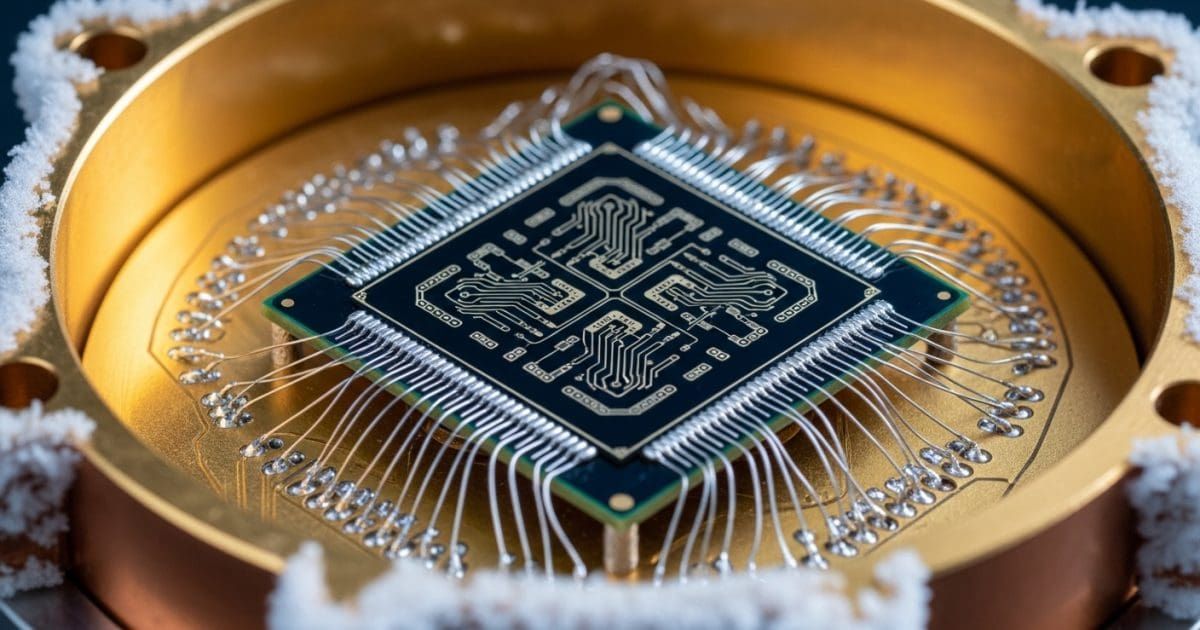
Researchers at École Polytechnique, CNRS have developed a method to detect fermion parity using a carbon nanotube-based Andreev molecule. This approach employs two coupled quantum-dot Josephson junctions to observe delocalized Andreev molecular states, a key step in controlling these systems. Changes in the molecular ground-state parity are identified through phase shifts in the nonlocal response, making global fermion parity an experimentally accessible degree of freedom. This method could be relevant for devices encoding quantum information in delocalized fermionic degrees of freedom, offering a new way to manipulate and read quantum states in hybrid superconducting circuits.
Detecting fermion parity of a superconducting state locally advances quantum information manipulation. Using a uniquely constructed Andreev molecule, researchers show how this fundamental property can be accessed through a nonlocal Josephson effect. The Andreev molecule, made from a carbon nanotube with two coupled quantum-dot Josephson junctions, reveals a pronounced nonlocal Josephson effect. The effect's magnitude is maximized when the molecular wavefunction delocalizes across both junctions, linking parity alteration to a measurable system behavior change.
The study details the creation of Andreev molecules using two coupled quantum-dot Josephson junctions within a carbon nanotube. This delocalization allows for observing a pronounced nonlocal Josephson effect, where supercurrent in one junction is influenced by the phase difference in the other. Changes in the molecule’s ground-state parity are detected through characteristic phase shifts in the nonlocal response, allowing researchers to infer global fermion parity from local measurements. This behavior echoes the transition of a single Josephson quantum dot but manifests in the phase of the nonlocal Josephson signal.
The research focuses on Andreev molecules, created by coupling two Josephson junctions within a nanotube, revealing information about delocalized superconducting states. This approach uses a quasi-one-dimensional platform for investigating complex quantum phenomena. The team observed a pronounced nonlocal Josephson effect, showing that shifts in the nonlocal response echo the transition of a single Josephson quantum dot, appearing in the phase of a nonlocal Josephson signal.
The ability to manipulate and detect fermion parity within quantum systems is moving toward applications in quantum information technologies. The experiment uses a carbon nanotube to create a minimal system where Andreev states hybridize, forming a molecular state sensitive to external control. Observed phase shifts provide a direct link between global fermion parity and local measurements.
Complex superconducting networks exhibit emergent behaviors from Andreev state hybridization. This work, centered around a novel Andreev molecule, moves beyond identifying parity to probing its influence on circuit behavior. The resulting network is a cohesive entity where electron behavior is dictated by the collective state.
Detecting and manipulating fermion parity, a fundamental quantum property, has advanced with Andreev molecules within carbon nanotubes. Researchers have demonstrated a platform for probing this characteristic using two coupled quantum-dot Josephson junctions on a single nanotube. This approach diverges from previous implementations, ensuring a minimal and controllable system. This advancement paves the way for devices that could encode and process quantum information using delocalized fermionic degrees of freedom.
Changes in the parity of delocalized superconducting states manifest as phase shifts within the nonlocal Josephson response, offering a new pathway for probing quantum systems. This nonlocal effect is central to the parity detection scheme, appearing as a phase shift in the nonlocal Josephson signal.
This finding allows for remote detection of a local quantum property. The experimental setup involved a carbon nanotube connecting three superconducting electrodes, allowing precise electrostatic control. The Andreev molecule formed in a pair of coupled Josephson junctions enabled researchers to identify a delocalized fermionic state and demonstrate that global fermionic parity can be inferred locally through transport measurements.
Source: Carbon Nanotubes Feed