Experimental coconut-derived C/CoNi aerogel shows measured electromagnetic properties
Researchers created a carbon nanofiber aerogel from coconut through freeze-drying and high-temperature carbonization.
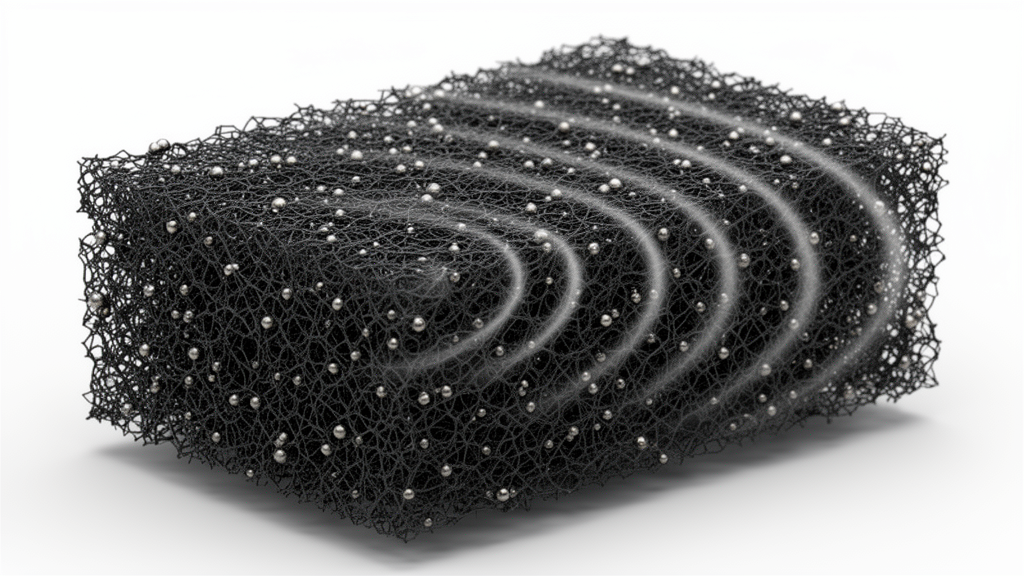
A laboratory study has demonstrated that a composite aerogel, composed of coconut-derived carbon nanofibers and cobalt-nickel alloy nanoparticles, achieved a minimum reflection loss of −39.41 dB at 1.5 mm and an effective absorption bandwidth of 4.58 GHz at 2.0 mm. The study also reports an electromagnetic shielding effectiveness of 24.5 dB and radar-cross-section reduction across various incident angles.
Researchers prepared the material by freeze-drying and carbonizing natural coconut to form a carbon nanofiber aerogel. Cobalt-nickel alloy nanoparticles were grown directly on the fiber surfaces using a hydrothermal process, resulting in the C/CoNi-NA material. Microscopy and related characterization confirmed that the nanoparticles were uniformly anchored to the fibers, and the aerogel's three-dimensional porous structure remained intact. This structure is associated with the material's compressive resilience and fatigue resistance, though quantitative mechanical-test results are not provided.
Electromagnetic characterization indicated that the addition of CoNi increased dielectric polarization and magnetic loss, resulting in synergistic dielectric and magnetic losses. The shielding analysis showed a total shielding effectiveness of 24.5 dB, with absorption shielding effectiveness exceeding reflection shielding effectiveness. The material demonstrated significant radar-cross-section reduction over a wide range of incident angles, though specific angular ranges and numerical values are not detailed.
The findings suggest that coconut-derived C/CoNi-NA is a promising lightweight, elastic material for broadband electromagnetic-wave absorption and electromagnetic-interference shielding. However, this conclusion is based on the abstract of the journal article, as detailed testing conditions, uncertainty estimates, specimen counts, comparative material results, durability-cycle measurements, and application-scale performance are not disclosed in the available text.
Source: Emerging Nano Carbons