Graphene concrete to be used in NC's Outer Banks and coastal infrastructure
Researchers are evaluating graphene-enhanced concrete for infrastructure projects in North Carolina's Outer Banks, comparing its performance to traditional concrete methods.
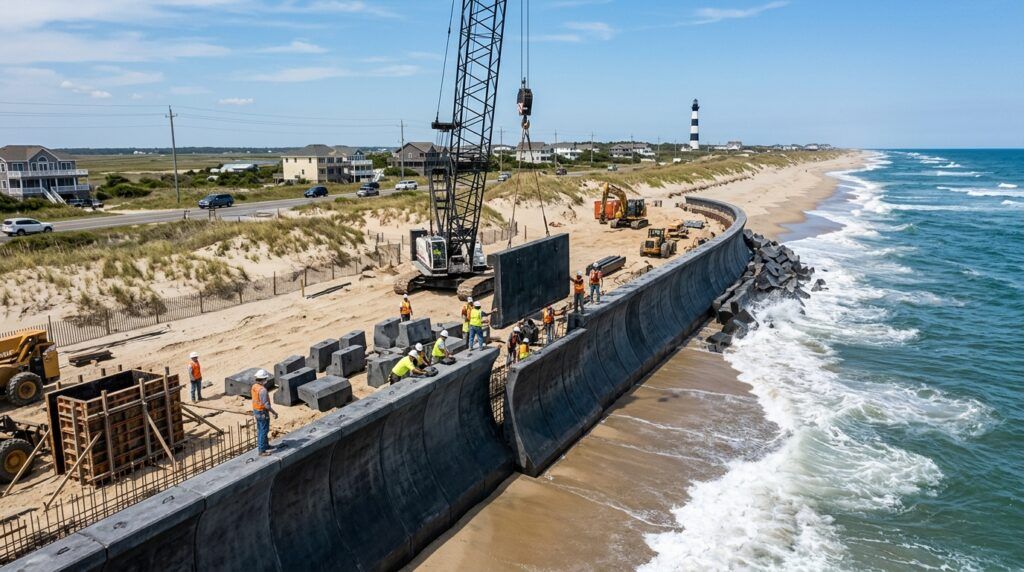
Graphene-enhanced concrete is gaining attention for its potential to improve the durability of infrastructure in North Carolina's Outer Banks, a region notorious for its harsh environmental conditions. The Outer Banks, with its salt-laden air, wind-driven sand, and tidal exposure, presents significant challenges for conventional concrete structures. As such, the search for more resilient materials is critical.
The Outer Banks environment accelerates concrete deterioration through salt penetration, which corrodes reinforcing steel, and abrasive sand, which wears down surfaces. Tidal exposure further exacerbates the issue by cycling concrete through wet and dry conditions, promoting chloride penetration. These factors make the durability of materials a key consideration for infrastructure projects in this area.
Traditional Portland cement concrete (PCC) has been the standard for many North Carolina Department of Transportation (NCDOT) projects. While it is cost-effective and familiar to contractors, its high permeability makes it unsuitable for the coastal environment, where chloride penetration is a significant concern. High-performance concrete (HPC) offers improved durability with lower water-cement ratios and supplementary cementitious materials (SCMs), but it still faces challenges over time in severe exposure conditions.
Graphene concrete offers a promising alternative by incorporating graphene nanoplatelets into the mix. This enhances the concrete's permeability and mechanical properties, making it more resistant to chloride penetration and improving its strength. In coastal and marine environments, where permeability is a primary failure driver, graphene concrete shows potential for extending the service life of infrastructure.
Despite its advantages, graphene concrete is not yet a standard NCDOT specification and requires project-specific documentation and approval. However, its potential for reducing lifecycle costs in coastal applications makes it an attractive option for projects with flexible approval pathways. Combining graphene concrete with corrosion-resistant rebar could further enhance durability by addressing both the concrete matrix and the reinforcement.
For those considering graphene concrete for North Carolina's coastal infrastructure, it is essential to bring third-party testing data to NCDOT materials discussions. This data should address standard performance metrics and specifically relate to the state's coastal exposure conditions. As the technology gains traction, it offers a compelling case for improving the resilience of infrastructure in one of the most challenging environments on the East Coast.
Source: Graphene Feed