Graphene-enhanced biochar membrane improves thermal storage and moisture control
Researchers have created a graphene oxide membrane that enhances the efficiency of isopropanol purification by reducing energy consumption and increasing processing speed.
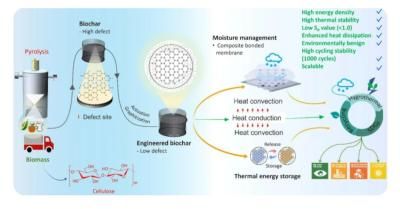
Researchers from Yonsei University, National University of Singapore, and Dankook University have developed a paper membrane that integrates food-waste-derived biochar, graphene, and a phase-change material (PCM) to enhance thermal energy storage, heat transfer, and moisture control. This innovation targets energy-recovery ventilation and other building thermal-management systems.
Phase-change materials are valued for their ability to store thermal energy by absorbing heat during melting and releasing it during solidification. However, traditional PCMs often suffer from low thermal conductivity and leakage issues. To overcome these challenges, the research team carbonized mixed food waste at 400°C to produce biochar, which was then activated with potassium hydroxide at temperatures between 600°C and 800°C. Approximately 1% by weight of graphene was coated onto the biochar using ultrasonication to expand its pore structure and enhance conductivity. The resulting porous carbon was then infiltrated with docosane, a paraffin-based PCM, to form the composite.
The biochar activated at 700°C exhibited optimal performance, with a surface area of 323.1 m2/g and a mesopore proportion of 82.8%, providing sufficient space to contain the PCM and prevent leakage. Incorporating graphene into this engineered biochar increased latent heat storage by up to 72.0% compared to the non-graphitized composite, achieving a phase-change enthalpy of 93.1 J/g at approximately 48.4°C. The composite maintained about 90.2% of its enthalpy after 1,000 heating-cooling cycles, equivalent to an estimated three years of ventilation-system operation.
When bonded to a commercial paper membrane, the composite improved thermal conductivity by 96.1% compared to a pristine reference membrane while retaining 80.2% of the bulk composite's latent heat. Despite the increased conductivity, moisture permeability remained robust, with the membrane meeting ISO 12572 standards and achieving an equivalent air-layer thickness of 0.71, below the 1.0 threshold for permeability.
Professor Sumin Kim of Yonsei University stated, "Our goal was to create a material that does more than simply store heat. By engineering waste-derived biochar and integrating it with graphene and a phase-change material, we were able to combine thermal energy storage, heat transfer, structural stability, and moisture management within a single membrane system."
The researchers present this approach as part of a circular-economy strategy, converting food waste into a functional carbon material while reducing the need for graphene sourced from mined graphite, which poses cost and scalability challenges. Further research is required to assess production energy requirements and techno-economic performance before considering large-scale implementation.
Source: Graphene Feed