Graphene thermal management: films, fibers, composites
Researchers have directly measured the anisotropic thermal properties of micrometer-thick graphene-based films, providing insight into their potential for advanced thermal management applications.
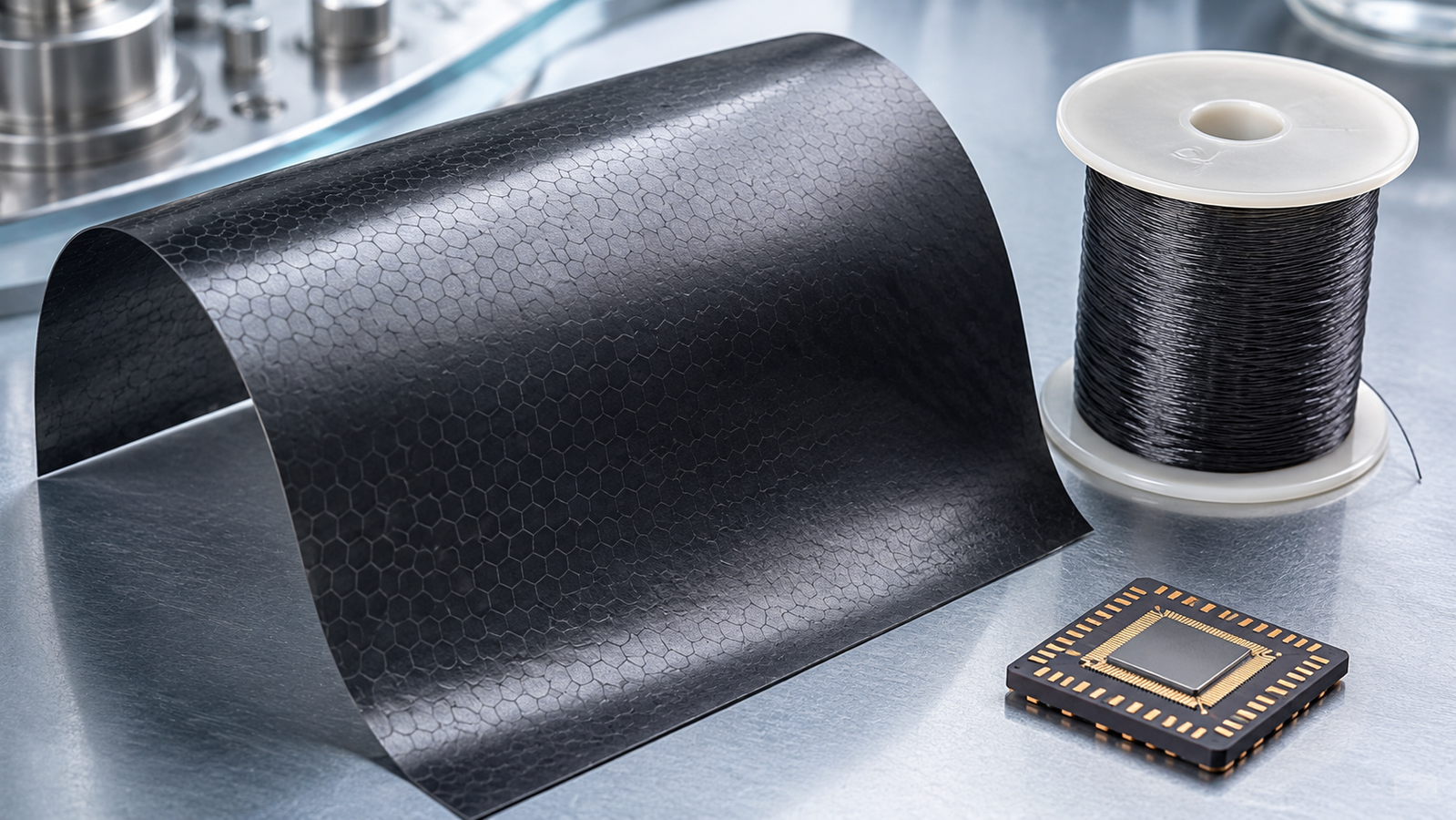
Graphene's exceptional thermal conductivity within its atomic planes makes it a material of interest for thermal management applications. However, its performance varies significantly depending on the direction of heat transport. In-plane, graphene conducts heat efficiently, making it suitable for spreading heat laterally. Conversely, through-plane transport is hindered by weak van der Waals forces between layers, limiting its effectiveness as a thermal-interface material. This article examines the strengths and limitations of graphene in different product forms, including films, fibers, and composites.
Graphene's in-plane thermal conductivity is carried by phonons and can reach values between 4,800–5,300 W·m⁻¹·K⁻¹ at room temperature, surpassing that of copper. This high conductivity is due to the strong bonds within the graphene lattice. However, through-plane transport is much weaker due to the weak interlayer coupling. This anisotropy is a critical factor in engineering decisions, as it affects the material's performance in various applications.
The processing of graphene can influence its thermal properties. In-plane transport benefits from long-wavelength acoustic phonons, but is sensitive to scattering from defects and grain boundaries. Through-plane transport remains limited by the need for phonons to hop across van der Waals gaps. The anisotropy ratio, which measures the difference in conductivity between directions, is a key parameter for optimizing graphene's thermal performance.
Graphene films, typically made from aligned flakes of graphene oxide, can achieve high in-plane conductivity through careful control of flake size, alignment, and defect repair. These films are effective in spreading heat laterally, making them suitable for applications in portable electronics and high-power contexts. However, the through-plane limitation remains a challenge, as heat must still cross the film's interfaces and thickness.
Graphene fibers, produced through wet-spinning of liquid-crystalline graphene oxide dispersions, offer a one-dimensional solution for thermal management. These fibers can achieve high thermal conductivity and mechanical strength along their length, making them suitable for routing heat in flexible paths or in thermally active textiles. The measurement of their thermal properties is straightforward, as fibers are ideal for transient electro-thermal methods.
In composites, the presence of graphene does not automatically confer high thermal conductivity. Interfaces between flakes and the matrix introduce thermal resistance, which can dominate the material's behavior. For instance, graphene aerogels, despite their high intrinsic conductivity, exhibit low effective thermal conductivity due to their structure. This highlights the importance of interfacial engineering in composite design.
Graphene's role as a thermal interface material (TIM) is complex due to its anisotropic properties. While flake-aligned graphene structures are not naturally suited for through-plane heat transfer, vertically aligned architectures and hybrid formulations can be engineered to improve performance. These solutions require careful measurement of through-plane resistance under realistic conditions to validate their effectiveness.
In summary, the use of graphene in thermal management requires a directional approach to measurement and verification. Each product form—whether film, fiber, or composite—must be evaluated based on its specific geometry and application requirements. This ensures that graphene's unique properties are effectively utilized in thermal design.
Source: Graphene Feed