Infrared-heated robot creates stronger carbon fiber composites
Researchers demonstrated improved mechanical properties in carbon fiber-polycarbonate composites using infrared-assisted automated fiber placement, highlighting its potential for semi-structural applications in aerospace and automotive industries.
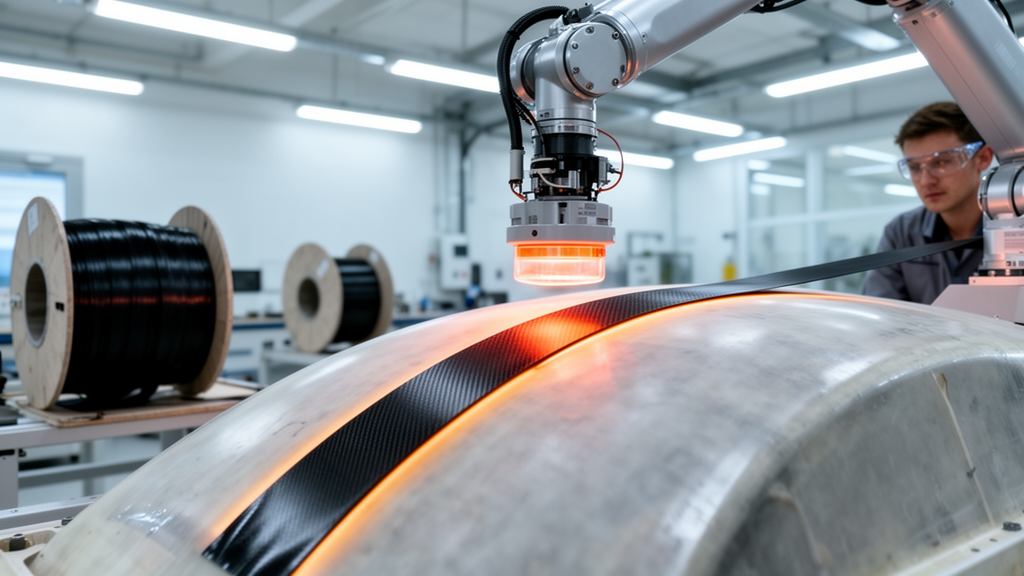
The study explores the use of infrared-assisted automated fiber placement (AFP) for carbon fiber-polycarbonate (CF/PC) thermoplastic composites, emphasizing the unique properties of polycarbonate as an amorphous matrix. Unlike semi-crystalline polymers like PEEK and PPS, polycarbonate softens over a range of temperatures, providing a broader processing window. This characteristic allows for greater tolerance in IR heating systems, accommodating variations in lamp output and robot speed, and reducing crystallinity-related property variations in the laminate.
Infrared heating offers a cost-effective alternative to laser-assisted tape placement and hot-gas torch heating. It provides radiant energy that efficiently couples with the dark surfaces of carbon fiber, minimizing energy loss. This method is particularly suitable for CF/PC, which requires moderate processing temperatures compared to high-temperature matrices.
The study identifies compaction force and tool temperature as critical parameters in the consolidation process. Compaction force influences the mechanical flow of the polymer, while tool temperature affects the thermal boundary conditions. These factors are crucial for achieving strong fusion bonds and minimizing defects such as interlaminar gaps and voids.
The research highlights the use of a 3D-printed polyetherimide mold for AFP, addressing challenges associated with traditional metal tooling. Polyetherimide's high glass transition temperature and low thermal conductivity make it suitable for repeated IR heating, reducing the heat-sink effect during placement. This approach enables rapid, low-cost production of complex shapes, facilitating prototyping and low-volume manufacturing.
The application of CF/PC in drone frames demonstrates its competitiveness in sectors requiring high stiffness-to-weight ratios and moderate mechanical loads. Thermoplastic matrices offer advantages such as weldability, impact resistance, and recyclability, aligning with environmental regulations in automotive and electronics industries.
The study underscores the importance of IR power and robot speed in AFP, with the energy delivered per unit length of tow being a key determinant of matrix viscosity. The findings suggest that extending AFP process knowledge to amorphous matrices like CF/PC can broaden application possibilities beyond aerospace, offering cost-effective solutions for consumer products and ground transportation.
Source: Carbon Fiber Feed