News13 October 2026· Emerging Nano Carbons
Glowing guest molecules boost organic solar cells past 20% efficiency
Emerging Nano CarbonsEnergy GenerationResearch & InnovationSustainability
6 articles on Emerging Nano Carbons in Energy Generation.
Researchers have achieved over 20% efficiency in organic solar cells using fullerene acceptors, which excel at light harvesting.

The Advanced Carbons Council calls for a U.S. carbon materials innovation platform focused on standards, testing and buyer qualification. The paper links engineered-carbon supply chains to manufacturing, energy, defense and AI infrastructure. Serves as a model for governments world-wide.
Sofab Inks' Tinfab modules maintained 87% efficiency after 504 hours in damp-heat conditions, surpassing fullerene-based modules that retained just 74.4%.
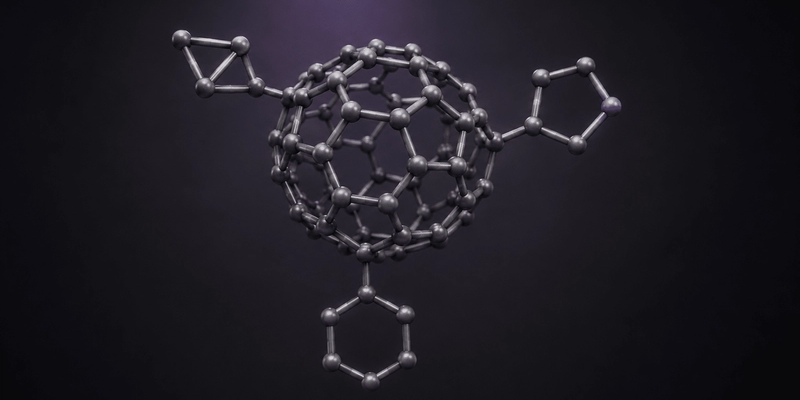
Bingel, Prato and Diels-Alder reactions each attach different groups to the C60 cage, changing solubility, electronic behaviour and how the fullerene organises with neighbouring molecules.
Researchers at City University of Hong Kong reached 20.5% power conversion efficiency in an organic solar cell by recovering normally non-emissive triplet excitons as extractable charge carriers.

Fullerene C60, a cage-like carbon nanomaterial discovered in 1985, is under active research for applications in organic electronics, photovoltaics, lubricants, coatings, biomedical systems, and perovskite/silicon tandem solar cells. Within the advanced carbon materials sector, C60 occupies a distinct niche from fiber- or graphene-based materials, with its electron-accepting properties and molecular tunability driving continued interest in energy and specialty coating applications.