Recycling spin-triplet excitons achieves 20.5% efficiency in organic solar cell
Researchers at City University of Hong Kong reached 20.5% power conversion efficiency in an organic solar cell by recovering normally non-emissive triplet excitons as extractable charge carriers.
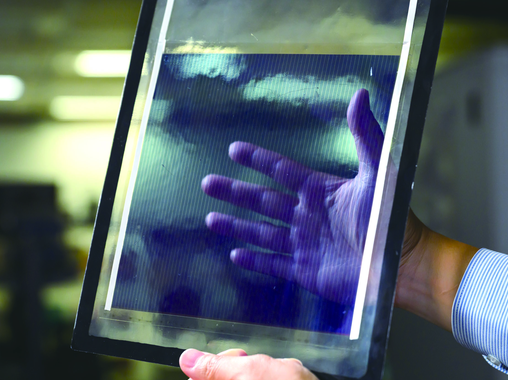
Researchers at City University of Hong Kong have achieved a power conversion efficiency of 20.5% in an organic solar cell by recycling spin-triplet excitons into free charge carriers. This approach addresses energy losses traditionally associated with organic photovoltaics by converting non-emissive triplet excitons into electrons and holes that can be collected at the electrodes, enhancing photocurrent generation.
In organic solar cells, triplet excitons are typically seen as loss channels due to their long lifetimes and spin-forbidden transitions, which hinder charge generation. The City University of Hong Kong team developed a mechanism to convert these excitons into free charge carriers, improving efficiency without affecting the device voltage.
The solar cell incorporates a small-molecule non-fullerene acceptor (NFA) called FTh-4F, known for its strong near-infrared absorption and efficient electron transport. By introducing this acceptor into other organic photovoltaic systems, the researchers managed to recover triplet-mediated losses and enhance efficiency by maximizing extractable photocarriers.
The study also found that free charge carriers last longer than spin-triplet excitons, suggesting that triplet excitons can be recycled into free charge carriers instead of being lost as heat. By optimizing the acceptor’s side-chain structure and exciton delocalization, the researchers reduced the singlet–triplet energy gap, improving triplet exciton dissociation.
Further laboratory experiments have pushed the power conversion efficiency beyond 21%. The research, detailed in "Recycling of spin-triplet excitons in organic photovoltaics" published in Nature, refines the understanding of exciton and charge carrier dynamics in organic optoelectronic devices, potentially enhancing energy utilization efficiency.
Source: Emerging Nano Carbons