Sofab's Tinfab modules outperform fullerene-based controls in 85/85 damp-heat test
Sofab Inks' Tinfab modules maintained 87% efficiency after 504 hours in damp-heat conditions, surpassing fullerene-based modules that retained just 74.4%.
Sofab Inks, a U.S.-based company, has released new stability data for its Tinfab tin-oxide nanoparticle electron transport layer (ETL) ink. The data comes from 85°C / 85% relative humidity (85/85) damp-heat testing of 30 × 30 cm P-I-N perovskite solar modules. Tinfab modules, which are fullerene-free, retained more of their initial efficiency compared to fullerene-based reference modules over approximately 500 hours.
The tests and fabrication of the new sample modules were conducted in collaboration with Alpha Precision Systems (APS), a U.S. provider of slot-die coating systems, vacuum-drying systems, and turnkey solutions for thin-film manufacturing. APS also offers module prototyping services through its affiliated companies.
In one comparison, a module with Tinfab and an ALD-deposited ETL retained 87.0% of its initial efficiency after 504 hours of damp heat, while an APS fullerene standard module retained 74.4%. The Tinfab module's efficiency increased slightly during the first 168 hours, and its lead over the fullerene module grew steadily throughout the test period.
A second set of modules showed similar results. The C60 control module's efficiency dropped to 91.74% at 168 hours, 82.82% at 336 hours, and 75.65% at 504 hours. In contrast, two Tinfab modules performed better, with one retaining 106.12%, 95.93%, and 96.16% efficiency at the same checkpoints, and the other retaining 99.59%, 93.98%, and 89.85%.
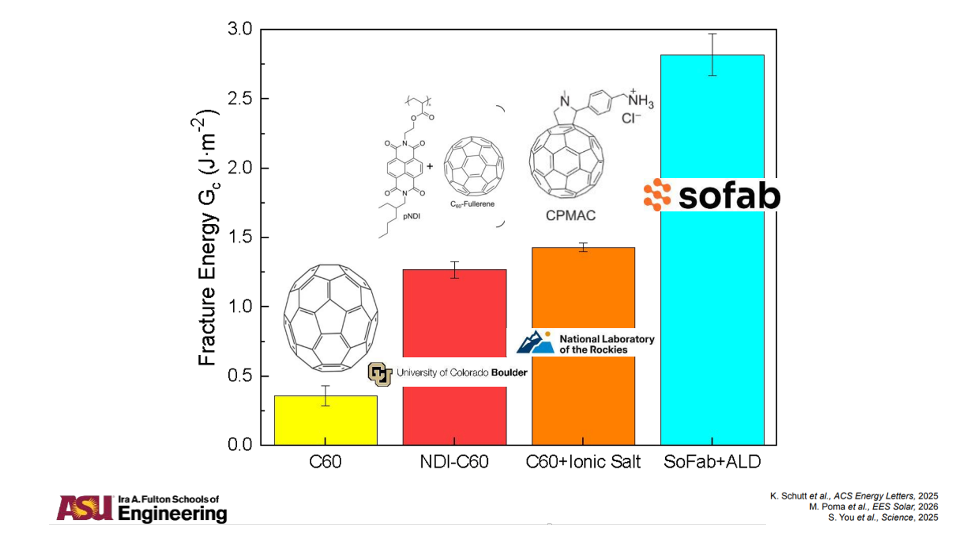
These results support Sofab's argument for replacing C60, the default electron transport material in high-efficiency p-i-n perovskite devices. Sofab identifies the fullerene layer as a significant source of voltage loss and mechanical weakness, leading to delamination in fielded modules. Testing at Arizona State University's Rolston Lab found that Tinfab increased fracture energy by approximately five times compared to fullerene-based layers.
Previously, Sofab Inks and Alpha Precision Systems reported a 22.2% efficient fullerene-free 30 × 30 cm module made on a slot-die coating platform, with one Tinfab module retaining 96% of its initial efficiency after 650 hours of 85/85 testing. Sofab has recently completed a $6 million seed round to support its scale-up toward full-size commercial modules.
Sofab Inks and Alpha Precision Systems will be present at Perovskite Connect 2026. Sofab Inks will exhibit at booth U01, and Alpha Precision Systems at booth U00, at the event on 21-22 October 2026 at the Estrel Convention Center in Berlin.
Source: Emerging Nano Carbons