Engineered carbon is industrial infrastructure: The case for a U.S. carbon materials innovation platform
The Advanced Carbons Council calls for a U.S. carbon materials innovation platform focused on standards, testing and buyer qualification. The paper links engineered-carbon supply chains to manufacturing, energy, defense and AI infrastructure. Serves as a model for governments world-wide.
In 2025, China's operational carbon fiber capacity reached 171,080 metric tons (377 million lb), 52.5% of a global total of 326,080 metric tons (719 million lb). It was the first time a single country had held more than half of world capacity, according to the ATA global market report as summarized by CompositesWorld.1 In the same year the United States mined no natural graphite and imported 100% of the 71,000 metric tons (157 million lb) it consumed, the U.S. Geological Survey (USGS) reports.2 Those two figures sit beside a third. As of Jan. 1, 2025, the U.S. demonstrated coal reserve base stood at about 468 billion short tons (425 billion metric tons), per the U.S. Energy Information Administration (EIA).3
The Advanced Carbons Council (ACC; New Bern, N.C.) holds that these numbers describe a single problem. The country has the feedstock and the science. It lacks the shared testing, standards and application-matching capacity that moves engineered carbons out of the laboratory and into qualified products. This paper sets out the case for a national carbon materials innovation platform and places that platform inside the larger advanced manufacturing base that depends on it.
Why carbon belongs in manufacturing policy
Carbon is not one material. The family ACC's members work with runs from graphite, pitch and petroleum coke through polyacrylonitrile (PAN)- and pitch-based carbon fiber, carbon-carbon (C/C) composites, carbon foams and biochar, to graphene, carbon nanotubes (CNTs), carbon nanofibers and related two-dimensional materials such as MXenes. Few of these reach the market as end products. They sit inside battery anodes, airframes, brake systems, heat spreaders, conductive coatings, semiconductor furnace hardware, concrete and polymer compounds. When supply or qualification of the carbon input fails, the downstream manufacturer carries the cost. Figure 1 maps the ecosystem ACC tracks, from four raw source categories through 20 processing routes to 13 classes of advanced materials and 28 end applications.
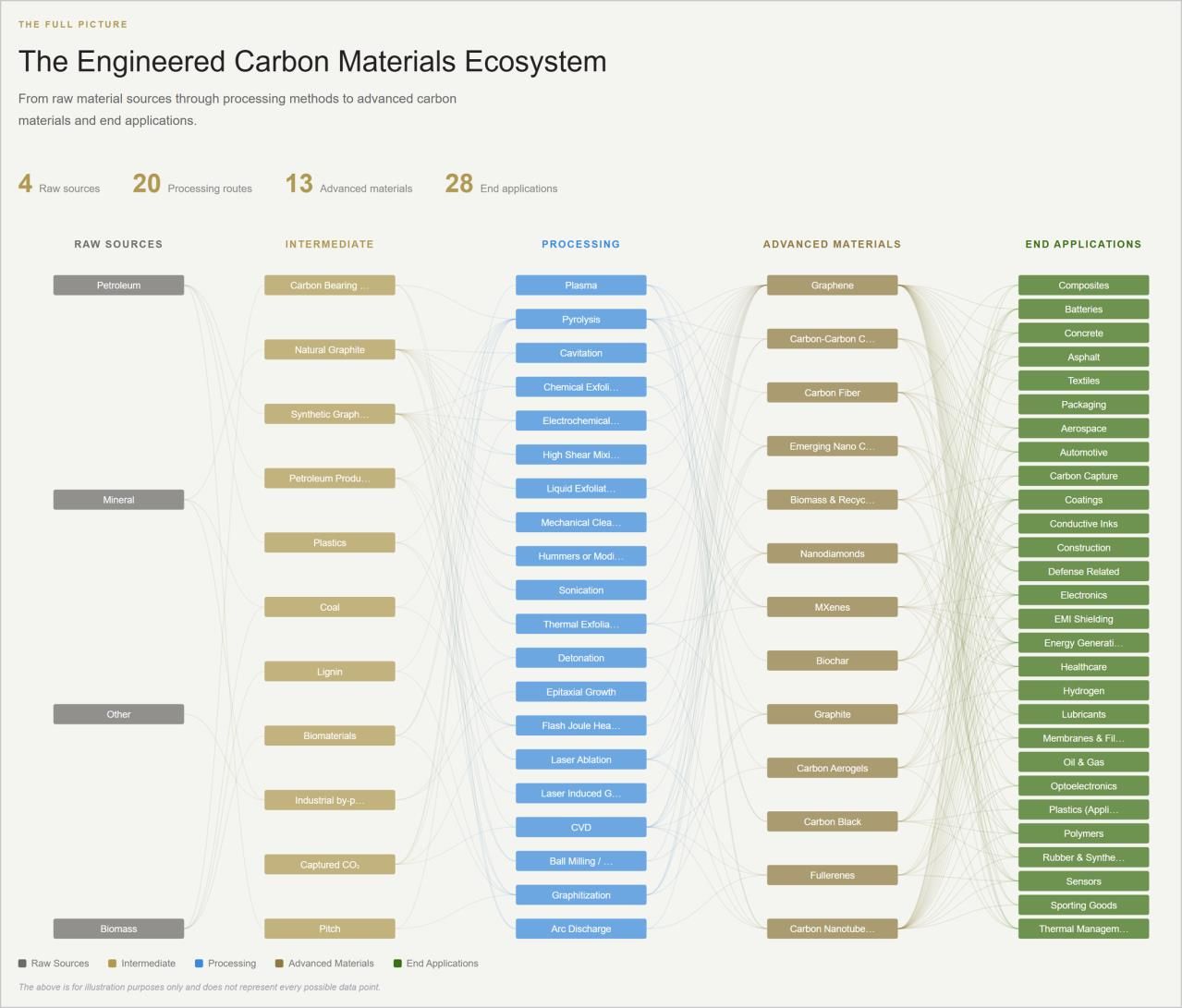
Public discussion of carbon rarely starts there. It starts with emissions. "Governments, business and the general public have to stop looking at 'carbon' as a negative and recognize it as a transformational opportunity," says Terrance Barkan, executive director of the Advanced Carbons Council. "Physical carbon is not just a tool to decarbonize emissions and mitigate harm, it is a valuable resource when engineered and applied across a broad spectrum of applications."
For that reason ACC treats carbon materials as an enabling platform rather than a set of separate commodity markets, with applications in more than 10 sectors, among them energy, transportation, infrastructure, aerospace, healthcare and defense. An advance in dispersion, surface treatment or characterization of a nanocarbon additive can serve a battery maker, a coatings formulator and a composites fabricator at once, provided the data exist in a form each of them can use.
The gap is translation, not discovery
The United States does not lack carbon science. In November 2025 the U.S.-China Economic and Security Review Commission (USCC) reported that China's research and development intensity in new materials still lags that of the United States, Japan and major European countries. Citing an April 2024 South China Morning Post analysis, the Commission noted that new materials had the lowest completion rate of the 10 Made in China 2025 priority sectors.4
The weak point is the distance between a promising result and a purchase order: the move from laboratory demonstration at technology readiness level (TRL) 3 to 4 to market-ready products at TRL 7 to 9. ACC sees three vulnerabilities in that span. Carbon materials rarely advance to industry-standard specifications and performance validation. Domestic coal, biomass and petroleum fractions are underused as feedstocks for advanced carbon products. Application-specific programs in aerospace composites, battery anodes and construction materials develop on their own, so a solution proven in one sector seldom reaches another.
Standards are the most concrete part of the gap. A buyer cannot qualify a graphene powder, a recycled carbon fiber mat or a coal-derived pitch without an agreed way to classify and test it. Since 2013 the ACC team has worked with the American National Standards Institute (ANSI), ASTM International and the International Organization for Standardization (ISO) on industry standards, including publication of the ISO/TS 9651 graphene classification framework. Further standards are in development for biochar, reclaimed and recycled carbon fiber, CNTs, graphene, MXenes and carbon nanofibers. Much of that work has been carried by member and volunteer effort. It is not a substitute for a funded, permanent testing and validation capability.
Hydrocarbons as materials feedstock
The U.S. carbon endowment is broad. Beyond the demonstrated reserve base, recoverable reserves at producing coal mines totaled 10,593 million short tons (9.61 billion metric tons) at the end of 2024, per EIA's Annual Coal Report.3 U.S. refineries produce petroleum coke and the decant oil from which needle coke is made. Needle coke is the preferred precursor for synthetic graphite in lithium-ion battery anodes and in graphite electrodes, and researchers have warned that battery-grade synthetic graphite supply may be constrained unless needle coke output rises or alternate feedstocks are commercialized.5,6 Coal tar pitch serves as both binder and precursor. Natural gas, through methane pyrolysis, can yield solid carbon alongside hydrogen.
Federal agencies have begun to treat these resources as materials inputs. In November 2025 the Department of the Interior added metallurgical coal to the final 2025 List of Critical Minerals, a list that already carries graphite.7 The Department of Energy (DOE) National Energy Technology Laboratory (NETL) runs a Carbon Ore Processing Program that supports laboratory and pilot-scale work on coal-derived carbon fiber, battery graphite, hard carbon for sodium-ion batteries, graphene, quantum dots, nanotubes and building products, all outside coal's traditional thermal and metallurgical roles.8
What is missing is the step after the pilot plant. A coal-derived graphite that performs in a coin cell must still be qualified by a cell maker. A pitch-based fiber must be characterized against the property sets that aerospace and automotive buyers already use. That qualification work is expensive, repeated across companies and poorly suited to any single producer; it is where a shared national platform earns its cost. The present underuse of domestic coal and biomass for advanced materials is lost economic opportunity, and lost employment in the regions that produce them. Selling a ton of coal for combustion and converting a ton into anode material or fiber precursor are different businesses. The second one requires a qualified product.
AI infrastructure runs on carbon
The build-out of AI data centers is usually discussed as a question of power and chips. It is also a materials question. The International Energy Agency (IEA) projects data center electricity consumption roughly doubling from 485 TWh in 2025 to 950 TWh in 2030, with AI-focused facilities growing faster still.9 Much of that load touches carbon. Battery energy storage that firms data center power uses graphite anodes. Servers and chip packages depend on graphite and graphene heat spreaders and thermal interface materials as rack power density rises. Semiconductor crystal growth relies on high-purity isostatic graphite hardware, and grid upgrades draw on carbon fiber composite conductor cores.
Battery graphite is the clearest exposure. IEA's Global Critical Minerals Outlook 2024 projected that more than 90% of battery-grade graphite in 2030 would originate in China.10 USGS data show U.S. imports of graphite battery anode material reaching 43,400 metric tons (95.7 million lb) in the first eight months of 2025, up from 28,100 metric tons (62.0 million lb) in the same period of 2024. China supplied 55%.2
South Korea has already drawn the connection between advanced carbons and thermal management. Its Ministry of Trade, Industry and Resources (MOTIR) launched a Graphene Industrialization Network on July 8, 2026, and released a commercialization roadmap that "begins with addressing heat-management challenges in advanced industries by using graphene's high conductivity."11 "Graphene is a material with the potential to transform advanced industries," said Choi Woo-hyuk, director general for high technology industry at MOTIR. The ministry has said it will support demonstrations and help create initial demand.11
In the United States, no single agency or strategy connects AI infrastructure planning to the materials it will need. "The lack of a coherent national industrial policy or strategy in the US is squandering opportunities to support innovations, like AI, with the advanced materials needed in the real, physical world," Barkan says.
Defense and transportation
Carbon fiber composites form the wings and fuselage of the F-35 and are used in the Air Force Collaborative Combat Aircraft family, the F-47 Next Generation Air Dominance fighter, the Army's Future Long Range Assault Aircraft, missiles and space systems, according to an April 2025 Lexington Institute white paper.12 "Three companies make aerospace-grade carbon fiber. Just one is American," the paper states. It notes that the Department of Defense (DoD) domestic sourcing requirement for PAN and carbon fiber was phased out in 2006.12
The commercial base under those programs has thinned. In early 2026 Teijin Ltd. (Tokyo, Japan) temporarily shut its carbon fiber plant in Greenwood County, S.C., citing slower aerospace recovery and losses tied to competition from Chinese producers. SGL Carbon (Wiesbaden, Germany) closed facilities in the United States and Portugal and discontinued PAN precursor production.1 In 2025 aerospace and defense fiber sold at roughly $80/kg ($36/lb), against about $12/kg ($5.44/lb) for wind energy grades; the segment accounted for 13.4% of carbon fiber demand by volume and 44.1% of revenue.1 Volume markets pay for the capacity that premium markets draw on. A country that gives up the volume tier puts the premium tier at risk.
Hypersonic systems add a further constraint. A Small Business Innovation Research (SBIR) award record for Mantis Composites Inc. (San Luis Obispo, Calif.) states that C/C production capacity "is a known limitation" for hypersonic intercept, decoy and countermeasure solutions, in part because existing suppliers are saturated by offensive weapon programs.13 The National Defense Industrial Association (NDIA) has called for further investment in the production and processing of high-temperature materials, carbon fiber among them.14
In ground transportation the same materials appear in lightweight structures, compressed gas and hydrogen storage tanks, battery enclosures, friction materials and anodes. Recycling belongs in this picture. Carbon fiber composite waste is an underused source of a strategic material, and recycling processes are still underdeveloped and economically challenged.
Competition with China
China's position was built by policy. Made in China 2025 listed new materials among its 10 priority sectors. The USCC reports that Chinese carbon fiber capacity grew from more than 20,000 tons in 2019, 17.3% of global capacity, to roughly 120,000 tons in 2023, and that a facility in Xinjiang is projected to produce 50,000 tons (110 million lb) a year by 2028. China met its goal of more than 10,000 tons of high-quality graphene powder a year by 2021.4 USGS estimates that China produced 82% of the world's natural graphite in 2025.2
Beijing has shown it will use that position. On Oct. 9, 2025, China's Ministry of Commerce (MOFCOM) announced export controls on graphite anode materials, equipment and technology, effective Nov. 8, 2025.15 Following the leaders' meeting in Busan, South Korea, MOFCOM suspended those measures until Nov. 10, 2026.16 The suspension is a pause, not a settlement; the legal framework for the controls remains in place, and the terms are being renegotiated between Washington and Beijing.16,17
Trade remedies have not settled the matter. The U.S. Department of Commerce issued final determinations on Feb. 11, 2026, setting a countervailing duty of 66.68% and an antidumping duty of 93.5% on Chinese active anode material.18 On March 12, 2026, the U.S. International Trade Commission voted 2-1 in the negative, and the duties were not imposed.19 Tariffs can buy time. They do not produce a qualified domestic material, a validated test method or a customer prepared to switch suppliers.
The USCC analysis also carries a caution for China's competitors, and an opening. Scale in capacity has not translated evenly into leadership across new materials, and the Commission reports that Chinese sources themselves describe progress toward the Made in China 2025 materials targets as "lackluster."4 Capacity can be built quickly with subsidy. Qualified adoption in demanding applications takes standards, data and trust between producer and user. That is where the United States and its allies still hold ground they can extend.
What a national platform would do
ACC proposes a United States Center of Excellence for Carbon Technology and Advanced Materials. It should not be a single laboratory whose failure would be a lost investment. It should be a central institute for standardization, testing and the matching of materials to applications, open to all U.S. manufacturers of advanced carbons, including startups. The platform would be driven by market pull rather than technology push, drawing on national assets such as Argonne National Laboratory, Oak Ridge National Laboratory, Rice University and MIT as needed, without permanent institutional integration.
"As a global, science based trade association, the Advanced Carbons Council is the only organization that exists today to help entrepreneurs, investors and other stakeholders to translate research and innovation across the entire spectrum of carbon materials into sustainable commercial success," Barkan says.
The platform should operate as an independent entity, organized as a public benefit corporation, and be led by a full-time executive director with commercialization experience who reports to a multi-sector board drawn from industry, national laboratories, academia and government. Core divisions would cover materials science and engineering, application development, standardization and quality, and business development, supported by a distributed team of national laboratory and university experts who keep their home appointments. The intellectual property (IP) model should let partners keep their background IP, hold platform technologies jointly, give the government purpose rights on publicly funded IP and allow the platform to take equity in startups to offset operating costs.
ACC sees six translational problems that such a platform is suited to address:
- Manufacturing scale-up and process validation. Many nanocarbon innovations stall between pilot production and commercial adoption.
- Material specifications and standards. Graphene, CNTs, recycled carbon fiber, biochar and new coal and petroleum derivatives lack standardized specifications, which blocks industrial adoption.
- Carbon fiber recycling. Composite waste is an underused supply of a strategic material.
- Graphene and nanocarbon application pathways. Properties are well documented; clear routes to commercial use are not.
- Coal- and biomass-derived advanced carbons. Domestic resources remain underused for advanced material production.
- A multi-sector carbon application ecosystem. Solutions developed in aerospace, automotive, energy, construction or defense can move to other sectors only if a mechanism exists to share information and technology.
Recommendations
ACC asks federal policymakers to treat engineered carbon as part of the advanced manufacturing industrial base and proposes the following actions.
- Fund the platform. Establish a national carbon materials innovation platform through a federal science, energy or defense agency, or a combination of them, with sustained, outcome-based funding and industry or philanthropic co-investment as a condition of award.
- Pay for standards and reference testing. Classification, test methods and reference materials for advanced carbons are public goods. Work through ISO, ASTM and ANSI should no longer depend on volunteer time.
- Connect feedstock programs to buyer qualification. DOE coal-to-products and critical minerals awards should include a route to qualification against real application requirements, so that coal-, petroleum- and gas-derived carbons reach customers and not only pilot reports.8
- Use federal demand. Defense and energy procurement can place early, specified orders for domestically produced and qualified carbon materials, much as MOTIR plans to create initial demand for graphene in Korea.11 Congress and DoD should also review whether a domestic sourcing preference for PAN precursor and aerospace carbon fiber should be restored.12
- Count AI infrastructure as a carbon materials customer. Supply chain assessments for data centers, energy storage and grid expansion should include anode graphite, thermal management carbons and composite conductor materials.
- Align standards with allies. Interoperable specifications with Europe, Japan, Korea and other partners widen the market for qualified non-Chinese supply.
A question for every industrial economy
This paper is written for U.S. policymakers, but the argument is not specific to the United States. Any country that intends to compete in advanced manufacturing over the next 5 to 10 years will face the same question. The products that define that competition, among them batteries, data center hardware, aircraft, drones, vehicles and grid equipment, carry engineered carbon inside them.
Several governments and companies are already acting. The European Commission has scheduled a proposal for an Advanced Materials Act for the fourth quarter of 2026, and stakeholders responding to its call for evidence stressed harmonized test methods and collaboration.20,21 South Korea launched its Graphene Industrialization Network in July 2026, and in 2022 it earmarked about 500 billion won ($418.1 million) over four years for carbon materials technology used in aircraft and spacecraft.11,22 Toray Industries (Tokyo, Japan) has outlined a multiyear shift from volume competition toward high-value applications.1 Saudi Aramco (Dhahran, Saudi Arabia) presents its nonmetallic materials work as a way to put the kingdom's hydrocarbon resources to use as materials feedstock, and is working to cut carbon fiber manufacturing cost for mass production by at least 50%.23
The Aramco case is the closest parallel to the U.S. one. A resource-rich economy can export feedstock and import finished materials, or it can build the capability to convert one into the other. Canada, Australia, India and Indonesia face versions of that choice with their coal, graphite, oil, gas and biomass. Economies without large feedstocks, including much of Europe and Japan, face a different form of it: whether they will hold the standards, qualification data and application know-how that decide who counts as a trusted supplier.
In each case, engineered advanced carbons belong in the design of an advanced manufacturing ecosystem, alongside semiconductors, critical minerals and energy. Carbon materials rarely appear on a finished product's specification sheet, which is part of the reason policy overlooks them. They are nonetheless inside most of the products on which industrial competitiveness now depends. ACC's position is that the United States should build a national carbon materials innovation platform now, and that its allies and trading partners should build their own, with standards designed to work across borders.
Source: Advanced Carbons Council