News2 October 2026· Emerging Nano Carbons
Papaya leaves produce nanomaterial that purifies water and fights cancer cells
Emerging Nano CarbonsHealthcareMembranes & FiltrationResearch & InnovationSustainability
8 articles on Emerging Nano Carbons in Healthcare.
Researchers have developed carbon dots from papaya leaves that can purify water and combat cancer cells without needing external dopants.

Researchers used quaternized carbon dots to fully prevent S. aureus biofilm formation at a concentration of 1,000 micrograms per milliliter.
The Advanced Carbons Council calls for a U.S. carbon materials innovation platform focused on standards, testing and buyer qualification. The paper links engineered-carbon supply chains to manufacturing, energy, defense and AI infrastructure. Serves as a model for governments world-wide.
Researchers have developed carbon dots that effectively kill bacteria and break down biofilms, offering a promising tool against superbugs.

Researchers in Houston found that C60-ser, a modified fullerene, reduced brain inflammation and improved spatial memory in mice after cranial radiation therapy.

Researchers examined how proteins bind to charged graphene quantum dots, assessing the impact on toxicity, cellular uptake, and light emission.
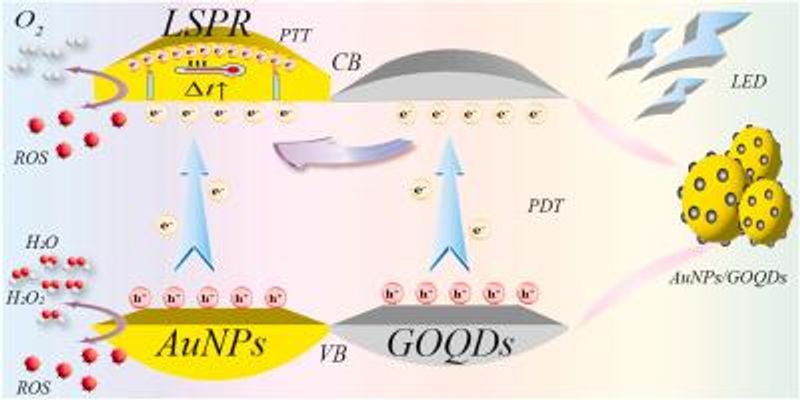
Researchers at Gannan Medical University and Shanghai University developed a gold nanoparticle–graphene oxide quantum dot (AuNPs/GOQDs) Schottky junction nanocomposite that achieved over 97% bacterial eradication in vitro and approximately 99% wound closure in mice within 9 days under 460 nm LED irradiation. The work advances graphene quantum dot applications by demonstrating that pairing GOQDs with AuNPs suppresses charge recombination to boost reactive oxygen species output while simultaneously enhancing photothermal conversion, offering a drug-free pathway to address multidrug-resistant infections.
Fullerene C60, a cage-like carbon nanomaterial discovered in 1985, is under active research for applications in organic electronics, photovoltaics, lubricants, coatings, biomedical systems, and perovskite/silicon tandem solar cells. Within the advanced carbon materials sector, C60 occupies a distinct niche from fiber- or graphene-based materials, with its electron-accepting properties and molecular tunability driving continued interest in energy and specialty coating applications.