Graphene quantum dot gold nanocomposite for drug-free antibacterial wound treatment
Researchers at Gannan Medical University and Shanghai University developed a gold nanoparticle–graphene oxide quantum dot (AuNPs/GOQDs) Schottky junction nanocomposite that achieved over 97% bacterial eradication in vitro and approximately 99% wound closure in mice within 9 days under 460 nm LED irradiation. The work advances graphene quantum dot applications by demonstrating that pairing GOQDs with AuNPs suppresses charge recombination to boost reactive oxygen species output while simultaneously enhancing photothermal conversion, offering a drug-free pathway to address multidrug-resistant infections.
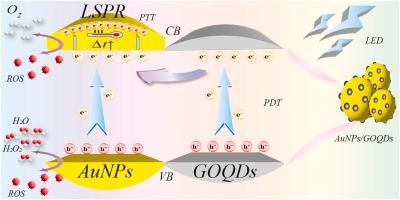
Researchers at Gannan Medical University and Shanghai University have developed a nanocomposite combining graphene oxide quantum dots (GOQDs) with gold nanoparticles (AuNPs) to create a Schottky junction-based system. This innovative approach offers a drug-free method for treating bacterial infections and promoting wound healing without antibiotics.
The rise of multidrug-resistant bacteria due to extensive antibiotic use presents a significant clinical challenge. Traditional methods like increasing antibiotic doses or developing new drugs face issues such as toxicity and resistance. Non-invasive phototherapies, including photodynamic therapy (PDT) and photothermal therapy (PTT), are emerging as alternatives, though they have limitations. The newly engineered nanostructure addresses these by forming a Schottky junction between AuNPs and GOQDs, facilitating directional charge transfer.
Under 460 nm LED light, GOQDs function as semiconducting photosensitizers, generating electron-hole pairs, while AuNPs act as electron sinks. This setup suppresses charge recombination, enhancing reactive oxygen species (ROS) generation. Concurrently, the system boosts photothermal performance, with AuNPs utilizing localized surface plasmon resonance for efficient light absorption and heat conversion. GOQDs add broad optical absorption and high electron mobility, leading to effective light-to-heat conversion and localized hyperthermia, which disrupts bacterial membranes and accelerates cell death.
GOQDs also enhance dispersion stability, biocompatibility, and tissue affinity, ensuring effective biological interactions. Experimentally, the AuNPs/GOQDs nanocomposite showed strong antibacterial activity against both Gram-positive and Gram-negative bacteria, achieving over 97% eradication of Staphylococcus aureus and Escherichia coli under light exposure. Imaging confirmed that ROS generation and photothermal effects caused membrane rupture and bacterial cell death.
In vivo studies in a murine wound infection model demonstrated the nanocomposite's therapeutic potential, achieving approximately 99% wound healing within nine days. This performance significantly surpassed control groups and individual components, with histological analysis showing enhanced tissue regeneration and reduced inflammation.
The integration of AuNPs and GOQDs into a Schottky junction-enabled platform allows for synergistic PDT/PTT using a single light source. By enhancing ROS production, photothermal conversion, and biological interactions, this nanocomposite presents a promising drug-free solution for treating multidrug-resistant infections and aiding wound repair, particularly in complex cases like burns and diabetic ulcers.
Source: Emerging Nano Carbons