New insights into graphene oxide's role in strengthening concrete
Researchers at the University of California at Los Angeles have discovered how graphene oxide (GO) can enhance concrete strength, achieving a more than 20% increase in 28-day compressive strength with just 0.05 wt.% GO dosage. This insight into GO's mechanisms of hydration-seeding and pore-refinement could lead to more effective applications of GO in commercial concrete, optimizing its use for improved structural performance.
Graphene oxide (GO), a nanomaterial, has been studied for its potential to enhance concrete strength. However, results have varied, and the mechanisms behind its strengthening effects were not well understood. Recent research led by the University of California at Los Angeles (UCLA) has provided new insights into these mechanisms, offering guidance for the effective application of GO in commercial concrete.
According to Gaurav Sant, Pritzker Professor of Sustainability at UCLA, the study demonstrates how GO can be used at low dosages to significantly improve concrete strength. The research shows that adding 0.05 wt.% of GO to the binder material can increase concrete's 28-day compressive strength by over 20%.
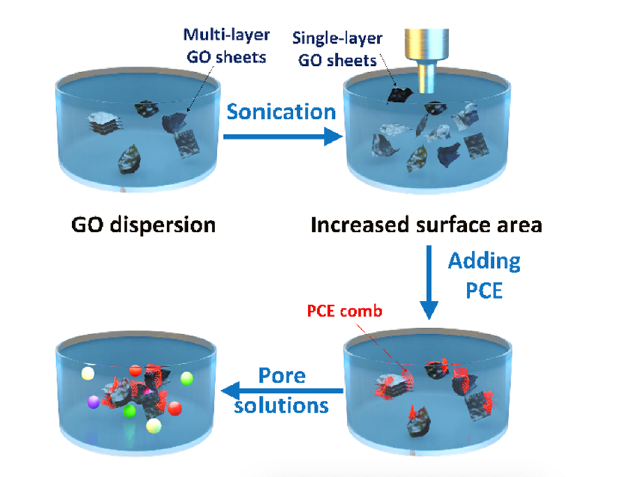
The study examined factors affecting GO's reinforcing effectiveness, such as dosage, physical treatments like sonication, and chemical treatments involving superplasticizers like polycarboxylate ether (PCE). While PCE is traditionally used to enhance concrete workability, it also acts as a surfactant that alters the dispersion of nanomaterials, including GO.
Sant's team found that GO's strength-enhancing effects depend on balancing its hydration-seeding and pore-refinement capabilities. GO's high specific surface area accelerates cement hydration, boosting early-age strength, while its nanoscale dimensions fill pores and densify the microstructure, improving later-age strength.
The dispersion of GO in concrete is influenced by sonication and PCE. Sonication exfoliates multilayer GO sheets into single layers, increasing surface area, while PCE adsorption reduces it. These processes can be optimized to balance hydration-seeding and microstructural densification, maximizing GO's effectiveness at any dosage.
Source: Graphene Feed