New robot without rigid parts moves like an inchworm
Hari Prakash Thanabalan at the University of Gothenburg built an inchworm-inspired soft robot using alternating polymer-carbon electrode layers that expand roughly 10% under low voltage, with no rigid parts, and ran it for four hours daily over four months without performance loss. The use of carbon nanotubes as a protective sheath—allowing the robot to continue functioning after needle punctures—demonstrates a practical structural application of CNTs in soft robotics actuators designed for harsh or remote environments.
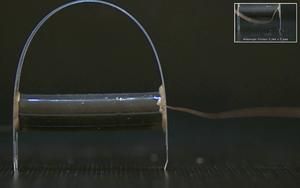
Researchers at the University of Gothenburg have developed a novel robot inspired by the movement of an inchworm, utilizing advanced carbon materials. This soft robot, devoid of rigid parts, employs a polymer-carbon configuration to mimic muscle flexion. The robot's design features alternating layers of carbon electrodes and polymer, which expand when a weak voltage is applied, enabling movement similar to that of a flexing muscle.
Hari Prakash Thanabalan, a researcher at the University of Gothenburg, explains the construction of the artificial muscle. By rolling a five-layer sheet of polymer and carbon into a cylindrical shape, the robot replicates the inchworm's locomotion when subjected to rhythmic voltage changes. A flexible plastic arch connects the ends of the artificial muscle, allowing the robot to move forward on ribbed surfaces.
The robot expands by approximately 10 percent when powered and returns to its original size when the power is off. Thanabalan tested various groove angles on surfaces, consistently achieving perpendicular movement to the grooves. This technology could lead to the development of autonomous robotic crawlers for pipeline inspections, with potential applications extending to challenging environments like Mars.
The robot's motor operates without moving parts, demonstrating durability by maintaining performance over four months of daily testing. Carbon nanotubes protect the robot, providing resistance to external damage and ensuring continued operation even when punctured. This protection also suggests potential resilience against cosmic radiation on Mars.
While further development is necessary, this research marks a step towards nature-inspired soft robots capable of functioning in extreme conditions, potentially paving the way for future exploration missions.
Source: Carbon Nanotubes Feed