Single- and bimetal nitrogen-doped carbon catalysts show promise
Researchers synthesized nitrogen-doped carbon catalysts by pyrolyzing graphitic carbon nitride, glucose, and metal precursors.
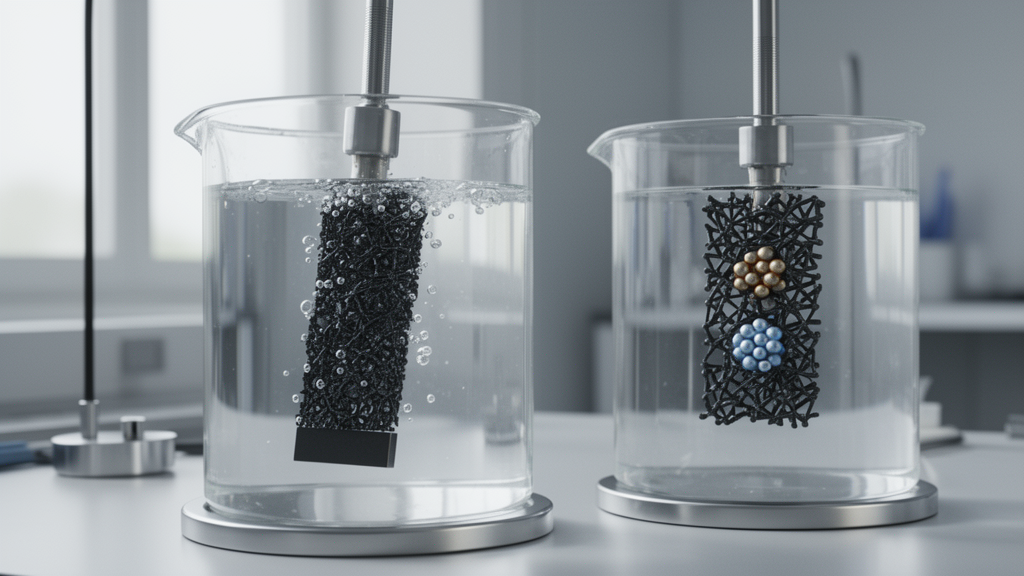
Researchers have developed a series of catalysts using a single pyrolysis process, focusing on iron, nickel, and manganese, as well as nickel–iron and manganese–iron combinations, supported on nitrogen-doped carbon. These catalysts are intended for the oxygen reduction reaction, a process critical to fuel cells and metal–air batteries. In electrochemical tests, the iron-only catalyst Fe/NC and the manganese–iron catalyst MnFe/NC demonstrated the most positive onset potential, reaching 0.900 V versus the reversible hydrogen electrode, nearing the performance of the Pt/C benchmark. This study emphasizes materials synthesis and catalyst characterization rather than application in complete energy devices.
The synthesis method involved pyrolyzing graphitic carbon nitride, glucose, and metal precursors to create nitrogen-doped carbon supports with dispersed metal oxide species. This approach produced three single-metal catalysts—Fe/NC, Ni/NC, and Mn/NC—and two bimetal catalysts, NiFe/NC and MnFe/NC. Characterization confirmed the dispersion of metal oxide species within the nitrogen-doped carbon matrix, supporting the method as an efficient route to a variety of supported catalysts with different metal combinations.
Catalyst performance varied across the series. Fe/NC and MnFe/NC achieved the highest onset potential of 0.900 V, while Mn/NC, NiFe/NC, and Ni/NC recorded onset potentials of 0.873 V, 0.842 V, and 0.800 V, respectively. These potentials indicate the point at which oxygen-reduction activity was observed during electrochemical evaluation. The leading materials approached the Pt/C benchmark, highlighting the influence of catalyst composition on performance.
All synthesized catalysts followed a favorable quasi-four-electron transfer pathway during oxygen reduction. However, the study did not provide detailed reaction intermediates, selectivity measurements, or kinetic parameters, so these findings should be seen as characteristics of the catalyst series rather than a comprehensive mechanistic description. The bimetal catalysts showed excellent durability in the oxygen reduction reaction, with minimal current degradation and stable chronoamperometry profiles, outperforming the single-metal catalysts.
The research highlights two key outcomes: Fe/NC and MnFe/NC delivered the highest onset potentials, while NiFe/NC and MnFe/NC exhibited the strongest durability. The findings, derived from laboratory synthesis, material characterization, and electrochemical testing, do not establish performance in complete fuel cells or metal–air batteries. Nonetheless, the results demonstrate that a straightforward pyrolysis route can yield both single-metal and bimetal catalysts supported on nitrogen-doped carbon with promising activity and stability under the assessed conditions.
Source: Graphite Feed