Tailor-made nanopores: Vienna team shapes white graphene at the atomic scale
Researchers at the University of Vienna have achieved atomic-level control over nanopore shapes in hexagonal boron nitride, using electron irradiation and oxygen to form circular or triangular pores.
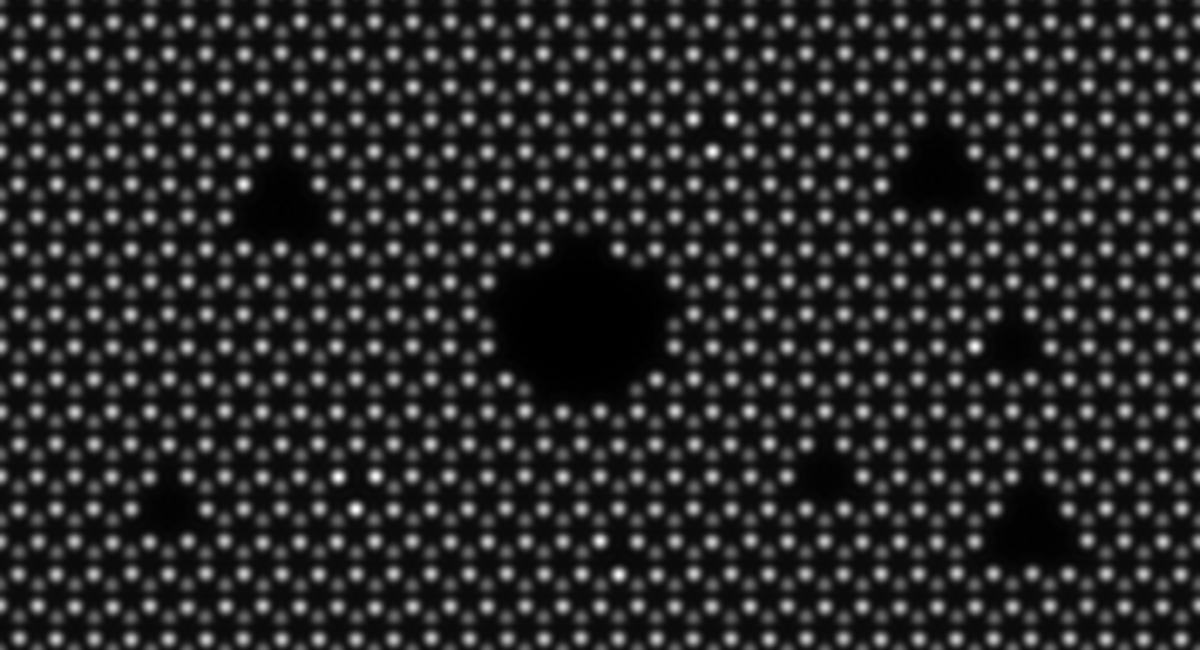
Researchers at the University of Vienna, led by physicist Jani Kotakoski, have developed a method to precisely control the shape of nanopores in hexagonal boron nitride (hBN), also known as 'white graphene'. This insulating material, consisting of a single atomic layer, can be engineered at the atomic level to create nanopores with specific shapes. The study, published in Nature Communications, highlights the potential applications of these engineered nanopores in fields such as filtration, DNA sequencing, catalysis, and quantum technologies.
Hexagonal boron nitride serves as a stable barrier that can protect other two-dimensional materials like graphene. By creating nanopores just a few atoms wide, this barrier becomes permeable, allowing molecules or ions to pass through. The precise shape of these nanopores and the atoms lining their edges are crucial for their interaction with passing molecules. Additionally, due to their small size, these pores exhibit quantum mechanical properties that are beneficial for catalysis and quantum applications.
The team employed electron irradiation in an ultra-high vacuum to create circular pores, while introducing small amounts of oxygen resulted in triangular pores. This process involves using the electron beam of a transmission electron microscope to knock atoms out of the material, forming nanopores. The study found that the pore shape is influenced by the surrounding atmosphere, not just the electron beam. Under ultra-high vacuum, circular pores formed, while the presence of oxygen led to triangular pores with nitrogen-terminated edges.
The research indicates that the electron beam splits molecular oxygen into reactive species, which chemically attack the material. This results in a competition between physics and chemistry: electron 'drilling' favors circular pores, while oxygen-mediated chemical etching favors triangular ones. By adjusting the atmospheric conditions during electron irradiation, researchers can control the pore shape, offering potential for creating atomically precise structures for various applications.
The study is part of the Austrian Science Fund (FWF) Cluster of Excellence 'Materials for Energy Conversion and Storage'. The team aims to use this method to develop new catalytically active structures. The research group includes Umair Javed, Manuel Längle, Vladimír Zobač, Alexander Markevich, Barbara Maria Mayer, Clara Kofler, Martin Paul, Darwin Lorber, Nandhini Ravindran, Clemens Mangler, Toma Susi, and Jani Kotakoski.
Source: Graphene Feed