The future of CFRP pressure vessels: larger sizes, lightweighting, data centers and space
Hexagon Composites has developed larger Type 4 composite pressure vessels utilizing carbon fiber-reinforced polymer (CFRP) to meet increasing demands in data centers and space applications. This advancement in CFRP technology allows for lighter and more efficient storage solutions, crucial for industries requiring high-performance materials.
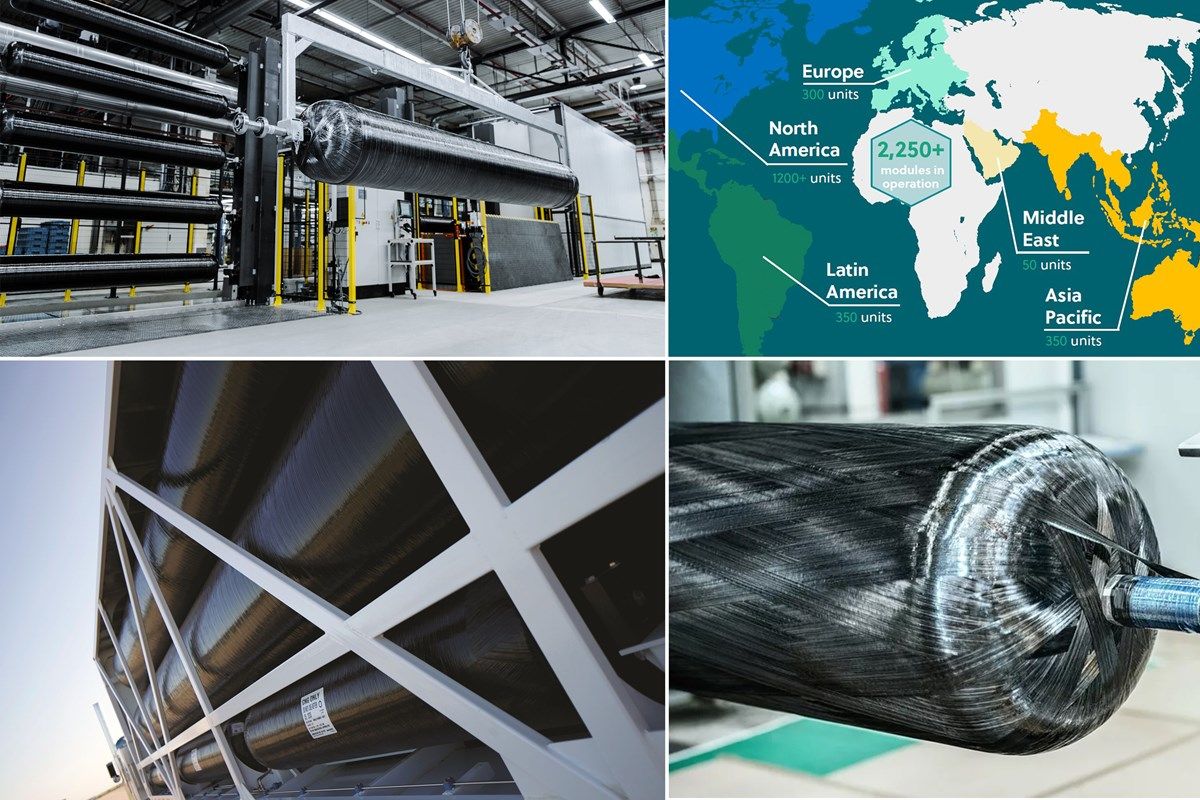
Hexagon Composites ASA, based in Ålesund, Norway, is advancing its technology in carbon fiber-reinforced polymer (CFRP) pressure vessels. These vessels, known as Type 4 composite pressure vessels, are used for the lightweight storage of compressed gases such as natural gas, hydrogen, and helium. The company has introduced its largest commercial Type 4 composite cylinder to date, the Titan 510 Mobile Pipeline, which is designed for high-volume gas applications, including energy supply to data centers.
Hexagon Composites is also re-entering the aerospace market, securing a second order exceeding $5 million for high-pressure tanks intended for space applications. The company is focusing on wet winding versus towpreg techniques, expanding winding capacity, and addressing carbon fiber supply challenges. These efforts aim to support growth in sectors like data centers and space.
The history of Hexagon Composites in Type 4 composite pressure vessels dates back to its acquisition of Raufoss Fuel Systems in 2003 and Lincoln Composites in 2005. Lincoln Composites, with roots in aerospace and defense, has been instrumental in developing advanced manufacturing processes for Hexagon's facilities in Germany and North Carolina. The company pioneered the Mobile Pipeline with the first Titan product in 2010, which led to the development of the virtual pipeline industry.
The Titan 510 Mobile Pipeline modules are designed to maximize payload and improve maneuverability. These modules use thermoplastic composite panels, reducing weight by nearly 2,000 pounds. The design maintains consistent plumbing and connections to facilitate easy interchangeability for customers operating large fleets.
Hexagon Composites is responding to the increasing demand for energy in data centers and industrial sites, driven by the challenges faced by the electrical grid. The Titan 510 and future products are part of this strategy, with customers like Certarus Ltd. using these modules to provide power for data centers.
The company continues to innovate in composite cylinder design, focusing on maximizing payload and manufacturability. Hexagon's expertise in wet filament winding allows for efficient use of carbon fiber, optimizing the speed of production based on tank size and requirements.
Hexagon Composites is a major consumer of carbon fiber for pressure vessels and maintains relationships with leading suppliers to ensure access to high-grade materials. The company is monitoring developments in China as a potential future market for carbon fiber supply.
The company's advanced manufacturing capabilities are exemplified by its facilities in Lincoln, Nebraska, and Kassel, Germany. These sites are equipped with state-of-the-art technology for large-scale filament winding, ready to scale with demand.
Hexagon's expertise in composite pressure vessels extends to the aerospace sector, where the company is addressing the unique challenges of designing tanks for space applications. The focus is on achieving lightweight, high-performance tanks that can withstand the demands of launch and operation in space.
The company's experience across various applications informs its approach to design and manufacturing, ensuring reliable quality and performance in its products.
Source: Carbon Fiber Feed