Tokyo University of Science develops sub-micrometer CNT alignment process
Researchers at Tokyo University of Science have developed a laser processing technique to align carbon nanotubes at the sub-micrometer scale.
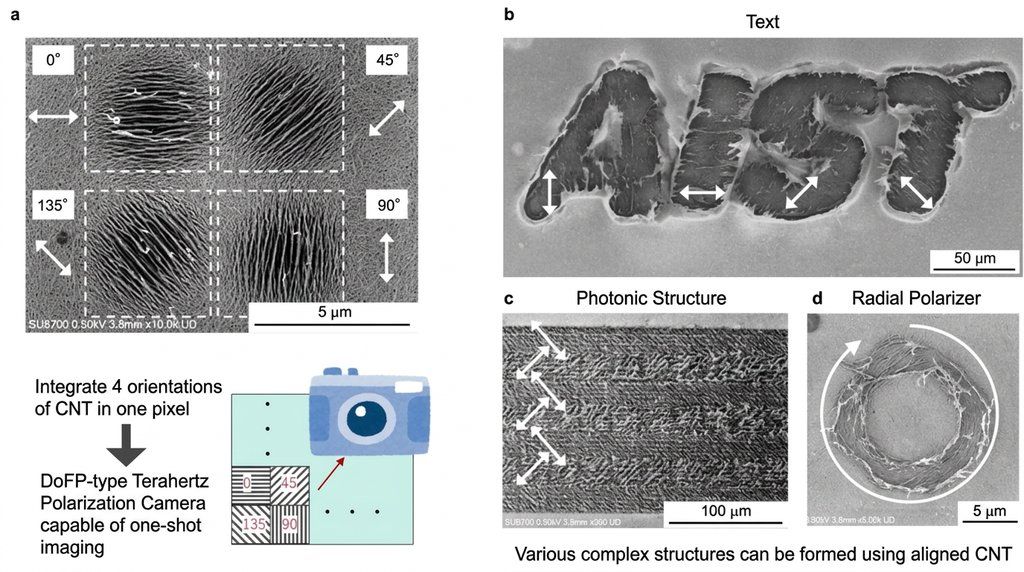
Tokyo University of Science, in collaboration with Japan's National Institute of Advanced Industrial Science and Technology (AIST), Osaka University, and RIKEN, has developed a light-based process to control the alignment of carbon nanotubes (CNTs) in deposited films. This advancement, announced on August 5, utilizes a polarization-controlled ultrashort pulse laser to achieve local alignment of CNTs, enhancing their application potential in next-generation devices.
The research, led by Associate Professor Taishi Nishihara from Tokyo University of Science and Senior Researcher Daichi Suzuki from AIST, involved contributions from Osaka University's Advanced Materials Implementation Research Division and RIKEN's Terahertz Sensing and Imaging Research Team. The findings were published in Nature Communications on August 1.
The new technique addresses the limitations of existing mechanical, chemical, and electrical alignment methods, which typically operate before film formation and are restricted to millimeter-scale regions. By applying the laser post-deposition, the researchers achieved sub-micrometer spatial resolution in CNT alignment, allowing for precise orientation control at targeted points within a film.
This post-processing method employs non-thermal structural processing, or laser ablation, to modify CNT orientation without heat diffusion, ensuring that only irradiated locations are affected. The institutions reported high alignment quality and local control, facilitating the integration of CNT structures with varied orientations on a single chip.
Potential applications of this technology include terahertz polarization image sensors and next-generation logic devices, which benefit from the unique electrical and optical properties of CNTs. These advancements could lead to high-speed, low-power consumption devices, expanding the role of CNTs in semiconductor and sensing research as alternatives to silicon.
AIST, a state-backed research institute in Japan, collaborates with universities and industry to develop applied technologies, underscoring the significance of this research in advancing CNT applications.
Source: Carbon Nanotubes Feed