Unusual superconductivity may emerge in valley-imbalanced rhombohedral graphene
A team from Harvard University and the University of Stuttgart theorized that valley-imbalanced rhombohedral graphene might exhibit unconventional superconductivity, potentially creating a superlattice of Cooper pairs.
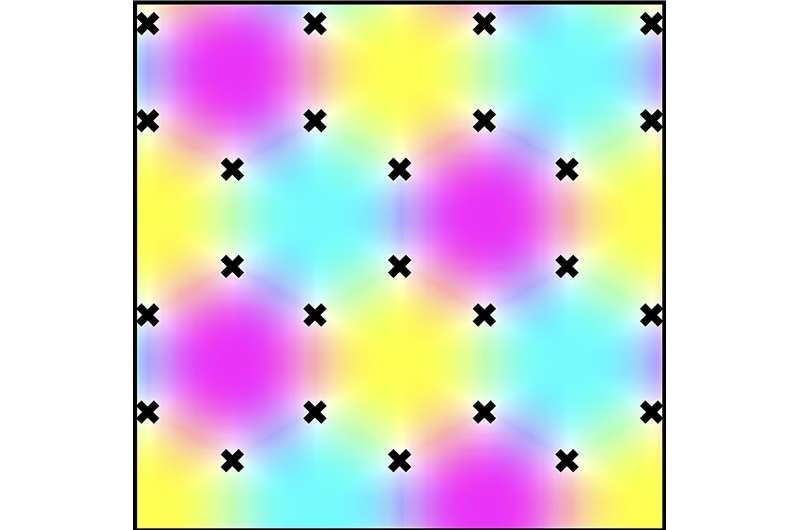
Researchers at Harvard University and the University of Stuttgart have proposed that a unique form of graphene, known as valley-imbalanced rhombohedral tetralayer graphene, could exhibit unconventional superconductivity. Their study, published in Physical Review Letters, highlights the potential for this material to form a superlattice of Cooper pairs, a phenomenon that could advance the development of superconductors capable of operating at higher temperatures.
Superconductors are materials that allow electrical current to flow without resistance, typically at low temperatures. Conventional superconductors achieve this through the pairing of electrons into Cooper pairs. However, some materials, termed unconventional superconductors, display superconductivity under atypical conditions that challenge existing theories.
The research team, including Mathias Scheurer, Maine Christos, and Pietro M. Bonetti, developed a theoretical framework to explore superconducting pairing instabilities in rhombohedral tetralayer graphene. This framework considers electron pairs with nonzero momentum and distinguishes between commensurate and incommensurate states, the latter not aligning with the crystal lattice's periodicity.
The study was inspired by experiments showing superconductivity emerging in rhombohedral graphene, where electrons preferentially occupy one of two valleys, breaking time-reversal symmetry. This symmetry is crucial to superconductivity, and its absence necessitates a reevaluation of theoretical models.
Using numerical and analytical techniques, the researchers explored whether superconductivity could coexist with broken time-reversal symmetry. They found that the superconductor in rhombohedral graphene likely possesses a unique topology influenced by underlying interactions, potentially leading to exotic features and spontaneous translational symmetry breaking.
Chirality, a concept where an object cannot be transformed into its mirror image, is also relevant to superconductors. The team's framework suggests that superconductors from a valley-imbalanced state might develop a vortex lattice without an external magnetic field, a prediction that experimental physicists may soon test.
The study opens avenues for further exploration, including interactions with light and the effects of inhomogeneities like tunnel junctions. These investigations could yield new insights into the properties of superconductivity in valley-imbalanced rhombohedral graphene.
Source: Graphene Feed