Accelerating Climate Action through Megaton and Gigaton Scale Carbon Storage
Yilmaz et al. tested pyrolysis conditions across 45 experiments using five agricultural waste streams—wheat straw, tomato waste, carnation stalks, banana residues, and vineyard prunings—finding that higher temperatures reduce yield but increase stable fixed carbon content, with feedstock type and peak temperature being the dominant variables. For the biochar sector, the results provide feedstock-specific processing parameters that directly inform production decisions where carbon stability and mineral retention are quality targets.
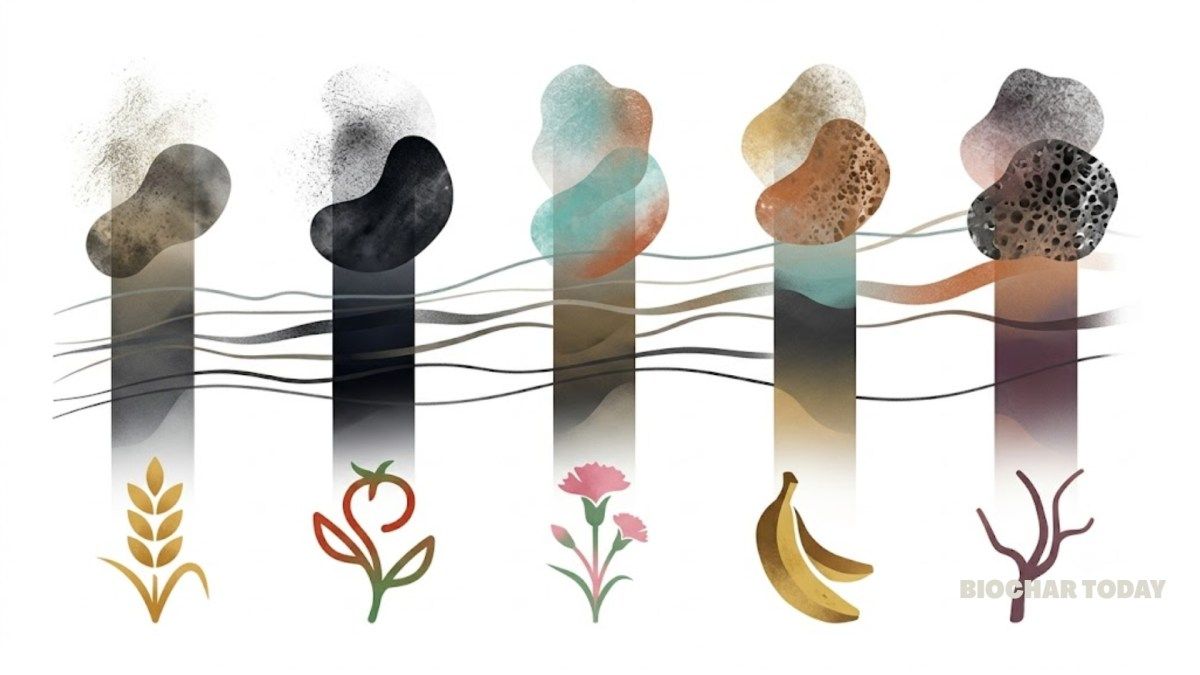
A recent study published in the Journal of Soil Science and Plant Nutrition by Erdem Yilmaz, Hasan Merdun, Moustapha Mahamane Galadima, and İsmail Veli Sezgin explores the optimization of pyrolysis temperatures to enhance fixed carbon and mineral retention in biochar production. The research involved forty-five experiments using five different agricultural waste streams.
The study evaluates how varying processing conditions impact the quality of soil amendments derived from farm waste. Researchers tested wheat straw, tomato waste, carnation stalks, banana residues, and vineyard prunings under different heating levels and speeds. Results indicate that the physical and chemical properties of the resulting char are more influenced by the original plant material and peak processing temperature than by the heating speed. Higher temperatures consistently remove volatile gases, resulting in a stable matrix dominated by permanent carbon structures resistant to decay.
A key finding is the effect of heating on the yield and chemical composition of the final material. As processing temperatures increase, the total weight of recovered charcoal decreases due to moisture and volatile organic matter loss, but the concentration of stable carbon rises significantly. Different agricultural residues respond uniquely to heat, with some materials maintaining a more robust physical framework. Tomato and banana residues processed at higher temperatures show high alkaline values, enhancing their ability to neutralize acidic soils and improve crop growth environments.
The study also highlights changes in nutrient and mineral ash concentration during thermochemical transformation. Chemical analysis shows that essential minerals become concentrated within the solid carbon structure as volatile elements escape. This effect varies by feedstock, with banana and tomato wastes having higher mineral content compared to woodier residues like vineyard prunings and wheat straw. The porous networks in high-temperature charcoal provide excellent structural spaces for water and nutrient retention, preventing nutrient loss during heavy rains and supporting sustainable agricultural production.
Source: Biochar Feed