Anomalous Duffing response in suspended CNT quantum dot at ultrastrong coupling
Researchers measured the Duffing nonlinear mechanical response of a suspended single-wall carbon nanotube quantum dot at 13 mK, extracting an electromechanical coupling ratio g/ωm of 4.0 and observing an anomalous stiffening-spring Duffing parameter near single-electron tunneling regions where softening was theoretically expected. The unexplained sign discrepancy in the nonlinear spring behavior challenges existing models of electron-vibron coupling in carbon nanotube resonators and has implications for the design of CNT-based nanoelectromechanical sensors and qubits operating in the ultrastrong coupling regime.
At cryogenic temperatures, suspended single-wall carbon nanotube (SW-CNT) quantum dots serve as both quantum dots and high-quality factor mechanical resonators. Single-electron tunneling enables an ultrastrong electron-vibron coupling regime, where the coupling parameter exceeds the vibration frequency. Due to high quality factors, a strongly nonlinear Duffing response is observed. This study quantitatively examines the Duffing response parameters of such a device and their relation to Coulomb blockade oscillation. At the edges of single-electron tunneling regions, a local increase in the Duffing parameter, corresponding to a stiffening spring, is noted. The size and scaling of this effect align with single-electron tunneling phenomena, which typically result in softening spring behavior.
The exceptional mechanical and electronic properties of SW-CNTs have made them a preferred material for studying nanoelectromechanical systems at the macromolecular scale. Their low mass, nanoscale size, extreme aspect ratio, and large mechanical quality factors at cryogenic temperatures have been leveraged for ultrasensitive force, mass, and charge sensing. The interaction between single-electron tunneling in a CNT quantum dot and the motion of the CNT has been extensively studied. Strong electron-vibron coupling and nonlinear mechanics of CNTs offer potential for diverse applications, including nano-electromechanical qubits, quantum state transfer, high-precision sensors, sideband cooling and driving, and exploration of fundamental quantum mechanics questions.
This research investigates the mechanical response of a SW-CNT nanomechanical resonator with an embedded quantum dot. The back action of tunneling electrons causes a softening of the mechanical mode, demonstrating ultrastrong coupling between vibration and single-electron tunneling. An electromechanical coupling parameter of g/2π = 2.3 GHz and a coupling ratio of g/ωm = 4.0 place the system deep in the ultrastrong coupling regime. Between the Coulomb oscillations of conductance, a nonlinear Duffing response of the electromechanical system is observed over a wide driving power range. Fitting the jump-down points of the response curve with a backbone equation allows extraction of both linear and nonlinear (Duffing parameter) components of the CNT spring constant.
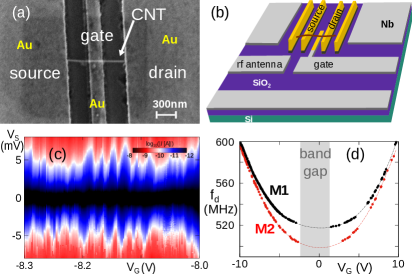
A scanning electron micrograph shows the measured device, where a CNT is grown across the prongs of a quartz tuning fork and transferred onto lithographically defined source and drain titanium/gold contacts. In the region between the contacts, it is suspended over a gate electrode. The measurement was conducted on a combined CNT-coplanar waveguide resonator device, with additional ports serving as a DC gate connection and MHz RF antenna for driving the nanotube into mechanical resonance.
At dilution refrigerator base temperature (T ≃ 13 mK), the CNT exhibits typical quantum dot behavior with moderately disordered Coulomb blockade oscillations. The gate lever arm is estimated as αarm = 0.37 and the charging energy as EC = 9 meV. This results in a gate capacitance CG = 6.7 aF and a total dot capacitance CΣ = 18.1 aF. The CNT is set in motion by a MHz drive signal coupled into the device through the nearby coplanar waveguide. The resulting nanotube oscillation amplitude increases significantly once the drive signal hits the mechanical resonance frequency.
Effective coupling of motion to the charge of single tunneling electrons is essential for many experiments. In Coulomb blockade, where EC ≫ kBT and electron tunneling on single-electron tunneling current peaks occurs much faster than the mechanical oscillation, back action of electronic tunneling causes electrostatic softening, leading to dips in resonance frequency. These dips in the mechanical resonance frequency of the nanotube correspond to the Coulomb oscillations of conductance.
A DC current measurement across three Coulomb oscillations, with a simultaneous RF driving signal applied on the nearby coplanar line, was performed. The measurement was at a low driving power of nominally Pd = −75 dBm at the chip socket, with the objective of observing linear oscillator response. The total DC current at a fixed driving frequency is shown, with the change in DC current as a function of gate voltage and driving frequency displayed. A finite bias VSD = 0.5 mV was required to obtain a mechanical resonance signal, traced by a dotted line as a guide to the eye.
Near the Coulomb blockade oscillations, electrostatic softening of the nanotube spring constant due to back action of tunneling electrons occurs, leading to distinct dips in resonance frequency. The characteristic step in the resonance frequency corresponding to the addition of one elementary charge to the quantum dot is indicated. The functional dependence of the resonance frequency on the time-averaged charge occupation of the quantum dot with gate voltage is well-defined due to separation of time scales.
For modeling the average occupation, a single Lorentz-broadened level coupled via tunnel barriers to Fermi distributions in the leads is used. This constructs a fit function with free parameters as well as the common tunnel rate that follows the evolution of quantum dot average occupation across a single Coulomb oscillation. The fit works well despite the finite applied bias, possibly due to an asymmetry of the tunnel barriers.
A nano-electromechanical system is in ultrastrong electromechanical coupling when its coupling parameter is larger than the mechanical resonance frequency. The coupling is related to the change of the electrochemical potential on the quantum dot. From the fit, a coupling g/2π = 2.3 GHz and a resulting coupling ratio g/(2πfm) = 4.0 is extracted, confirming ultrastrong electromechanical coupling. This is an important prerequisite for advanced nano-electromechanical experiments.
At millikelvin temperatures and increased power of the drive signal, the mechanical response of the nanotube becomes nonlinear for wide ranges of gate voltage. This is illustrated by plotting the DC current as a function of gate voltage and drive frequency across two Coulomb blockade oscillations. The nonlinear artifacts are strong, particularly in the Coulomb blockade regions where the high amplitude branch extends far upwards in frequency, overshadowing the gate voltage dependence of the linear response resonance frequency.
The Duffing equation is widely used in modeling and analyzing oscillating mechanical systems. Its simplest form includes mass, position, driving force amplitude, damping, spring constant, and nonlinearity. The polynomial represents the stiffness of the CNT spring, with the linear response part controlled by the spring constant and the nonlinear part by the Duffing parameter. For a stiffening system, the spring constant is said to be stiffening; conversely, for a softening system, it is softening.
The drop-down point at the edge of the bistability region follows the backbone curve as a function of drive power. A theoretical expression for this curve can be derived, allowing extraction of both the linear spring constant and the Duffing parameter. For the chosen fixed gate voltage, fit parameters are obtained.
The evolution of the electronic and nano-electromechanical system parameters as a function of gate voltage across a Coulomb oscillation is shown. The linear response resonance frequency can be used to calculate the corresponding spring constant. The resulting values are plotted as a consistency test. Reasonable agreement in magnitude and approximate functional behavior is observed.
The Duffing parameter is plotted, with the theoretically expected value of the single-electron tunneling contribution estimated from the linear spring constant. While the absolute value behaves similarly in both evaluations, the difference in sign is a striking deviation. Away from the center of the current peak, the SET contribution to the nonlinear behavior should lead to a softening spring, while the data displays stiffening spring behavior.
Initial publications assumed that SET always dominates the nonlinear response, compared to the non-SET related material nonlinearity which acts stiffening. However, stiffening spring behavior has been observed in experiments at low temperature, with the typical explanation being that material nonlinearity is the dominant contribution. The material-induced nonlinear mechanical response is expected to grow with the tension in the nanotube.
An interplay of both SET and material nonlinearity effects can be considered, but it provides no clear explanation of the growth of the Duffing parameter near the SET current maximum. Further experiments are required to enable a deeper understanding of this phenomenon.
In conclusion, the nonlinear mechanics of a suspended carbon nanotube quantum dot at dilution refrigerator base temperature have been studied. Motion and electron tunneling interactions in this system offer insights into advanced nano-electromechanical applications.
Source: Carbon Nanotubes Feed