Biochar Enhances Carbon Capture in Construction Waste Aggregates
Researchers led by Weizhuo Zhang found that alkali-modified biochar in construction waste aggregates boosts carbon dioxide uptake and increases compressive strength by up to 851% through enhanced carbonation.
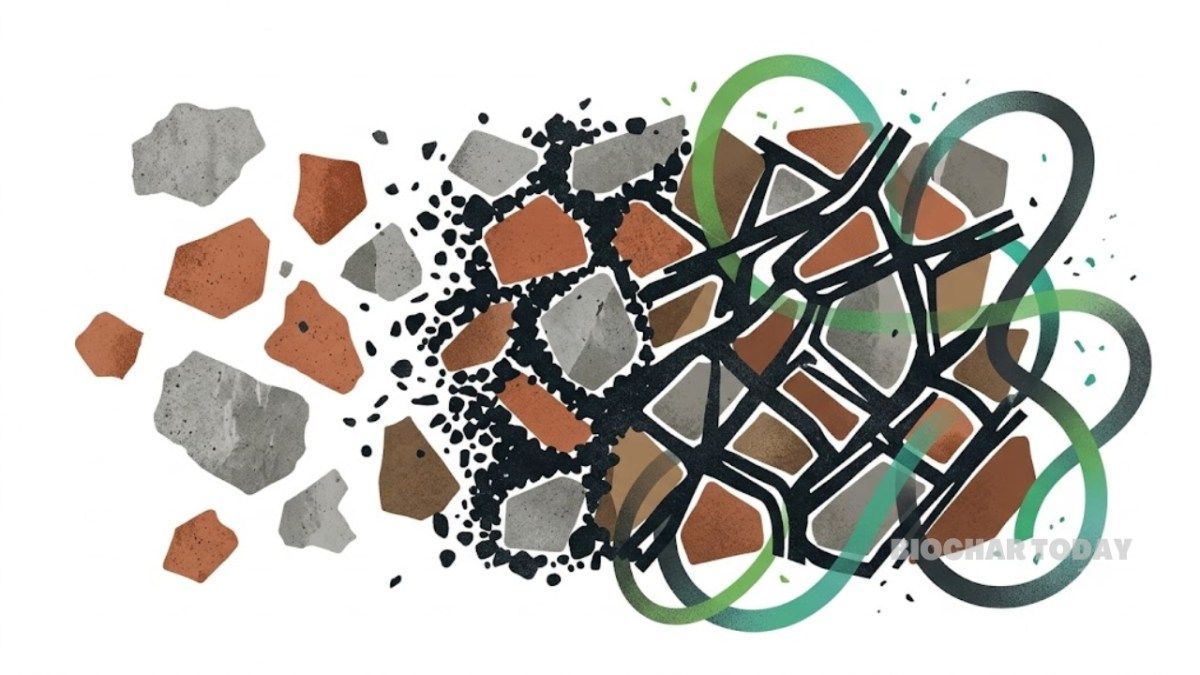
A study published in Green Energy and Resources by Weizhuo Zhang and colleagues highlights the potential of alkali-modified biochar in construction waste aggregates to enhance carbon dioxide capture and improve compressive strength by up to 851% through deeper carbonation.
The research team, including Weizhuo Zhang, Shihao Zhou, Zhenhua Huang, Renjie Niu, Junjie Hu, Yanpu Chen, Zhengdong Wang, Lei Cheng, Guangming Xie, Junyao Liu, and Jun Liu, explored the carbon sequestration capabilities and mechanical properties of concrete waste-biochar aggregates. The study focused on converting low-reactivity construction waste powder, a byproduct of recycled aggregate production, into high-value artificial aggregates using bamboo-derived biochar and carbon dioxide curing treatments.
Construction waste powder, rich in calcium, can bind atmospheric carbon dioxide to form stable calcium carbonate. However, the dense outer carbonate shell formed during carbonation typically hinders gas diffusion, slowing long-term carbonation. To address this, the researchers incorporated 5% biochar into a binder mix of 10% ordinary Portland cement and 90% construction waste powder, evaluating unmodified, water-washed, and alkali-modified biochar treated with sodium hydroxide.
Testing showed that carbonation curing significantly enhanced aggregate performance across all formulations. Accelerated carbon dioxide conditions increased single-particle compressive strength by 117% to 851% compared to uncarbonated samples. While water-washed biochar showed the highest early strength at three days, alkali-modified biochar excelled in long-term performance, achieving the highest strength and density at 28 days.
Carbonation tracking revealed that biochar particles acted as micro-channels for carbon dioxide transport within the aggregate matrix. Aggregates without biochar formed a dense calcium carbonate layer, reducing internal carbon dioxide diffusion and causing a 41% drop in carbonation uptake between 14 and 28 days. In contrast, aggregates with alkali-modified biochar saw only a 2.5% drop, indicating that the porous biochar network mitigated matrix densification and enabled sustained internal carbon sequestration.
Microstructural and chemical analyses using X-ray diffraction and scanning electron microscopy clarified the synergistic mechanism. Bamboo biochar in its raw state retained hydrophobic tar residues that clogged pores. Alkali modification removed this tar layer, exposing the porous structure and enhancing hydrophilicity. The unblocked pores facilitated internal water transport for cement hydration and carbon dioxide diffusion for deep carbonation. Additionally, deprotonated surface functional groups on modified biochar provided nucleation sites for calcium hydroxide crystallization and calcium silicate hydrate gel formation.
The authors concluded that using alkali-modified biochar with construction waste powder offers dual environmental benefits by transforming solid waste into carbon-capturing building materials. These lightweight artificial aggregates sequester 8% to 19% carbon dioxide by weight and achieve crushing strengths up to 6.8 megapascals, paving the way for low-carbon concrete manufacturing and industrial carbon utilization.
Source: Biochar Feed