Effect of T6 heat treatment on microstructure, carbon nanotube dispersion, and defects
Researchers optimized the mechanical properties of thermoplastic polyurethane composites reinforced with multi-walled carbon nanotubes through T6 heat treatment.
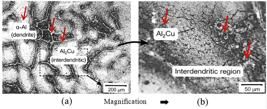
The integration of carbon nanotubes (CNTs) into metallic matrices, particularly in Al-Cu alloys, has shown potential for enhancing mechanical properties through microstructural refinement. This study focuses on the processing and characterization of Al-Cu/CNT nanocomposites, comparing them to the base Al-Cu alloy. Samples were created by casting with multi-walled CNTs added during the semi-solid stage. Results indicate CNTs serve as heterogeneous nucleation sites, leading to grain refinement. Increased CNT content resulted in reduced grain size and increased grain density, improving mechanical strength by approximately 15% in the as-cast condition and up to 35% post T6 heat treatment. Despite porosity and microstructural heterogeneities, hardness increased across all composites, primarily due to Al2Cu intermetallic phase precipitation. Scanning electron microscopy showed CNTs near defects, suggesting involvement in defect formation. Raman spectroscopy revealed changes in the D and G band intensity ratio, indicating structural changes due to mechanical stresses without clear degradation evidence. Reinforcement efficiency is highly dependent on dispersion quality and interfacial bonding.
Microstructural refinement significantly influences the mechanical properties of metallic materials, with grain size reduction linked to increased mechanical strength, as per the Hall–Petch relationship. The use of nucleating agents has been effective in promoting microstructural refinement and enhancing mechanical performance in metallic alloys. Advances in nanotechnology have led to the development of nanocomposites with superior properties.
CNT incorporation into metallic matrices is promising due to their excellent mechanical properties and high specific surface area. CNTs act as nucleating agents and barriers to dislocation motion, enhancing mechanical strength. However, reinforcement effectiveness depends on CNT dispersion and interfacial interaction with the metallic matrix. Homogeneous dispersion can improve strength and ductility, while agglomeration may cause defects like porosity and stress concentrators, compromising performance. Control of the matrix/reinforcement interface remains a key challenge in developing metal matrix nanocomposites.
Aluminum and its alloys, especially the Al-Cu system, are favored in structural applications for their low density and mechanical properties. Adding CNTs to these systems can refine microstructure and enhance strength through load transfer, heterogeneous nucleation, and grain boundary pinning. Heat treatments like T6 are crucial in microstructural evolution, particularly through precipitation hardening with Al2Cu phases. However, the combined effect of CNT addition and T6 heat treatment on microstructural evolution and defect formation in Al-Cu nanocomposites is not fully understood. The interaction between precipitation mechanisms, CNT dispersion, and structural defect formation needs further exploration.
While many studies have examined CNT-reinforced aluminum alloys, most focus on either CNT strengthening mechanisms or T6 heat treatment precipitation phenomena. Few studies integrate microstructural characterization, Raman spectroscopy, defect evolution, and mechanical behavior in cast Al-Cu nanocomposites with semisolid CNT incorporation. This study aims to correlate CNT structural evolution via Raman spectroscopy, microstructural changes from T6 heat treatment, processing-related defect formation, and mechanical behavior in cast Al-Cu nanocomposites.
The study investigates the combined influence of CNT incorporation and T6 heat treatment on microstructural evolution, CNT structural response, defect formation, and mechanical behavior in cast Al-Cu nanocomposites. Emphasis is on correlating grain refinement, precipitation behavior, Raman structural response, and processing-induced defects with mechanical behavior. Optical microscopy, scanning electron microscopy with energy-dispersive spectroscopy, Raman spectroscopy, and hardness measurements provide a comprehensive understanding of processing conditions, microstructural evolution, CNT structural response, defect formation, and mechanical behavior.
The masses of aluminum, copper, and CNTs were determined based on nominal compositions for producing the Al-Cu alloy and CNT-reinforced nanocomposites. Raw materials were weighed using a precision electronic balance, and melting occurred in an electric muffle furnace. Aluminum was melted first, followed by copper, forming the Al-4.6 wt.% Cu alloy matrix. Approximately 300 g of molten alloy was produced, with a representative sample collected for chemical characterization via X-ray fluorescence.
For nanocomposite production, 80 g portions of the alloy were remelted, and multi-walled CNTs were introduced during the semi-solid stage to minimize flotation and promote incorporation. A welding flux protected against oxidation and structural damage to the nanotubes. After reaching the semi-solid state, the mixture was homogenized by mechanical stirring with an alumina-coated tool. This procedure was conducted for CNT concentrations of 0.2% and 0.4% by weight. After solidification, samples were sectioned for microstructural characterization.
Samples were prepared by sequential grinding with abrasive papers and polishing with a 1 μm alumina suspension. Chemical etching with Keller’s reagent revealed the microstructure. Microstructural analyses used optical microscopy and scanning electron microscopy. Raman spectroscopy characterized the nanotubes' structure.
The T6 heat treatment applied to samples involved three stages using resistive furnaces. Samples were solution treated at 530 °C for 3 hours, quenched in water at 70 °C, and subjected to artificial aging at 135 °C for 3 hours to promote controlled precipitation of strengthening phases and microstructural modification.
Average grain size determination followed ASTM E112 procedures using the linear intercept method. Proper metallographic preparation was essential for accurate grain boundary revelation and reliable results. Based on the average intercept length, the ASTM grain size number was determined, and grain density per unit area was calculated using standardized tables.
Microstructural characterization of CNTs and samples used scanning electron microscopy to analyze morphology, nanotube distribution within the metallic matrix, and defect presence. A Vega3 LMU scanning electron microscope with an energy-dispersive spectroscopy detector enabled qualitative chemical composition identification. Analyses were conducted at the Federal Institute of Pará, acquiring high-resolution images for detailed material microstructure evaluation.
Raman spectroscopy characterized CNTs in the Al-4.6%Cu matrix, verifying structural integrity and presence. Raman spectroscopy, based on monochromatic radiation interaction with the material, provides information about molecular vibrations and structure.
Source: Carbon Nanotubes Feed