Entropy facilitates charge separation in one-dimensional semiconductors
Researchers at the Netherlands Lattice Research (NLR) have demonstrated that entropy can facilitate charge separation in single-walled carbon nanotubes (SWCNTs) by attaching a negatively charged dodecaborane structure. This finding could enhance the efficiency of carbon nanotube-based semiconductors, potentially impacting electronics and energy applications.
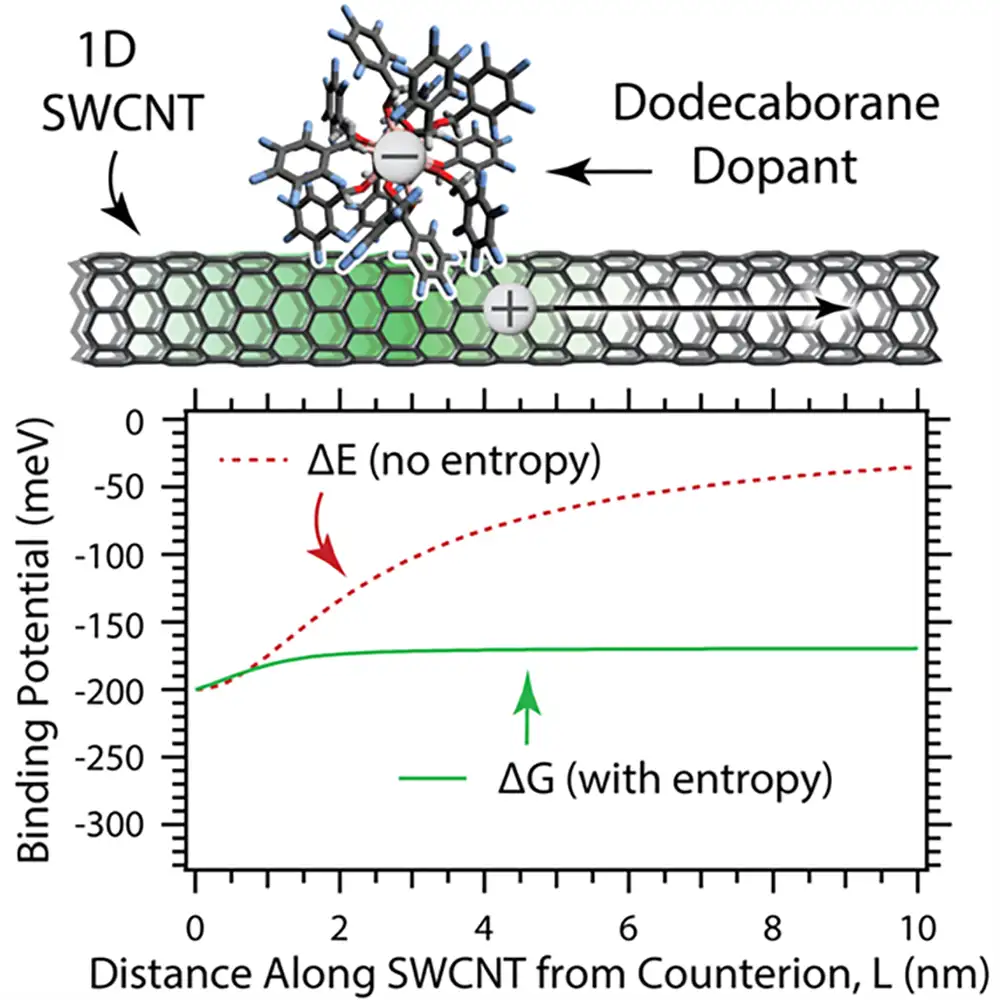
Entropy, a measure of the number of ways a system can organize itself, is crucial in the function of photoelectronic devices, including light-emitting diodes, transistors, and batteries. In organic electronic devices, which utilize polymers or small molecules instead of silicon, entropy aids in the separation of negatively charged electrons and positively charged holes, facilitating effective movement and preventing recombination. This process is essential for optimizing device efficiency, though the role of entropy in charge separation has been debated. Historically, it was believed that entropy did not significantly impact one-dimensional (1D) materials.
Researchers from the National Laboratory of the Rockies (NLR), in collaboration with the University of Colorado Boulder, the University of California, Davis, and the University of California, Los Angeles, have challenged this view. Their study, published in Advanced Materials, demonstrates that entropy can indeed influence charge separation in 1D systems. This research was funded by the U.S. Department of Energy's Office of Science, Basic Energy Sciences Photochemistry and Radiation Chemistry Program, and the Bio-inspired Light-Escalated Chemistry (BioLEC) Energy Frontier Research Center.
The study began with a focus on organic photovoltaics, but its findings apply broadly to organic electronic devices, including organic light-emitting diodes and transistors. Jeff Blackburn, a senior research fellow at NLR, noted that recent efficient devices often incorporate one-dimensional components, prompting a reevaluation of entropy's role in these systems.
The research team found that in practical experiments, where materials interact thermally with their environment, a "constant-temperature" view of entropy is more applicable than the previously used "constant-energy" perspective. Their modeling indicates that entropy can significantly reduce the energy barrier needed for charge separation in 1D systems.
To validate their findings, the team conducted experiments using semiconducting single-walled carbon nanotubes (SWCNTs) with controlled electronic doping. They employed a contactless microwave conductivity technique to measure charge separation, even under conditions where previous models predicted no conductivity. Contrary to these predictions, they observed that positive charges could overcome the electron-hole attraction.
The study also examined the impact of dopant molecule size and shape on conductivity. Bulky, round dopant molecules enhanced conductivity, while compact, planar dopants had minimal effect at low carrier densities. The larger dopants increased the electron-hole distance, reducing attraction and allowing entropy to facilitate charge separation.
These insights provide practical design guidelines for maximizing conductivity in 1D materials through strategic dopant selection. This understanding could enhance the performance of organic electronic devices utilizing 1D materials, enabling better control of charge carriers and optimization of device performance.
Further information on basic energy sciences at NLR and the U.S. Department of Energy's Office of Science Basic Energy Sciences program can be found in the article “Revisiting the Role of Entropy for Charge Separation in 1D Pi-Conjugated Semiconductors,” published in Advanced Materials.
Source: Carbon Nanotubes Feed