Exciton binding energies in carbon nanotubes from two-photon photoluminescence
Researchers identified distinct excitonic states in single-walled carbon nanotubes using one- and two-photon luminescence excitation spectroscopy.
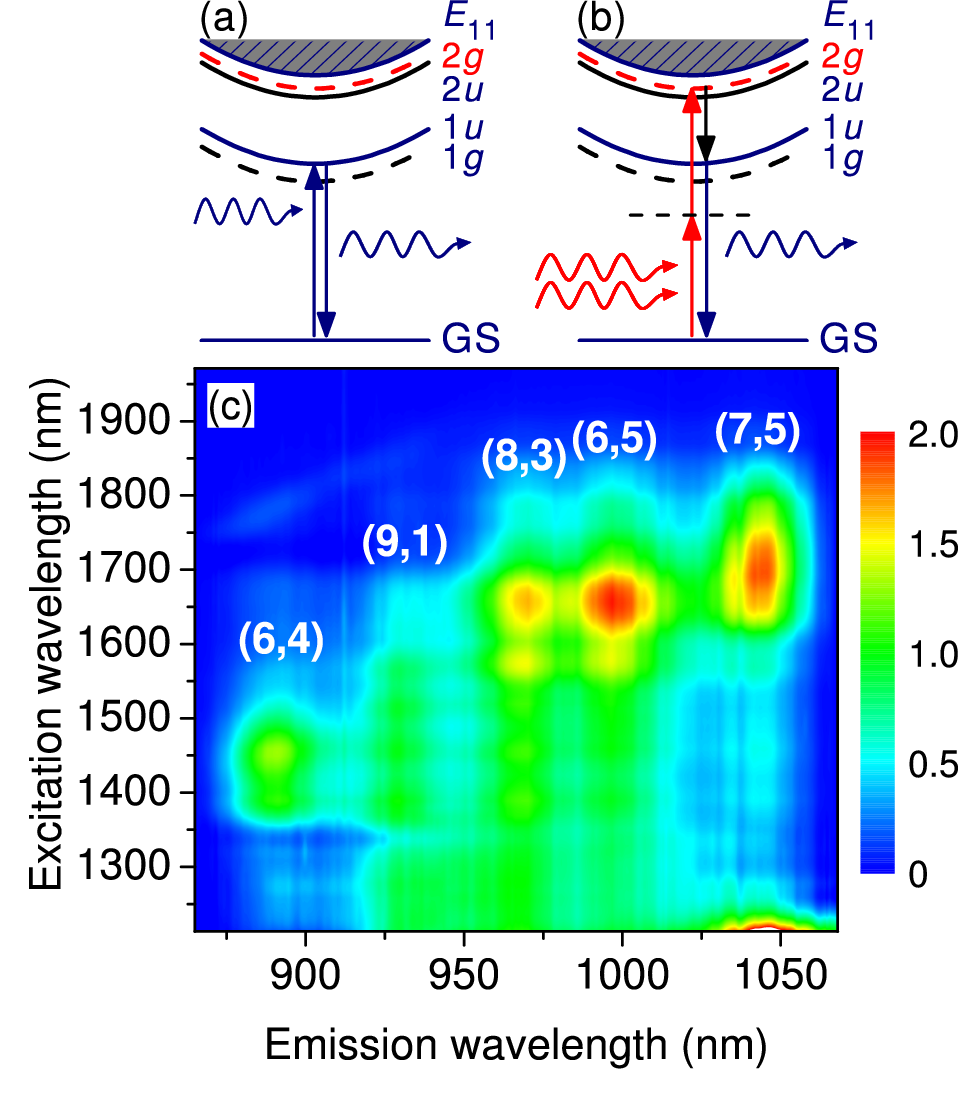
Recent studies using one- and two-photon luminescence excitation spectroscopy have identified distinct excitonic states in single-walled carbon nanotubes. The energy difference between one- and two-photon-active exciton states, which have different wavefunction symmetries, serves as a key indicator of excitonic interactions in these nanotubes. Exciton binding energies were determined to be between 0.3 and 0.4 eV for nanotubes with diameters ranging from 6.8 Å to 9.0 Å. These findings, supported by ab-initio calculations of the optical spectra, confirm that the elementary optical excitations in carbon nanotubes are strongly Coulomb-correlated electron-hole pairs, which remain stable even at room temperature. This discovery enhances our understanding of the electronic structure and Coulomb interactions within carbon nanotubes, impacting the optical and transport properties of nanotube-based devices.
Single-walled carbon nanotubes exhibit unique geometric, electronic, and optical properties, making them promising candidates for applications such as nanoscale field-effect transistors and nanosensing. Historically, their optical properties were underexplored due to photoluminescence quenching in nanotube bundles. However, the discovery of band-gap luminescence in individual tubes has allowed for direct optical property studies.
Traditionally, nanotube optical spectra have been interpreted through single-particle excitations, influenced by van-Hove singularities in the density of states. Recent theoretical work suggests that excitonic effects, resulting from Coulomb interactions between excited electrons and holes, significantly affect transition frequencies and optical spectra shapes. Due to quantum confinement, large exciton binding energies are anticipated, though calculated values vary widely. Resolving these discrepancies is crucial, as Coulomb correlation strength affects electronic state ordering and the correlation between optical and structural properties.
Experimental evidence for excitonic correlations in nanotubes has been indirect, with absorption and emission energies differing from single-particle predictions. Ultrafast intersubband relaxation times also support the exciton model. Direct experimental proof, particularly of exciton binding energies, has been lacking until now. This study directly identifies exciton binding effects in single-walled carbon nanotubes through one- and two-photon luminescence, determining binding energies of 300 to 400 meV.
The experiment validates the excitonic character of optical excitations in carbon nanotubes by addressing excitonic states with different wave function symmetries. In one-photon spectroscopy, transitions to excitonic states with odd symmetry are expected, while two-photon spectroscopy couples to optically inactive even states. The energy splitting between observed states indicates the strength of Coulomb correlations, making two-photon absorption a valuable technique for determining excitonic effects.
Single-walled carbon nanotubes were suspended in D2O and excited at room temperature with 150 fs pulses from an optical parametric oscillator. Luminescence was recorded, identifying emissions from various nanotube species. The photoluminescence for excitation below the band gap revealed maxima in luminescence intensity, attributed to resonant two-photon excitation of the lowest two-photon allowed exciton state. The energy shift between exciton states signifies excitonic absorption and emission at room temperature, with binding energies nearly one-fourth of the band-gap energy.
Power dependence analysis of emission intensity supports the two-photon absorption assignment. Two-photon photoluminescence excitation spectra for different nanotube species show emission intensity as a function of energy difference between excitation and emission energy. For instance, the (7,5) tube shows a resonance maximum 240 meV above the one-photon active state.
The energy splitting allows for exciton binding energy estimation using a two-dimensional hydrogen model. A variational model for electron-hole interactions on a cylindrical surface provides a better description, yielding a binding energy of 0.31 eV for the (7,5) tube.
First-principles calculations of excited states using density functional theory in the GW approximation further our understanding of excitonic states in carbon nanotubes. These calculations predict bound exciton states with binding energies consistent with experimental observations. The electron-hole interaction significantly affects the energy difference between two-photon and one-photon active states, aligning well with measured values.
Source: Carbon Nanotubes Feed