Graphene device measures fractional electric charges in quantum physics
Researchers at EPFL developed a graphene device to measure fractional electric charges in quasiparticles during the quantum Hall effect, revealing charges of one-third and two-thirds of an electron.
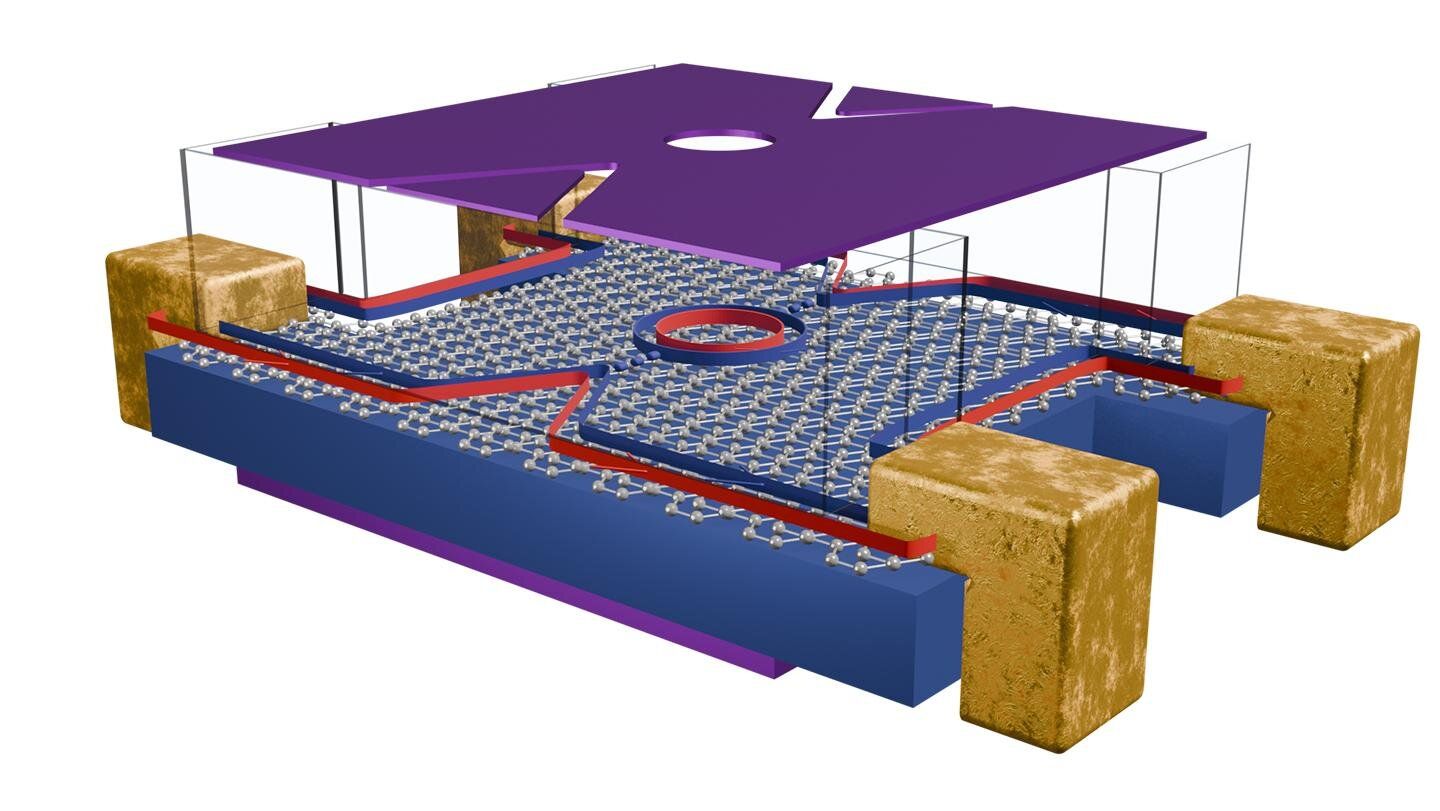
Researchers at Ecole Polytechnique Federale de Lausanne (EPFL) have developed a graphene-based device capable of measuring fractional electric charges carried by quasiparticles. These quasiparticles emerge under extreme conditions, such as the quantum Hall effect, where electrons confined to two dimensions in a strong magnetic field at low temperatures form ordered quantum states. The new device, constructed from bilayer graphene, simplifies the study of these phenomena by acting as a sensitive charge meter.
The device utilizes bilayer graphene, a material composed of two layers of carbon atoms, and features an antidot created using electrical gates. Quasiparticles move around this energy hill in defined paths, and changes in the magnetic field or gate voltage cause them to tunnel across the device, producing oscillations in the electrical signal. By analyzing these oscillations, researchers can determine the quasiparticles' charge.
The team, led by Professor Mitali Banerjee, observed quasiparticles with fractional charges at various quantum Hall states, including charges of one-third, two-thirds, and three-fifths of an electron. These findings, published in Nature Physics, provide insights into the behavior of topological quantum matter, a class of materials with properties derived from the collective behavior of particles.
The study also noted unusual behavior in the 8/3 quantum Hall state, where the device detected charges of one-third and two-thirds of an electron. This anomaly may be due to different edge structures or tunneling mechanisms. Such fractionally charged quasiparticles are crucial for understanding quantum mechanics and exploring future quantum technologies.
The antidot design offers a practical and tunable method for investigating exotic quantum states, potentially serving as a building block for topological quantum computers. The researchers propose that this approach could be extended to other two-dimensional materials, broadening the scope of quantum state studies.
Source: Graphene Feed