Graphene from used sensors can be reprinted five times without losing performance
Researchers have demonstrated that few-layer graphene recovered from used sensors can be reprinted up to five times without losing performance.
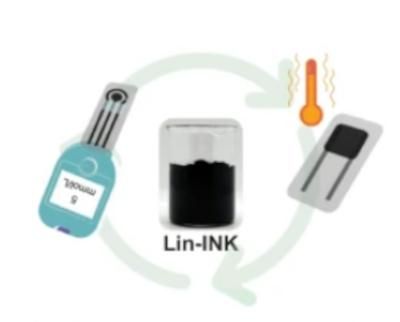
Silicon Austria Labs (SAL) and École Polytechnique Fédérale de Lausanne (EPFL) have developed a recyclable graphene nanoplatelet (GNP) ink that can be reused multiple times without performance degradation. The ink, which is surfactant-free, utilizes linalool, a naturally occurring terpene alcohol, as its solvent and ethyl cellulose as its binder. Researchers successfully printed electrochemical sensors with this ink, dismantled them post-use, and recovered over 93% of the graphene, solvent, and PET substrate. The recycled materials were then used to print new devices, maintaining performance across five recycling cycles.
The closed-loop recycling system enables the reuse of materials to print new sensors and heaters. This approach contrasts with traditional conductive inks that rely on petrochemical solvents like NMP and DMF, which are often carcinogenic or toxic. Previous recycling methods for printed electronics typically involved corrosive solvents that damaged substrates or only partially recovered materials.
To select an appropriate solvent, the team employed Hansen solubility parameters and the GlaxoSmithKline Solvent Sustainability Guide, focusing on toxicity, safety, and environmental impact. The multilayer GNPs required a tailored solubility model, ruling out solvents such as cyrene and toluene. Linalool demonstrated superior performance in dispersion tests compared to terpineol, NMP, and cyrene. A 70 wt% GNP loading achieved optimal conductivity, printability, and substrate adhesion.
Sensors printed with the ink on PET substrates were cured at 140 °C, outperforming commercial terpineol/ethyl cellulose graphene inks that required higher curing temperatures and exhibited unstable responses. The linalool-based sensors had an electrochemically active surface area of approximately 1.6 cm², slightly exceeding that of commercial carbon inks. They retained 84.2% of their initial response after 28 days and successfully detected uric acid and ascorbic acid.
For recycling, used sensors were immersed in a linalool bath with mild sonication, which swelled and partially dissolved the ethyl cellulose binder, releasing the printed layers. The shared ethyl cellulose–linalool matrix facilitated both formulation and recovery. Graphene was separated by filtration, with Raman analysis confirming its structural integrity over five cycles. Recovered graphene was used to print new sensors and Joule heaters, which reached temperatures above 70 °C at 8 V. The process was also effective on a compostable cellulose-based substrate.
A materials-level carbon footprint assessment indicated that the fresh ink had a carbon footprint of 16.02 kg CO₂ eq. per kg, about 42% lower than the average for conventional graphene inks. The recycled ink's footprint was 6.49 kg CO₂ eq. per kg, approximately 59% lower than the fresh version. This assessment covered material components only, excluding energy used in production, printing, and recycling. Other research groups are also exploring environmentally friendly graphene inks, including water-based and polypropylene carbonate-based options.
Source: Graphene Feed