Graphene plasmon cavities enable advanced, scalable terahertz photodetectors
Researchers at ICFO and partner institutions built a monolayer graphene terahertz photodetector using acoustic graphene plasmon cavities grown via chemical vapor deposition, achieving a 30% higher photoresponse than conventional devices without hexagonal boron nitride encapsulation, published in ACS Photonics in 2026. The result shows that CVD-grown graphene can deliver competitive THz detection performance without the fabrication complexity of hBN encapsulation, lowering a barrier to large-scale graphene device manufacturing.
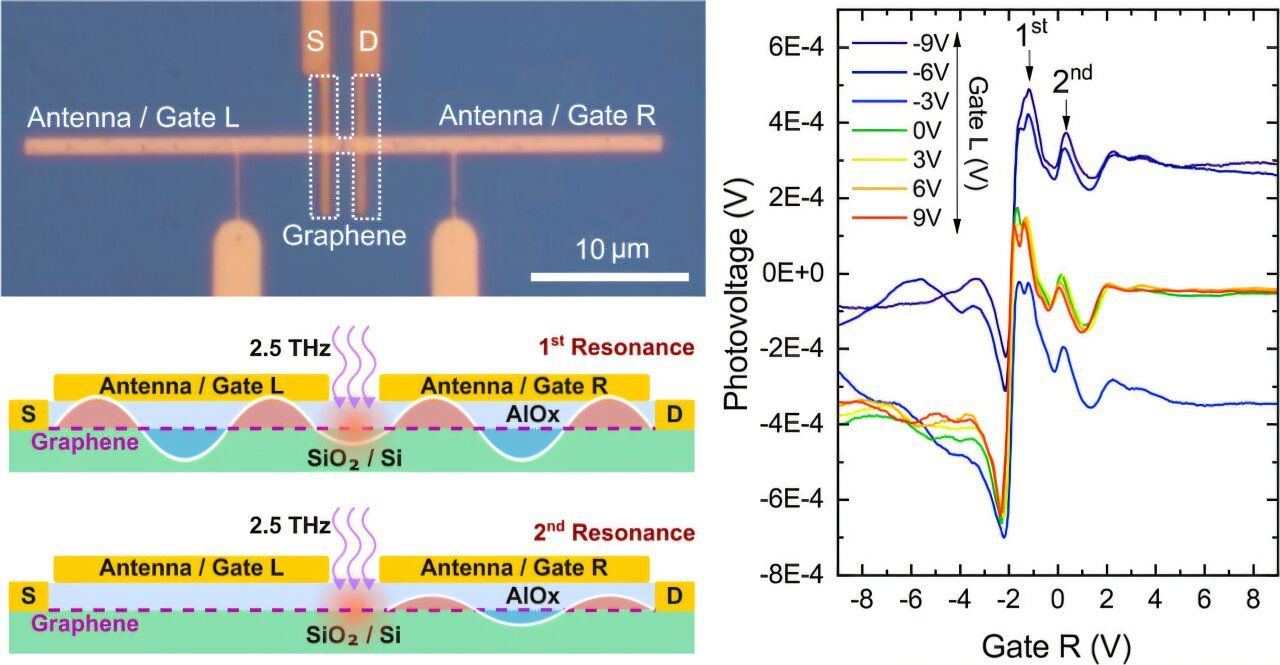
Graphene's potential in terahertz (THz) photodetection has been further explored by researchers at ICFO and collaborating institutions. The team, led by ICREA Prof. Frank Koppens, has developed a novel device using monolayer graphene that emits a strong electric signal when exposed to THz radiation under liquid nitrogen cooling. This advancement, published in ACS Photonics, paves the way for practical, tunable, and selective THz detectors.
The innovation centers around a terahertz cavity utilizing acoustic graphene plasmons (AGPs), which are electron oscillations on graphene's surface. The device employs a THz antenna to focus incoming radiation, launching AGPs within the graphene. These AGPs become trapped, forming standing-wave resonances akin to sound in a musical instrument.
The AGPs enhance the interaction between light and graphene by compressing light into nanoscale spaces, significantly increasing absorption. This absorption results in localized heating in graphene, creating a temperature differential that is converted into an electrical signal, indicating light detection.
Graphene's use in THz detection is not new, given its broad frequency interaction and efficient current generation. However, previous efforts faced challenges due to weak plasmon responses or the need for complex encapsulation with hexagonal boron nitride (hBN). This new approach achieves a 30% higher photoresponse without hBN, suggesting potential for compact, efficient sensors for material identification.
The research team highlights the importance of producing graphene single crystals via chemical vapor deposition (CVD) and leveraging AGP cavity resonances to enhance the THz field. They anticipate that further reducing plasmon losses could enable AGP strength at room temperature, a significant milestone for THz sensing.
Source: Graphene Feed