Graphene-Reinforced Polyethylene Films: A Practical Route to Downgauging Without Performance Loss
An industrial study evaluates graphene masterbatch reinforcement in polyethylene blown film. At a 1% let-down ratio, the study reports mechanical-property gains and demonstrates 10% gauge reduction with retained tensile and puncture performance.

Correspondence: Steve Bell ([email protected]) or Vince Livoti ([email protected]) for technical inquiries, samples, and application development support
Abstract
Downgauging of polyethylene blown film is limited by the loss of mechanical performance at reduced thickness. This paper reports a two-phase industrial study on the reinforcement of polyethylene (PE) blown films with NanoXplore's xGnP™ high-surface-area graphene, delivered through a specially designed masterbatch (no powder handling, no equipment modification, no change to the process recipe). At the optimized masterbatch let-down ratio (LDR) of 1%, 1-mil films gained 120% in tensile stress at break, 63% in elongation at break, 28% in stress at yield, 17% in Young's modulus, and 106% in thickness-normalized puncture resistance (ASTM D882/F1306). That headroom enabled a 10% gauge reduction with no loss of tensile or puncture performance. At 20%, tensile strength at break, puncture load, and machine-direction tear held in 1- and 4-mil films. Downgauged 1-mil films even exceeded the tensile strength at break of the full-gauge reference. The effect is thickness-dependent: the higher shear and elongational stresses of thin-film processing improve graphene dispersion, confirmed by optical microscopy particle-size analysis, so reinforcement is strongest precisely where downgauging pressure is highest. Implications for resin savings, sustainability targets, and post-consumer resin (PCR) enablement are discussed.
1. Introduction
Every film producer faces the same equation: thinner, stronger, cheaper; historically you could pick two. Polyethylene (PE) remains the most widely used polymer family in blown-film extrusion, combining processability, melt strength, and toughness at low cost across consumer flexible packaging, industrial liners, and agricultural films [1]. In all of these markets, downgauging has become the default cost and sustainability strategy: resin is typically the largest single cost component of a film, so every micron removed drops straight to margin, cuts the plastic placed on the market, and lowers the fee base under extended producer responsibility schemes.
As gauge decreases, tensile strength, puncture resistance, and tear strength decline, and the resin savings are quickly erased by failures in filling lines, palletizing, transport, and end use [2]. The conventional toolkit for managing this trade-off is showing its limits: high-performance LLDPE and metallocene grades carry price premiums and can complicate bubble stability; adding layers means capital and complexity and can work against mono-material recyclability goals; and traditional mineral fillers need loadings high enough to affect processing, optics, and film weight. What the industry needs is a reinforcement that works at loadings low enough to leave the film (and the process) essentially unchanged.
Graphene is a two-dimensional carbon material of exceptional intrinsic strength and very high aspect ratio, whose platelet geometry creates a large filler–matrix interface and transfers stress efficiently at loadings one to two orders of magnitude below conventional fillers [3,4]. What has kept it out of production film has never been its properties: it has been dispersion, finding the right type of graphene that works, and a solution that is cost-effective. Graphene platelets agglomerate strongly, and an agglomerate is not a reinforcement; it is a defect. Many published dispersion strategies require extra processing steps or chemistries that no film plant would accept.
This paper reports an industrial study that solves the dispersion problem with two deliberately conventional tools: NanoXplore's xGnP™ graphene (a high-surface-area, fine-particle-size grade) pre-compounded into a specially designed pelletized masterbatch, and the shear and elongational stresses of the blown-film process itself. The purpose of the paper is practical: to quantify what a 1% masterbatch let-down does for the mechanical performance and downgauging potential of PE blown film, to define honestly where the effect is strongest and where it weakens, and to spell out what implementation requires and does not require on a production line.
2. Materials and Methods
The films in this study were reinforced with NanoXplore's xGnP™ graphene, a high-surface-area powder with fine particle size selected for superior dispersion. The graphene was pre-compounded into a specially designed pelletized masterbatch developed with Techmer PM and dosed during film extrusion using standard feeding equipment. Films were blown on conventional extrusion equipment at standard processing conditions for the lower-density PE grade used, with no equipment modification.
The study ran in two phases. Phase 1 screened masterbatch let-down ratios (LDR) from 0.75% to 6% in 1-mil PE blown film to find the optimal dosing. Phase 2 used that optimum (1% LDR) to produce films at 10% and 20% gauge reductions and compare them against full-gauge references. The core data set covers 1-mil and 4-mil structures; heavier-gauge (8-mil) films were also examined to establish how the reinforcement depends on thickness.
Films were conditioned for at least 40 h at 23 ± 2 °C and 50 ± 10% relative humidity before testing. Tensile properties were measured per ASTM D882, puncture resistance per ASTM F1306, and tear strength per ASTM D1004, in both machine (MD) and transverse (TD) directions where applicable. Light transmission was measured on all downgauged structures, and graphene particle size (D-numbers) was analyzed by optical microscopy on film samples.
3. Results and Discussion
3.1. Let-Down Optimization: Why 1% Is the Sweet Spot
Figure 1 presents the Phase 1 let-down screen. Performance peaked consistently at a 1% LDR across tensile properties. Relative to the unfilled control, stress at yield rose 28%, stress at break 120%, and elongation at break 63% (Table 1). Pushing the dosing beyond 1% LDR did not buy more performance; it eroded it, consistent with re-agglomeration at higher concentrations. Commercially, that is good news: the optimal dose is also close to the minimal dose, keeping additive cost per kilogram of film low, and at these low let-down ratios the impact on the rest of the formulation (density, slip/antiblock balance, pigmentation) is negligible.
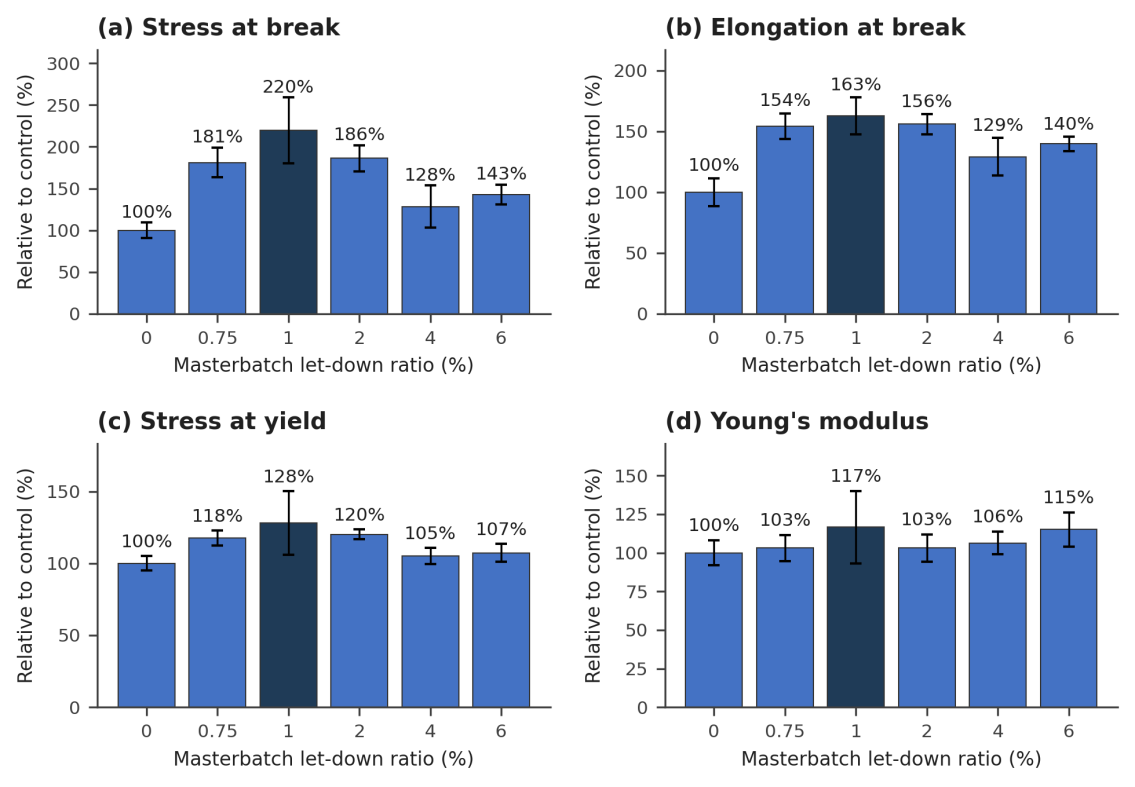
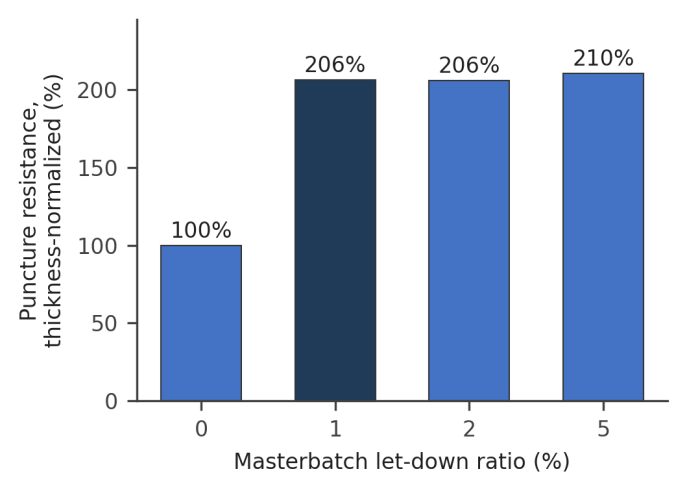
The simultaneous gain in strength and elongation deserves emphasis: the film becomes both stronger and tougher, rather than trading one for the other as stiffening additives typically do. Operationally, that is the property combination that survives filling lines, transport vibration, and rough handling. The same 1% LDR more than doubled thickness-normalized puncture resistance (Figure 2), and that doubling at unchanged gauge is precisely the headroom that makes the downgauging results of Section 3.2 possible.
| Property | Test Method | Change vs. Control |
|---|---|---|
| Tensile stress at break | ASTM D882 | +120% |
| Elongation at break | ASTM D882 | +63% |
| Tensile stress at yield | ASTM D882 | +28% |
| Young's modulus | ASTM D882 | +17% |
| Puncture resistance ¹ | ASTM F1306 | +106% |
¹ Normalized by film thickness.
3.2. Downgauging Performance
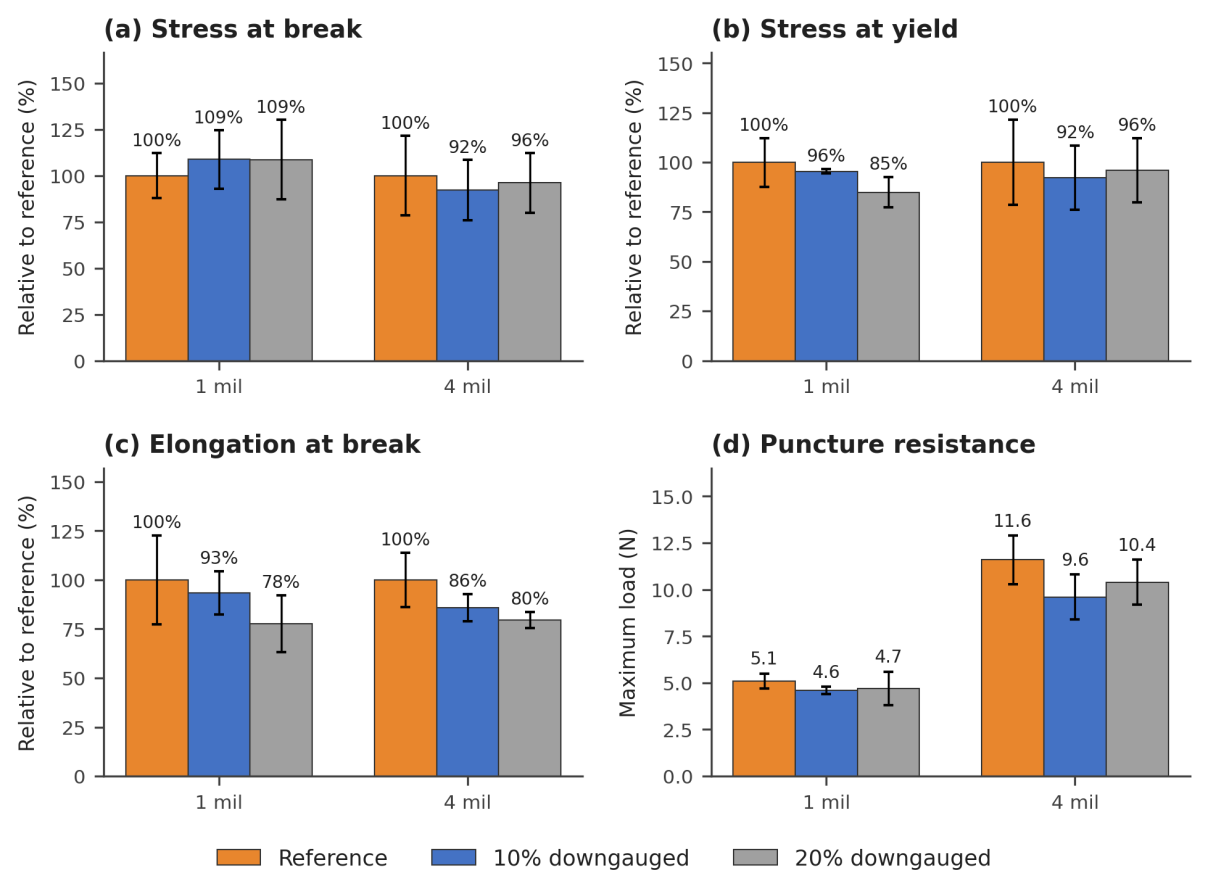
Figure 3 summarizes the Phase 2 results at the optimized 1% LDR. A 10% gauge reduction was achieved with full retention of tensile properties across the films tested. At a 20% reduction, the picture is property-specific: tensile stress at break was maintained in 1- and 4-mil films, with downgauged 1-mil films averaging roughly 9% higher stress at break than the full-gauge reference (Figure 3a), while yield stress and elongation at break were reduced (Figure 3b,c). Maximum puncture load was essentially maintained across the downgauged 1- and 4-mil films (Figure 3d). Normalized per unit thickness, the 20% downgauged films outperformed the references, with the 10% downgauged films essentially matching them: each remaining micron works harder.
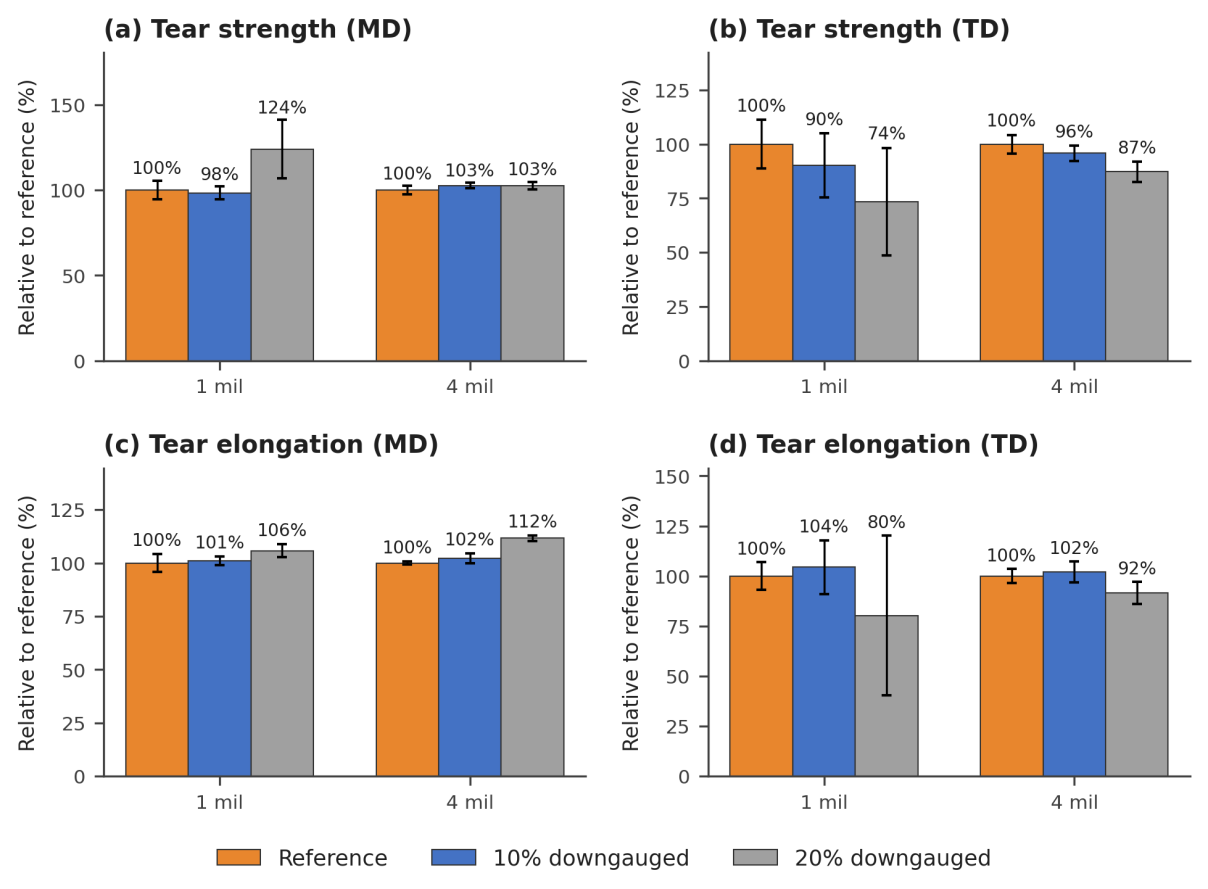
Tear behavior is direction-dependent (Figure 4). Machine-direction tear strength was maintained or improved after downgauging, with the 20% reduction in 1-mil film delivering a gain of up to 24% (Figure 4a). Transverse-direction tear was slightly lower in 20% downgauged films (Figure 4b), likely associated with the larger relative thickness variation across the film width typical of thin films; converters should verify this property against their own specification during qualification.
Performance envelope and mechanism. The reinforcement effect is thickness-dependent. Optical microscopy showed that thinner films contain measurably smaller graphene particles (lower D-numbers): the higher shear and elongational stresses generated when drawing down to thin gauges break residual agglomerates apart, increasing the graphene–polymer interfacial area and improving stress transfer. In the 10% downgauged films, the median agglomerate size (D50) in 1-mil film was roughly one-third smaller than in 8-mil film, and the coarsest fraction (D90) was nearly 40% smaller, with 4-mil films falling in between. Improved platelet alignment under elongational flow is expected as well, but was not directly measured in this study. Consistent with this mechanism, 8-mil films (where process stresses are lower and dispersion correspondingly coarser) showed declines in tensile and puncture performance at the 20% downgauging level. The demonstrated sweet spot is therefore thin film, approximately 4 mil and below, with a 10% reduction robust across the range tested, and a 20% reduction demonstrated in 1- and 4-mil structures where tensile strength at break, puncture, and MD tear govern the specification. Further formulation optimization is expected to extend these limits; that is a development statement, not a measured result. In practical terms, the thinner the film, the better the particle separation and dispersion: the technology is strongest exactly where downgauging is hardest.
3.3. Optical Properties
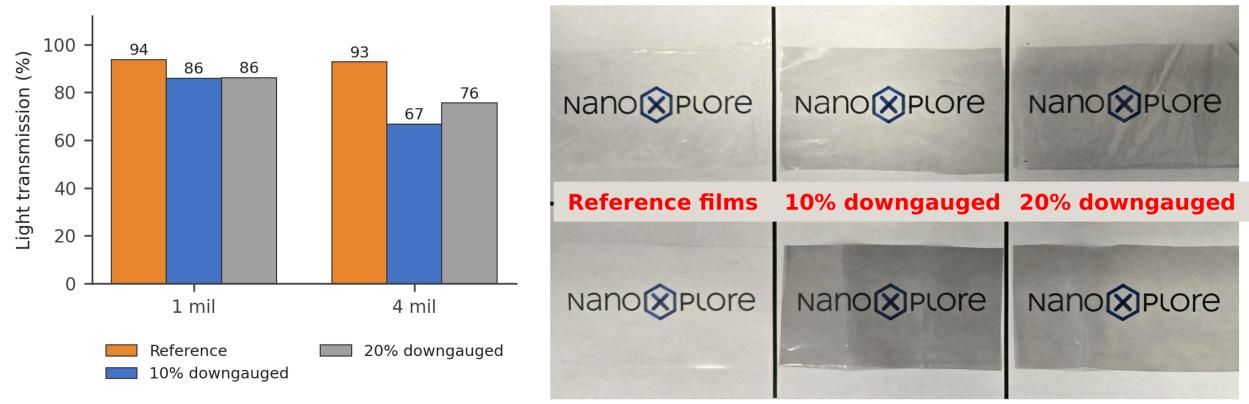
At the 1% LDR, light transmission of the thinnest films was minimally affected: 1-mil downgauged films retained approximately 86% transmission versus 94% for the reference (Figure 5). Thicker downgauged structures showed larger reductions. The films are translucent rather than water-clear: graphene-reinforced structures suit the large volume of applications where translucency is acceptable or opacity is desirable, and are not positioned for high-clarity display packaging.
4. Processing and Implementation Considerations
The graphene is supplied pre-dispersed in a specially designed pelletized masterbatch, dosed through standard gravimetric or volumetric feeding at a 1% let-down ratio, comfortably within the range every film line handles daily for pigments and processing aids. There is no powder handling, no additive-specific pre-drying, and no dedicated feeding hardware. Trial films were produced at standard processing conditions with no change to the process recipe, and existing slip, antiblock, and pigment packages were not reformulated. Bubble behavior in the trials was consistent with normal operation for the PE grade used; die pressure and melt temperature effects were not formally instrumented in this study, and line-specific verification is a standard part of any qualification trial NanoXplore and Techmer PM support.
Surface-dependent operations (sealing, printing, and lamination) were outside the scope of this mechanical study. At these low loadings of a bulk-dispersed, non-migrating platelet, no surface chemistry change is expected, but converters should validate seal curves and print adhesion on their own structures as they would for any formulation change. Regulatory suitability, including food-contact use, is assessed application by application; producers evaluating food-contact structures are encouraged to engage early so compliance requirements can be addressed within the development plan.
Scale-up support is part of the offering. Techmer PM operates a dedicated applications laboratory able to replicate customer film processes, backed by an ISO 17025-accredited analytical laboratory, shortening the path from sample evaluation to production trial. On the raw-material side, NanoXplore is among the world's largest graphene producers, with more than 4,000 metric ton/yr powder production capacity in Montréal, Canada. This matters because additive programs fail as often on supply consistency as on performance, and batch-to-batch consistency of the xGnP™ powder is a core quality commitment.
5. Applications and Perspectives
The demonstrated performance envelope (thin-gauge PE blown film, translucent to opaque) maps onto a large share of the flexible packaging and industrial film market: thin-gauge packaging films and liners (≤4 mil), where 10% downgauging was directly demonstrated with full property retention, and 20% where tensile strength at break, puncture, and MD tear govern the specification; industrial and heavy-duty films such as liners, sacks, and protective films, where puncture and tear resistance define the specification; and agricultural films, where toughness per gram of resin drives both cost and field performance. The study was run on a lower-density grade of PE; based on the reinforcement mechanism, similar performance is expected across the polyolefin family of resins, to be confirmed per resin system during qualification. Stretch and collation applications are a natural extension given the tensile and elongation gains, but were not part of this study and should be treated as an evaluation target rather than a demonstrated result. The economics follow directly: a 10–20% gauge reduction is, to first order, a 10–20% reduction in resin purchased per unit area of film sold, against a masterbatch dosed at a 1% let-down ratio; customer-specific cost modelling is available during evaluation.
PCR enablement: a forward-looking perspective. Post-consumer resin is inherently inconsistent: it arrives from diverse waste streams with varying degradation histories, and its mechanical shortfall is the practical ceiling on PCR content in thin films. Because graphene reinforcement compensates for exactly the properties PCR degrades (strength, puncture, tear) [5], it offers a route to higher PCR loadings without sacrificing film integrity. This is presented as a development direction supported by the mechanism and the virgin-resin data above; dedicated PCR trial data will be the subject of future work.
6. Conclusions
At a 1% masterbatch let-down ratio, the xGnP™ reinforcement raised the tensile stress at yield of 1-mil PE blown film by 28% and more than doubled its tensile stress at break and thickness-normalized puncture resistance. That headroom enabled 10% downgauging with no loss of tensile or puncture performance, and 20% downgauging in 1- and 4-mil structures where tensile strength at break, puncture load, and machine-direction tear govern the specification, on unmodified conventional equipment. The mechanism (shear-driven particle separation and dispersion during thin-film processing, confirmed by particle-size analysis) explains why the reinforcement is strongest in the thin gauges where downgauging pressure is highest, and defines an honest performance envelope of approximately 4 mil and below.
The claims in this paper are limited to what was measured, and the fastest way to test their relevance is on your own film. NanoXplore invites film manufacturers and converters to a technical discussion of specific structures, masterbatch samples for line trials, and application development support through to qualification.
About NanoXplore
NanoXplore is the world's largest graphene producer, operating a fully automated production facility in Montréal, Canada, with more than 4,000 metric tons per year of graphene powder capacity. The company produces several grades of graphene, including the xGnP™ series, with a focus on batch-to-batch consistency, enabling reliable industrial-scale supply for polymer, film, and composite applications. NanoXplore's graphene is globally registered, including with ECCC/Health Canada in Canada, the EPA in the United States, and ECHA in Europe (under REACH), and is also registered in the United Kingdom under UK-REACH. NanoXplore is publicly traded on the Toronto Stock Exchange (TSX: GRA) and OTCQX (NNXPF). Learn more at www.nanoxplore.ca.
About Techmer PM
Techmer PM is a U.S.-based materials design company founded in 1981, specializing in masterbatch development and polymer modification. Headquartered in Clinton, Tennessee, Techmer PM operates a dedicated applications laboratory capable of replicating customer film processes, backed by an ISO 17025-accredited analytical laboratory, supporting customers from initial sample evaluation through production-scale qualification. Learn more at www.techmerpm.com.
References
1. Micic, P.; Bhattacharya, S.N. Rheology of LLDPE, LDPE and LLDPE/LDPE blends and its relevance to the film blowing process. Polym. Int. 2000, 49, 1580–1589.
2. Williamson, A.; Gomes, J.; Karjala, T.; do Valle, C. Rheology modifier additive for enhanced processability of polyethylene for blown-film applications. J. Vinyl Addit. Technol. 2023, 29, 709–723.
3. Connolly, K.B. Graphene Makes PE Stretch Film Ultrathin and Strong. Plastics Today, 20 July 2023. Available online: www.plasticstoday.com/sustainability/graphene-makes-pe-stretch-film-ultrathin-and-strong.
4. Pinto, G.M.; Cremonezzi, J.M.; Ribeiro, H.; Andrade, R.J.; Demarquette, N.R.; Fechine, G.J. From two-dimensional materials to polymer nanocomposites with emerging multifunctional applications: a critical review. Polym. Compos. 2023, 44, 1438–1470.
5. Diallo, A.K.; Helal, E.; Gutiérrez, G.; Madinehei, M.; David, É.; Demarquette, N.; Moghimian, N. Graphene: A multifunctional additive for sustainability. Sustain. Mater. Technol. 2022, 33, e00487.
Disclaimer: Results reported herein were obtained under the study conditions described (PE blown film; ASTM D882, F1306, D1004) and may vary with resin system, film structure, and process conditions. Statements regarding future development, extended downgauging potential, and PCR enablement are forward-looking and not measured results.
Source: NanoXplore Inc.